














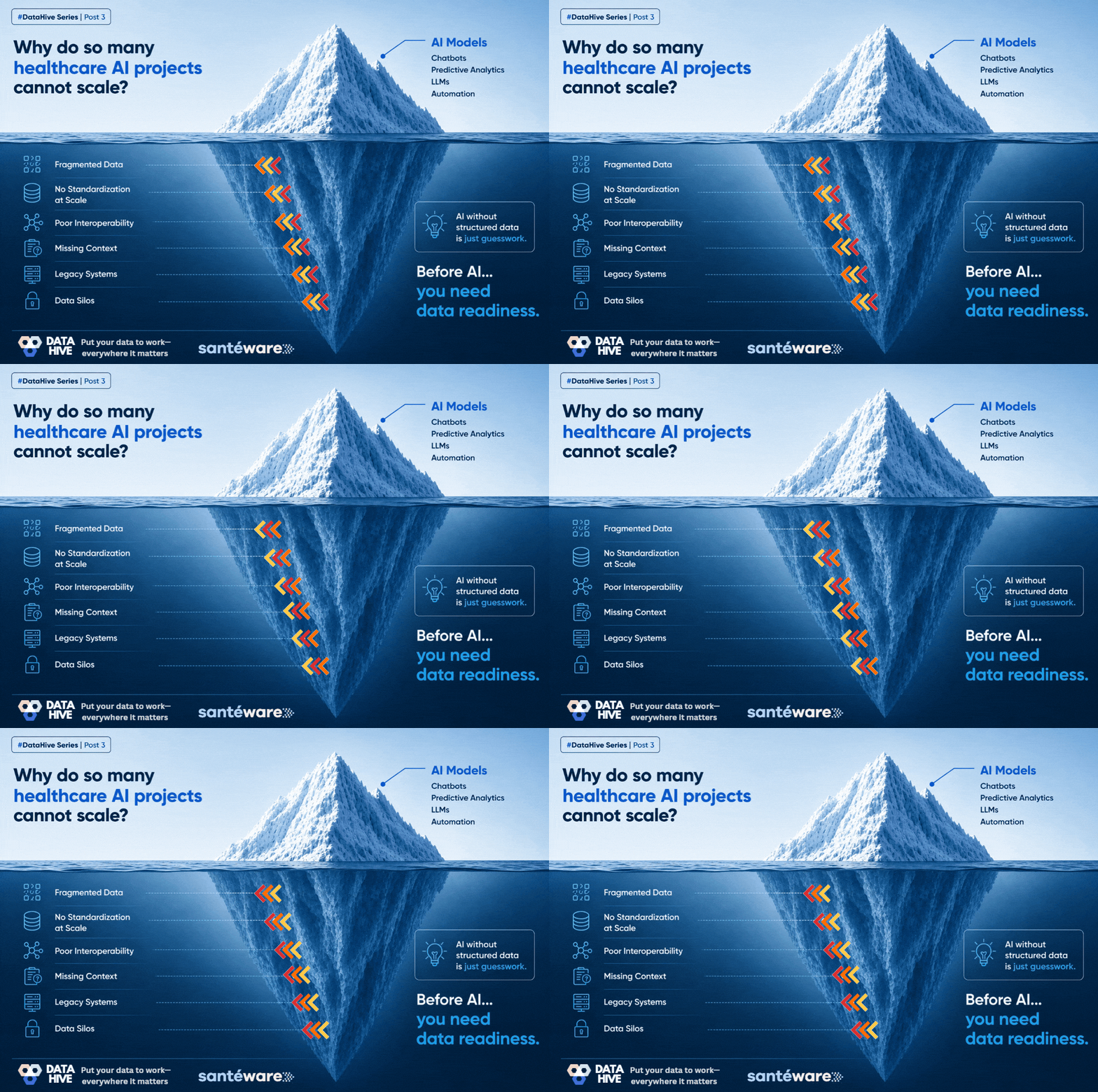
🤖 Why So Many Healthcare AI Initiatives Struggle to Scale
Artificial Intelligence is rapidly becoming one of the most discussed priorities across healthcare.
Organizations are investing in AI to:
🏥 Improve clinical outcomes
⚡ Accelerate operations
🔮 Enable predictive decision-making
📉 Reduce administrative burden
📊 Unlock greater value from healthcare data
From Generative AI and Clinical Intelligence to Operational Automation and Advanced Analytics, expectations are high.
Yet despite growing investment and increasing experimentation, many healthcare AI initiatives struggle to move beyond pilots and isolated use cases.
✅ Proofs of concept succeed.
✅ Demonstrations generate excitement.
❌ But enterprise-wide scale remains difficult.
The reason is often misunderstood.
⚠️ The issue usually is not the AI model.
🎯 It is the data foundation behind it.
📊 Healthcare Has Data. But That Does Not Mean It Is AI Ready.
Healthcare organizations already manage enormous volumes of information.
📋 Clinical records
🗄️ Historical archives
🏥 EMRs
💳 Claims data
💰 Billing systems
⚙️ Operational workflows
👨⚕️ Physician notes
📄 Scanned documents
🔬 Research repositories
The challenge is not availability.
The challenge is usability.
For AI to generate meaningful outcomes, healthcare data must be:
✅ Structured
✅ Connected
✅ Contextualized
✅ Trusted
Unfortunately, many healthcare environments still face foundational barriers that limit AI adoption at scale.
1️⃣ Inconsistent and Manual Coding Creates Unreliable Inputs
Healthcare data often originates across multiple departments, systems, facilities, and workflows.
Over time:
🔄 Coding practices evolve
📝 Manual processes remain
📏 Standards differ
🔀 The same clinical event may be represented differently across environments
Organizations frequently encounter:
❌ Variability in coding standards
❌ Manual classification and mapping processes
❌ Duplicate representations of clinical concepts
❌ Inconsistent metadata structures
❌ Historical data inconsistencies
AI systems depend on patterns.
When the underlying data lacks consistency, outcomes become harder to reproduce and scale.
⚠️ Even advanced AI cannot reliably compensate for inconsistent inputs.
2️⃣ Disconnected and Siloed Systems Limit Data Accessibility
Healthcare ecosystems were built incrementally.
🏥 Clinical platforms
⚙️ Operational systems
💰 Financial applications
🗄️ Legacy repositories
🔗 Third-party tools
Most continue to operate independently.
As a result, valuable information remains distributed across disconnected environments.
This fragmentation creates challenges such as:
❌ Multiple sources of truth
❌ Limited cross-system visibility
❌ Delayed access to critical information
❌ Increased data preparation effort
❌ Difficulty establishing connected patient journeys
🎯 AI systems perform best when information is unified—not isolated.
3️⃣ Valuable Clinical Context Remains Locked Inside Unstructured Data
A significant portion of healthcare information exists outside structured databases.
📋 Clinical notes
📄 Discharge summaries
🗂️ Scanned records
📝 Narrative documentation
🗄️ Historical archives
These datasets often contain meaningful patient context—but remain difficult to operationalize.
Organizations commonly face challenges including:
❌ Limited searchability
❌ Difficulty extracting relationships
❌ Incomplete context preservation
❌ Reduced analytical usability
❌ Delayed access to historical insights
⚠️ When context remains inaccessible, AI receives only part of the story.
Incomplete context limits reliable outcomes.
4️⃣ Missing Longitudinal Patient Views Reduces AI Effectiveness
Patients are not isolated encounters.
Healthcare outcomes are shaped across time.
But many organizations still struggle to establish connected patient histories.
Information often remains fragmented across visits, providers, and systems.
Without longitudinal visibility:
📉 Trends become harder to identify
🔮 Predictive models lose context
🔗 Care pathways remain disconnected
📊 Population insights become incomplete
🚀 AI becomes significantly more powerful when it understands progression—not isolated events.
5️⃣ Limited Normalization and Interoperability Restrict Scale
Healthcare data exists across different structures, standards, formats, and technologies.
Without normalization and interoperability, organizations frequently encounter:
⚠️ Complex integration efforts
⚠️ Limited reusability across initiatives
⚠️ Increased transformation costs
⚠️ Reduced analytics readiness
⚠️ Difficulty operationalizing AI outputs
AI requires more than connectivity.
✅ It requires information that can be consistently understood and reused across environments.
🏗️ Before AI Transformation Comes Data Readiness
Organizations often focus on:
🤖 Selecting models
🏢 Evaluating vendors
☁️ Expanding infrastructure
But sustainable AI adoption begins much earlier.
It begins with establishing data readiness.
That means creating an environment where healthcare data becomes:
🔍 Accessible
📋 Structured
📏 Standardized
🔗 Connected
🛡️ Governed
🧩 Contextualized
🌐 Interoperable
✅ Trusted at scale
Only then can AI move beyond experimentation and become operational.
🚀 Building the Foundation for Scalable Healthcare AI
Healthcare organizations do not need more data.
💡 They need better access to the value already hidden inside existing data ecosystems.
That requires capabilities that can:
🔗 Unify fragmented healthcare information
📚 Normalize historical and clinical datasets
✔️ Improve data quality and validation
🧠 Enable intelligent utilization of structured and unstructured data
🛡️ Support interoperability and governance
📊 Create stronger foundations for analytics and AI initiatives
That is where platforms such as DataHive by Santeware become increasingly important.
Not as AI platforms themselves—
But as the foundational layer that helps healthcare organizations prepare, connect, normalize, validate, and intelligently utilize healthcare data before AI initiatives scale.
Because AI success is rarely determined by the model.
🎯 It is determined by the quality of the foundation beneath it.
🌟 Healthcare AI Does Not Begin with Algorithms
It begins with Data Readiness.
Organizations that invest in strong data foundations will be better positioned to:
🚀 Scale AI initiatives
📊 Improve analytics outcomes
⚡ Accelerate innovation
🏥 Enhance clinical decision-making
🔗 Strengthen interoperability
💡 Unlock hidden value across healthcare ecosystems
Because the future of healthcare AI is not defined by how much data organizations possess.
It is defined by how effectively they can connect, trust, govern, and utilize it.
🤖 AI Starts with Data.
🔗 Scale Starts with Readiness.
🏥 Healthcare Transformation Starts with the Foundation.
Get in touch with www.santeware.com or teams@santeware.com to learn more.