















⚠️ “How we automated our way out of manual deploys – and ended up with a compliance story we can actually back up.”
A lot of healthcare software teams still deploy the way everyone used to: someone connects to the server, copies over the build, restarts a service, and hopes for the best. It works, until the day it doesn’t, and then you’re debugging a live system under pressure while a clinic somewhere can’t load a patient chart. When the data on the other end is protected health information, that’s not a risk worth carrying.
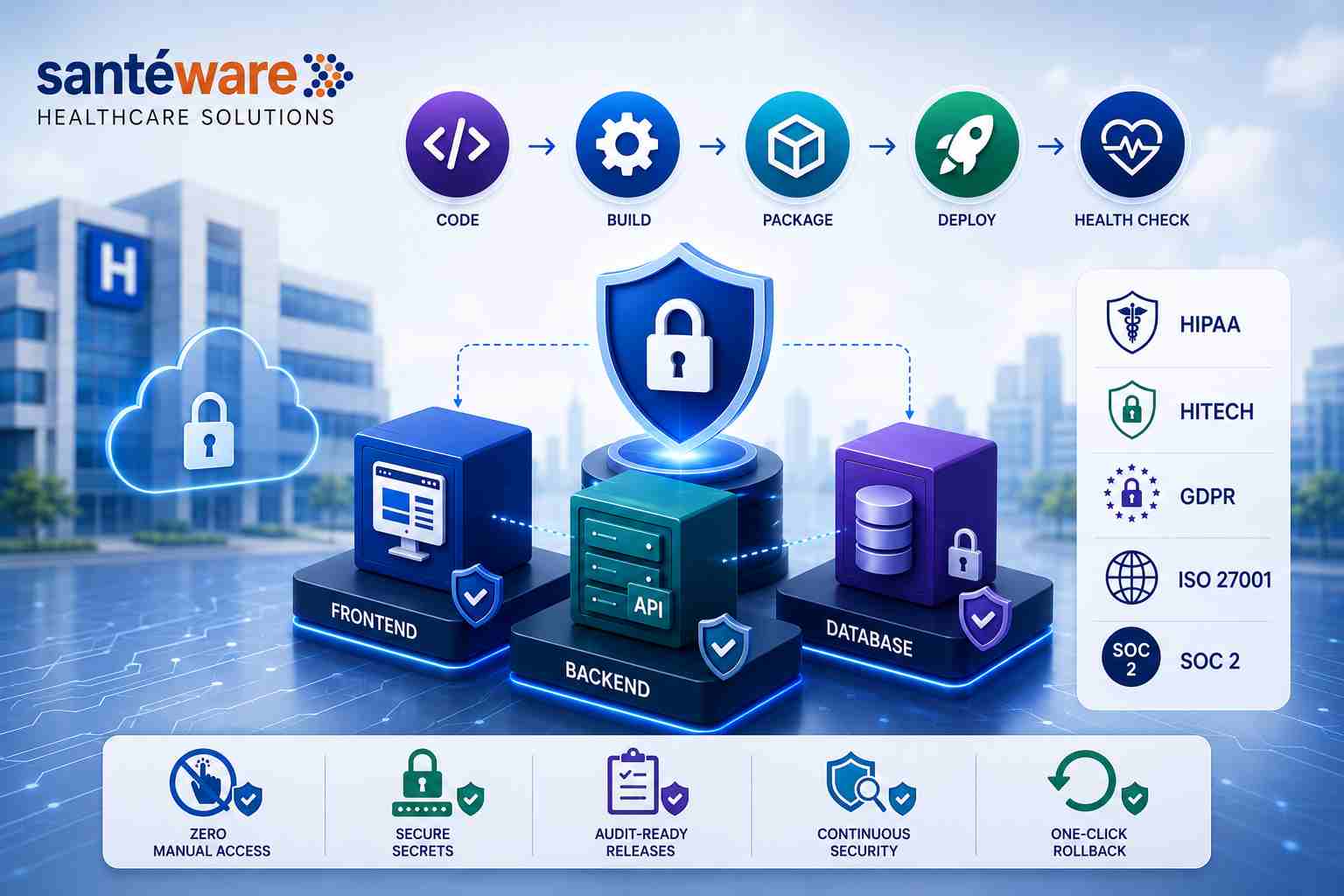
We build a healthcare data platform used by hospitals and clinics to manage patient information, so a few years back we moved away from manual deployments entirely. Everything now goes through an automated CI/CD pipeline. Every release follows the same steps, in the same order, whether it’s a Tuesday morning patch or a Friday afternoon feature. And because the pipeline is doing the work, the compliance controls we need for HIPAA, HITECH, GDPR, ISO 27001, and SOC 2 aren’t something we scramble to document after the fact – they’re just how the system behaves.
Here’s how it actually works, and where compliance fits into it.
No One Touches Production by Hand
When a developer pushes a commit, it doesn’t go anywhere near a live server. It goes into a pipeline that builds it, runs the test suite against it, and packages it as a versioned container image. Same process, every time. Engineers decide what ships. The pipeline decides how it gets there.
The platform itself is split into independent pieces – a frontend, a backend API, and a database layer – each built and shipped on its own. That matters more than it sounds like it should. A frontend change genuinely cannot touch the backend runtime. A UI release can’t accidentally trigger a schema migration. Each piece has its own version history and its own audit trail, so if something needs to be traced back, it’s traceable.
We also keep a hard line between the machines that build and test code and the server that actually runs it. The deployment host never compiles anything – it only pulls images that have already been built and verified elsewhere, and brings them online. Going live is the riskiest part of any release, so that’s the part we’ve made the most boring.
A Release Starts With One Trigger
From that single trigger, the pipeline pulls images, recreates containers, starts services in the right order, and runs health checks before anything takes real traffic. Nobody’s running a checklist from memory.
It’s also idempotent, which just means: if a service’s image already matches what’s running, the pipeline leaves it alone instead of restarting it for no reason. Fewer moving parts touched, fewer chances for something to go sideways.
Everything runs in containers rather than being installed straight onto a server. We’ve been burned before by servers that drift over months of manual tweaks until nobody can say exactly what’s installed anymore – containers avoid that problem by design. Optional pieces, like our workflow automation, the internal AI/LLM layer, and monitoring, sit as separate stacks that can be switched on without touching the core platform.
What’s Actually Running Underneath
| Layer | Technology | Role |
| Reverse Proxy / TLS | Nginx | Single entry point; routes requests and terminates HTTPS |
| Frontend | Single-page Application | The clinician- and admin-facing interface |
| Backend | REST API + Secure File Storage | Business logic, patient data access, stored files |
| Certificates | Automated Certificate Management | SSL/TLS issuance and renewal, no manual expiry |
| Automation (Optional) | Workflow Engine | Internal process automation |
| AI Layer (Optional) | Local LLM + Vector Search | On-premise AI serving, no data leaves the environment |
| Monitoring | Dashboards & Alerting | Observability and audit-log visibility |
Where Compliance Actually Lives in This
Secrets handled properly, TLS that never lapses, migrations that are tracked instead of typed by hand into a live database – none of this is exotic. It’s just careful engineering. But when the data behind it is protected health information, that same careful engineering becomes the evidence you’d hand an auditor, not just a set of good habits.
Secrets never live in the codebase. Credentials, API keys, tokens – none of it gets baked into a container or committed to a repo. It’s injected as environment variables at deploy time, scoped to whichever service actually needs it. This is more or less exactly what the HIPAA Security Rule and SOC 2’s access-control criteria are asking for.
Certificates renew themselves. We stopped trusting anyone to remember an expiry date years ago. TLS is issued and renewed automatically, which covers the transmission-security piece of HIPAA and the appropriate technical measures language in GDPR Article 32.
Database migrations are tracked, not typed. Every schema change is a pipeline step with a record attached to it – never someone editing a live table by hand at 11pm. That gives us the kind of change history HITECH and ISO 27001 both expect to see.
Every image is tagged and immutable. At any point, we can say exactly what code was running in production and when. That’s the audit trail regulators ask for, and honestly it’s also just useful for us when something needs debugging.
Services stay isolated from each other. Frontend, backend, and database run in separate containers with their own permissions, so if one component were ever compromised, it wouldn’t have a clear path to the rest. That’s the data-minimization idea GDPR and ISO 27001 both build their access-control requirements around.
None of this replaces an actual compliance program – policies, risk assessments, the paperwork still has to exist. What it does is make sure the technical controls that program depends on are already true, every time, instead of something we retrofit before an audit.
If Something Breaks, We Roll Back
Every release is a tagged image, so undoing a bad deploy isn’t a scramble – it’s redeploying the last tag that worked. It’s fast, it’s predictable, and it’s something we can point to when someone asks how we handle an incident.
What the Pipeline Actually Does, Step by Step
📌 Commit. Someone pushes to the repo. That’s the whole trigger.
⚙️ Build, per service. Frontend, backend, and database each get built and packaged on their own track.
✅ Test and package. If the checks pass, the build gets packaged as a versioned, immutable image. If they don’t, it stops here.
📦 Push to the registry. Verified images go up with their tags. The build side of things is done.
🚀 Trigger the deploy. One action tells the deployment host it’s time.
🔄 Pull and compare. The deploy server pulls the target images and checks them against what’s already running – anything unchanged just gets skipped.
🔐 Inject secrets. Credentials and keys go in as environment variables right here, scoped to each service.
🗄️ Run migrations. Any schema changes happen as a verified step, before the new backend takes any traffic.
🐳 Recreate containers. Services come up in the right order and get health-checked before they go live.
🌐 Route through Nginx. Traffic gets sent to each service, TLS terminates here, and certificates keep renewing on their own.
♻️ Roll back, if needed. If something’s wrong, the previous tag gets redeployed and we’re back to a known-good state.
Why We Bother With All This
It would be easy to file all of this under “how the engineering team spends its time,” but for a platform sitting on top of patient data, the deployment process and the compliance story are really the same conversation. A hospital vetting us isn’t just asking if the software works. They want to know who can touch patient data, how a change gets tracked, what happens if something goes wrong, and whether we can actually prove any of it when asked. This pipeline is, in a fairly direct way, our answer to all of that.
A few things worth remembering:
🔄 Every release goes through the same repeatable pipeline – no manual steps, no one relying on memory.
⚙️ Services are built and versioned independently, so one bad change doesn’t take everything down with it.
🔐 Secrets are injected at deploy time, never committed, never baked into an image.
🛡️ TLS and routing are centralized, and certificates renew themselves.
📋 Every deployment leaves a trace, and rolling back is never more than a redeploy away.
✅ Together, that’s what lines up with HIPAA, HITECH, GDPR, ISO 27001, and SOC 2 – not because we set out to check boxes, but because it’s how we’d want to build this regardless.
For a healthcare platform, reliability and compliance aren’t things you bolt on once the product works. They’re the foundation everything else sits on. This pipeline is what lets us ship often, sleep reasonably well, and answer honestly when someone asks how patient data is actually protected.
Get in touch with www.santeware.com or teams@santeware.com to learn more.