











Every health organization has a closet full of legacy applications no one wants to touch, outdated EHRs (MEDITECH, Siemens Soarian, McKesson Horizon), retired financial ERPs (Lawson, PeopleSoft), and fragmented departmental databases (PACS, lab systems). Each platform holds vital clinical, financial, and workforce data that you are legally required to retain, but keeping these systems running poses escalating security, financial, and compliance risks.
Managing legacy healthcare data isn’t simply about storing old files; it is about keeping historical clinical records, financial transactions, and operational data accessible, secure, and usable long after the primary software is decommissioned.
🚀 The Hidden Risks and Costs of Legacy Healthcare Systems
Maintaining legacy platforms indefinitely creates severe vulnerabilities such as:
🛡️ Cybersecurity Exposure: Unsupported operating systems and unpatched legacy platforms are prime targets for ransomware attacks.
⚖️ Regulatory Compliance Gaps: Retaining data in siloed platforms makes it difficult to satisfy HIPAA audit trail mandates and 21st Century Cures Act timeline requirements against information blocking.
💰 Escalating Financial Burden: Maintaining end-of-life hardware, specialized IT staffing, and vendor extended support contracts consumes up to ~60-70% of IT budgets—starving innovation.
🏥 Clinical Workflow Drag: Clinicians forced to log into multiple disjointed applications to view historical records face significant workflow friction, impacting care continuity.
📉 Revenue Leakage: Accounts Receivable (AR) locked inside decommissioned billing systems often goes uncollected, leading to avoidable write-offs.
🧠 4 Strategic Approaches to Legacy Data (And Their Trade-Offs)
When addressing legacy infrastructure, healthcare organizations typically evaluate four paths:
- Keep Systems Running (“Do Nothing”): Familiar, but leads to compounding maintenance costs, severe cyber risks, and eventual hardware failure.
- Full Migration to New EHR: Consolidates data in your production EHR (e.g., Epic, Oracle Health), but risks cluttering live systems with unmapped, mismatched historical records.
- Data Conversion (ETL to Standard Formats): Converts legacy data into modern formats (HL7, FHIR). Ideal for active data reuse, but complex and resource-intensive for massive data volumes.
- Active Archiving (The Industry Best Practice): Extracts data from legacy systems and loads it into a secure, single-pane-of-glass repository that interfaces directly with your go-forward EHR via Single Sign-On (SSO).
🗄️Mitigating Legacy Risks with Santeware’s DataHive Archival Platform
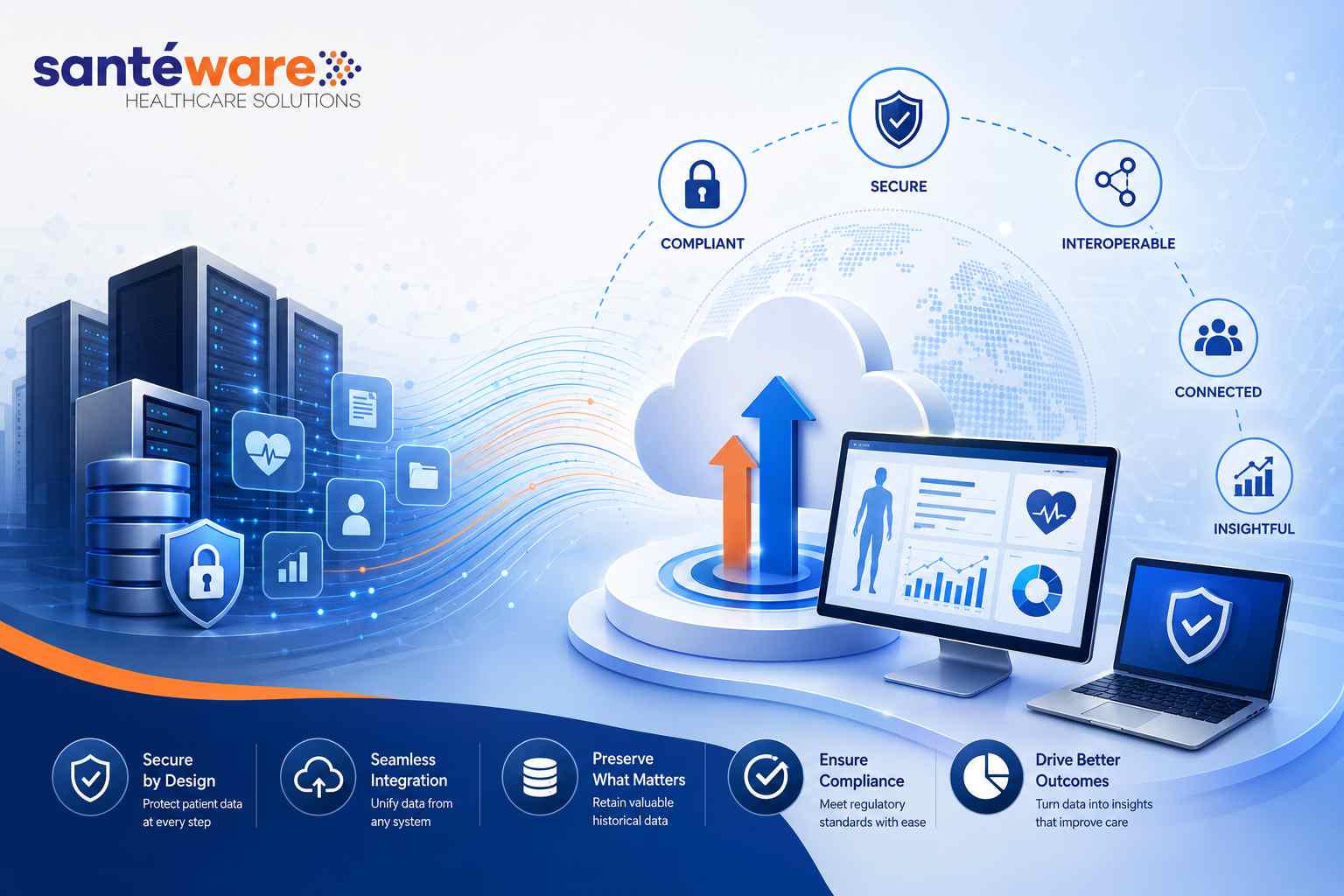
To eliminate legacy system vulnerabilities while maintaining seamless compliance, healthcare organizations turn to Santeware DataHive—a cloud-agnostic, unified healthcare data and archival platform built specifically for clinical, financial, and operational data management.
☁️ How DataHive Solves the Legacy Challenge:
🗄️ Complete System Decommissioning: Safely extract historical data from any EMR, HIS, ERP, billing, or departmental database, allowing you to retire expensive, vulnerable servers and license agreements.
🔗 Seamless EHR Integration & SSO: Clinicians view a patient’s full longitudinal health history directly within their primary go-forward EHR (Epic, Cerner, AthenaHealth, TrackCare etc.) without logging into separate tools.
🛡️ Regulatory & Compliance Assurance: Features automated PHI De-Identification/Tokenization, HIPAA-compliant audit trails, and data validator tools to satisfy 21st Century Cures Act mandates.
🔄 Healthcare Interoperability Native: Built-in HL7/FHIR converters, terminology crosswalks, and native support for OMOP and FHIR R4 standards ensure historical data remains queryable for research and clinical analytics.
🌐 Global MoPH Common Data Model Alignment: Fully compatible with regional healthcare exchange platforms including Malaffi, NABIDH, NPHIES, and QHUB.
💰 Financial & AR Management: Archival tools tailored for revenue cycle management allow billing teams to continue working down outstanding legacy AR without maintaining the original billing platform.
🎯 Plan Your Next Migration with Confidence
Santeware Healthcare empowers health systems to retire legacy tech debt safely, protect patient records, and optimize IT budgets. Contact our data archiving team to learn how DataHive can streamline your decommission strategy.
Whether you’re planning an EMR modernization, hospital system consolidation, or an ERP transformation, a well-designed cutover strategy can make the difference between a seamless transition and a costly disruption.
We specialize in enterprise data extraction, migration, archival, reconciliation, and analytics for complex healthcare and business environments. From strategy and mock cutovers to production go-live and hypercare, we help organizations execute migrations with confidence and minimal business disruption.
🚀 Ready to plan a low-risk migration?
Get in touch with www.santeware.com or teams@santeware.com to learn more.
Want Santeware’s help assessing your legacy application portfolio for decommissioning?