













Healthcare organizations today generate enormous volumes of data across Electronic Medical Records (EMRs), laboratory systems, imaging platforms, billing applications, ERP solutions, IoT devices, and third-party applications. While this data is essential for improving patient care and operational efficiency, managing it effectively has become increasingly challenging.
Without a structured governance strategy, organizations often struggle with fragmented information, inconsistent data quality, security vulnerabilities, regulatory compliance, and limited trust in analytics.
This is where Santeware DataHive delivers value.
DataHive provides a unified platform that enables organizations to discover, govern, secure, and share healthcare data while maintaining complete visibility throughout the data lifecycle.
🚀 Why Data Governance Matters More Than Ever
Healthcare organizations are no longer asking:
“How do we store more data?”
Instead, they are asking:
📍 How do we know where our data resides?
🔐 Who has access to sensitive patient information?
📋 Can we prove compliance during an audit?
📊 Can we trust our analytics?
🤖 How do we safely enable AI and machine learning?
🤝 How do we securely share data across hospitals and research organizations?
These challenges cannot be solved through security tools alone.
They require a comprehensive data governance framework.
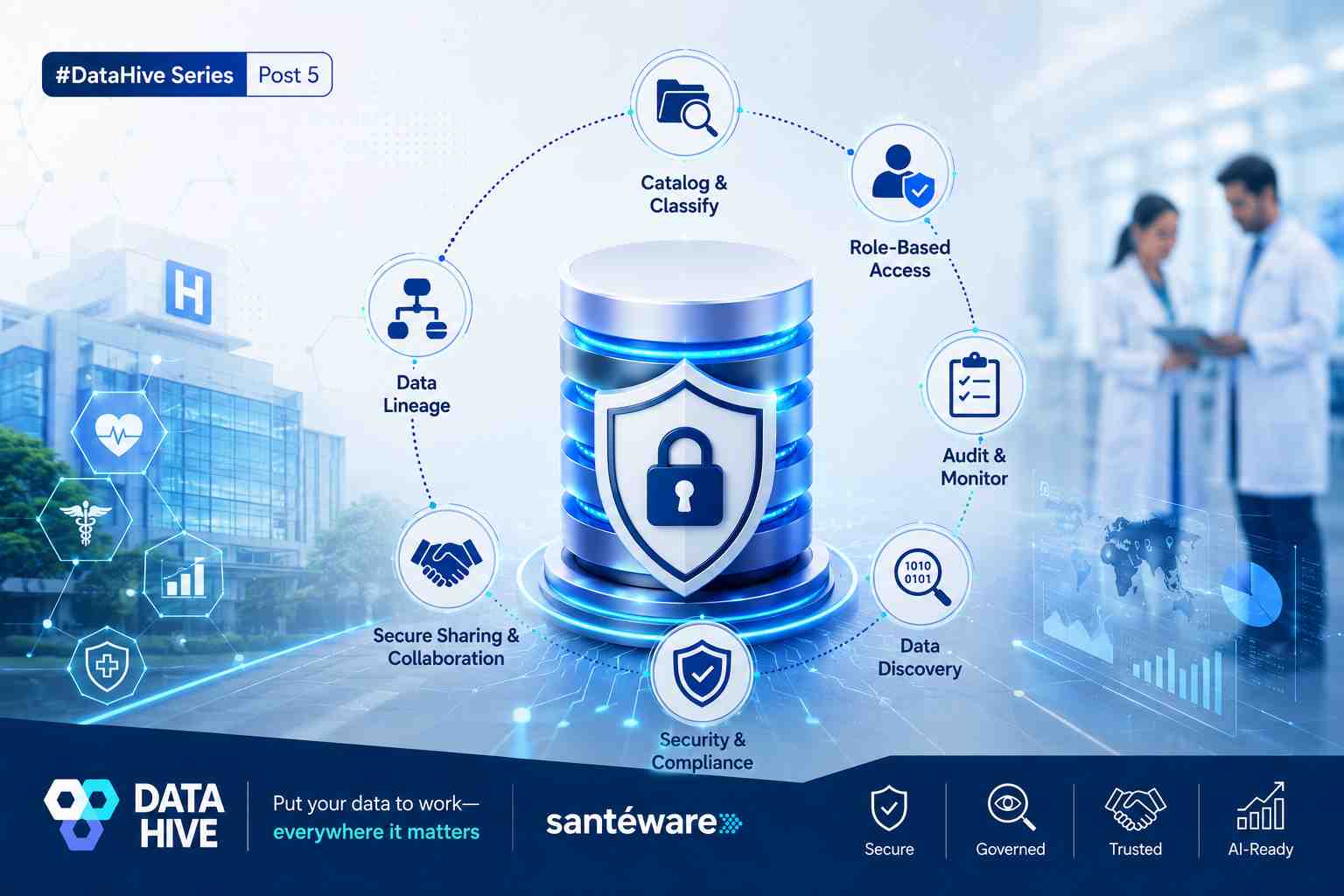
🏗️ The DataHive Governance Framework
DataHive brings together seven essential governance capabilities within a single platform.
📚 1. Cataloging & Classification
Data governance begins with understanding what data exists.
Most healthcare organizations manage hundreds—or even thousands—of databases, reports, APIs, interfaces, and file repositories. Without a centralized inventory, valuable data often remains hidden.
DataHive automatically organizes and catalogs enterprise data assets by creating a centralized metadata repository.
🔑 Key Capabilities
📂 Enterprise data catalog
📖 Business glossary management
🏷️ Metadata management
🔍 Sensitivity classification
👤 Asset ownership tracking
💼 Business Benefits
⚡ Faster data discovery
📘 Standardized business definitions
♻️ Reduced duplication
🤝 Better collaboration across departments
📈 Improved confidence in enterprise reporting
🔐 2. Role-Based Access Control (RBAC)
Healthcare data is among the most sensitive information organizations manage.
Not every employee should have access to every dataset.
DataHive enforces Role-Based Access Control (RBAC) to ensure users only access information necessary for their responsibilities.
🔑 Key Capabilities
👥 Role-based permissions
🛡️ Least privilege access
🎯 Fine-grained authorization
🏢 Department-level security
👤 User and group management
✅ Benefits
🚫 Reduced insider risk
❤️ Better protection of PHI
⚙️ Simplified access administration
📋 Stronger audit readiness
📊 3. Auditing & Monitoring
Healthcare regulations require organizations to demonstrate accountability.
Every access, modification, export, or administrative action should be traceable.
DataHive continuously captures audit events across the platform.
🔑 Features
👀 User activity tracking
📝 Audit logs
📑 Compliance reporting
📡 Continuous monitoring
🚨 Alert generation
💼 Business Value
Organizations can quickly answer questions such as:
👤 Who viewed this patient record?
⏰ When was data modified?
📈 Which reports accessed sensitive information?
🚫 Were unauthorized access attempts detected?
🔎 4. Intelligent Data Discovery
One of the biggest challenges in healthcare is knowing where sensitive information exists.
Patient identifiers, financial records, physician notes, and diagnostic reports are often spread across multiple applications.
DataHive automatically discovers enterprise data and identifies sensitive information.
🔑 Capabilities
🤖 Automated data discovery
🔍 Sensitive data identification
🏥 PHI detection
📊 Data profiling
📈 Data quality insights
✅ Benefits
⚡ Reduced manual effort
📋 Faster compliance initiatives
💎 Better data quality
🛠️ Improved governance planning
🔄 5. End-to-End Data Lineage
Trust begins with transparency.
When executives review dashboards or clinicians rely on analytics, they need confidence in where the data originated.
DataHive provides complete data lineage across the data lifecycle.
It enables organizations to
🔄 Visualize data movement
🔍 Track transformations
🔗 Understand dependencies
📊 Perform impact analysis
✅ Validate reporting accuracy
💡 Why Lineage Matters
If a source system changes, administrators can immediately identify:
📈 Reports affected
🔗 Interfaces impacted
🏗️ Downstream applications
🤖 AI models using the data
This significantly reduces operational risk.
🤝 6. Secure Data Sharing & Collaboration
Healthcare increasingly depends on collaboration.
🏥 Hospitals exchange patient records.
🧪 Research institutions require anonymized datasets.
📊 Operational teams need shared analytics.
🤝 Partners require controlled access.
DataHive enables secure collaboration without compromising governance.
🔑 Features
🔒 Secure internal sharing
🌍 Controlled external collaboration
🔑 Permission-based access
📋 Compliance-aligned sharing
📈 Data usage governance
🎯 Result
Organizations can collaborate confidently while maintaining complete control over sensitive information.
🛡️ 7. Security & Compliance
Governance is incomplete without enterprise-grade security.
DataHive incorporates security controls throughout the data lifecycle.
🔑 Security Features
🔐 Encryption in transit
💾 Encryption at rest
👤 Secure authentication
🗂️ Data retention policies
📜 Compliance controls
⚖️ Policy enforcement
📋 Supports Regulatory Compliance
DataHive helps organizations align with industry standards including:
✅ HIPAA
✅ GDPR
✅ Regional healthcare regulations
✅ Internal governance policies
Rather than treating compliance as an afterthought, DataHive embeds it into everyday operations.
🌐 Why an Integrated Governance Platform Matters
Many organizations rely on multiple disconnected tools for cataloging, security, metadata management, lineage, auditing, and compliance.
This fragmented approach often results in:
📄 Duplicate metadata
⚠️ Inconsistent governance policies
💰 Higher operational costs
👀 Limited visibility
🚨 Increased compliance risks
DataHive unifies these capabilities into a single platform, providing one source of truth for enterprise healthcare data governance.
📈 Business Outcomes Delivered by DataHive
Organizations implementing DataHive can achieve:
🚀 Faster data discovery and accessibility
🔐 Stronger protection of sensitive healthcare information
📋 Improved regulatory compliance
🤖 Better trust in analytics and AI initiatives
⚠️ Reduced operational risks
⚙️ Simplified governance management
🤝 Greater collaboration across teams
🌍 Enterprise-wide visibility into data assets
🚀 Accelerated digital transformation
🤖 The Foundation for AI-Ready Healthcare
Artificial Intelligence is only as reliable as the data that powers it.
Without governed, secure, and well-classified data, AI initiatives often struggle with inconsistent results, compliance concerns, and poor adoption.
By establishing a strong governance foundation, DataHive prepares healthcare organizations for advanced capabilities such as:
🏥 Clinical analytics
🌍 Population health management
📊 Predictive analytics
🤖 AI-powered clinical decision support
🔬 Research and Real-World Evidence (RWE)
⚙️ Data-driven operational optimization
💡 Good governance is not simply about compliance—it is the foundation for trusted innovation.
✅ Conclusion
Healthcare organizations face growing pressure to manage increasing volumes of sensitive data while meeting stringent regulatory requirements and enabling data-driven innovation.
A modern governance strategy must go beyond security. It should provide visibility, accountability, control, and collaboration across the entire data ecosystem.
Santeware DataHive brings these capabilities together in one unified platform by combining cataloging, access control, auditing, data discovery, lineage, secure collaboration, and compliance into a comprehensive governance framework.
The result is governed data, protected information, trusted decisions, and a secure foundation for analytics and AI.
As healthcare continues its digital transformation journey, organizations that invest in robust data governance today will be better positioned to deliver better patient outcomes, operational excellence, and long-term innovation tomorrow.
Get in touch with www.santeware.com or teams@santeware.com to learn more.