











Healthcare software has come a long way from simple patient management systems. Today’s healthcare platforms are expected to securely manage sensitive patient data, integrate with multiple clinical systems, support regulatory compliance, and increasingly, leverage AI to improve care delivery and operational efficiency.
Whether you’re building a patient portal, a clinical data platform, a telehealth solution, or a hospital management system, choosing the right technology stack is one of the earliest—and most important—decisions you’ll make.
Two frameworks frequently appear on that shortlist: Django and Laravel. Both are mature, open-source frameworks trusted by organizations worldwide. Both can power enterprise-grade applications. But when the requirements include healthcare interoperability, compliance, scalability, and long-term maintainability, each framework brings different strengths to the table.
In this article, we compare Django and Laravel through the lens of modern healthcare software development.
A Quick Comparison
| Capability | Django | Laravel |
| Security | ★★★★★ | ★★★★★ |
| Development Speed | ★★★★☆ | ★★★★★ |
| Scalability | ★★★★★ | ★★★★★ |
| REST API Development | ★★★★★ | ★★★★★ |
| Healthcare Data Processing | ★★★★★ | ★★★★☆ |
| AI & Machine Learning | ★★★★★ | ★★★☆☆ |
| Developer Experience | ★★★★☆ | ★★★★★ |
| Enterprise Readiness | ★★★★★ | ★★★★★ |
As you can see, this isn’t a story of one framework outperforming the other. Instead, it’s about choosing the right tool for the type of healthcare platform you’re building.
Security Comes First
Security is non-negotiable in healthcare. Patient records, clinical documents, billing information, and operational data all require strong protection against unauthorized access and cyber threats.
Both Django and Laravel provide excellent security foundations, including protection against SQL injection, cross-site scripting (XSS), cross-site request forgery (CSRF), secure password hashing, authentication, authorization, and encrypted sessions.
Django is often praised for its “secure by default” philosophy, making it a popular choice in highly regulated industries. Laravel, on the other hand, offers an equally mature security toolkit with a developer-friendly implementation.
It’s worth remembering that compliance with standards such as HIPAA or GDPR isn’t determined by the framework alone. Secure architecture, infrastructure, access controls, auditing, and operational processes are equally important.
Interoperability Matters More Than Ever
Healthcare applications rarely exist in isolation. They need to communicate with EHRs, laboratory systems, pharmacy platforms, billing applications, imaging systems, and third-party services.
Whether your platform relies on HL7, FHIR, SMART on FHIR, DICOM, or custom APIs, both Django and Laravel can support modern interoperability requirements.
The difference lies in the surrounding ecosystem. Django benefits from Python’s extensive libraries for healthcare data processing, making it particularly attractive for integration-heavy platforms or applications that process large volumes of clinical data.
Laravel also performs exceptionally well as an API-first framework and is widely used for healthcare portals, administrative systems, and integration layers where business workflows take priority.
AI Is Becoming Part of Every Healthcare Platform
Artificial intelligence is no longer limited to research labs. Healthcare organizations are adopting AI to summarize clinical notes, assist with coding, identify trends in patient data, and automate repetitive workflows.
This is where Django has a clear advantage.
Because it is built on Python, Django fits naturally into the same ecosystem as leading AI and data science libraries such as TensorFlow, PyTorch, Pandas, Scikit-learn, and Hugging Face. Teams building predictive analytics, clinical decision support, NLP solutions, or intelligent data platforms can often work within a single technology ecosystem.
Laravel applications can absolutely integrate AI capabilities, but they typically rely on external Python services or cloud-based AI platforms rather than running advanced AI workloads directly.
If AI is central to your product roadmap, Django often provides a smoother path.
Performance and Scalability
A successful healthcare application should continue performing reliably whether it serves one clinic or an entire healthcare network.
The good news is that both Django and Laravel are proven enterprise frameworks capable of supporting large-scale applications.
In reality, scalability depends far more on architecture than on the framework itself. Factors such as database design, caching strategies, containerization, background processing, cloud infrastructure, and monitoring have a much greater impact on long-term performance.
With a well-designed architecture, either framework can comfortably support high user volumes and complex healthcare workloads.
Which One Should You Choose?
There isn’t a universal winner, because healthcare software isn’t built for a single purpose.
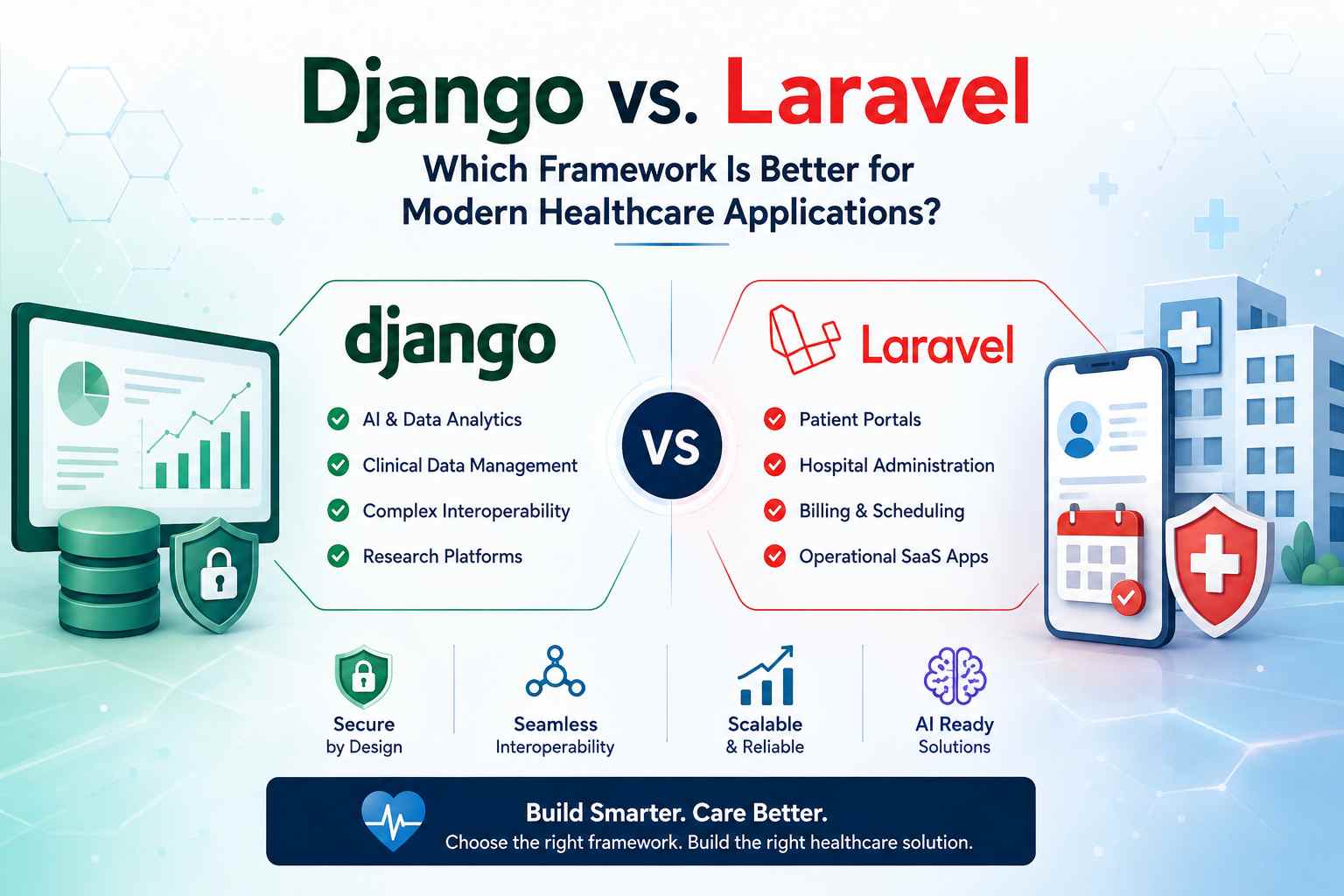
Django is often the better choice for platforms focused on:
🏥 Healthcare analytics
📋 Clinical data management
🤖 AI-powered applications
🗄️ Data archival
🔬 Research platforms
🔗 Complex interoperability
Laravel is an excellent fit for:🧑⚕️ Patient portals
🏥 Hospital administration systems
📅 Appointment scheduling
💳 Billing platforms
🤝 Healthcare CRM solutions
☁️ Operational SaaS applications
Many organizations also adopt a hybrid approach—using Laravel for customer-facing applications and Django for AI, analytics, or healthcare data services. As healthcare platforms grow in complexity, this separation of responsibilities can offer the best of both worlds.
The Framework Is Only Part of the Equation
Choosing between Django and Laravel is important, but it’s only one piece of building successful healthcare software.
The bigger challenge is designing a platform that is secure, scalable, interoperable, and adaptable to changing clinical and regulatory requirements. A well-architected application built on either framework will outperform a poorly designed system regardless of the technology stack.
That’s why successful healthcare projects focus first on architecture, security, data governance, and interoperability—and only then on the framework itself.
Building Healthcare Solutions with Confidence
At Santeware, we believe there is no one-size-fits-all technology stack for healthcare.
Every project has different goals, technical requirements, integration challenges, and long-term objectives. That’s why our engineering teams work with both Django and Laravel, selecting the framework that best aligns with each solution rather than forcing every project into the same technology.
From healthcare data management platforms and interoperability solutions to patient portals, AI-powered applications, and enterprise healthcare software, we help organizations build secure, scalable, and future-ready digital health solutions that are designed to grow with their business.
Get in touch with www.santeware.com or teams@santeware.com to learn more.