














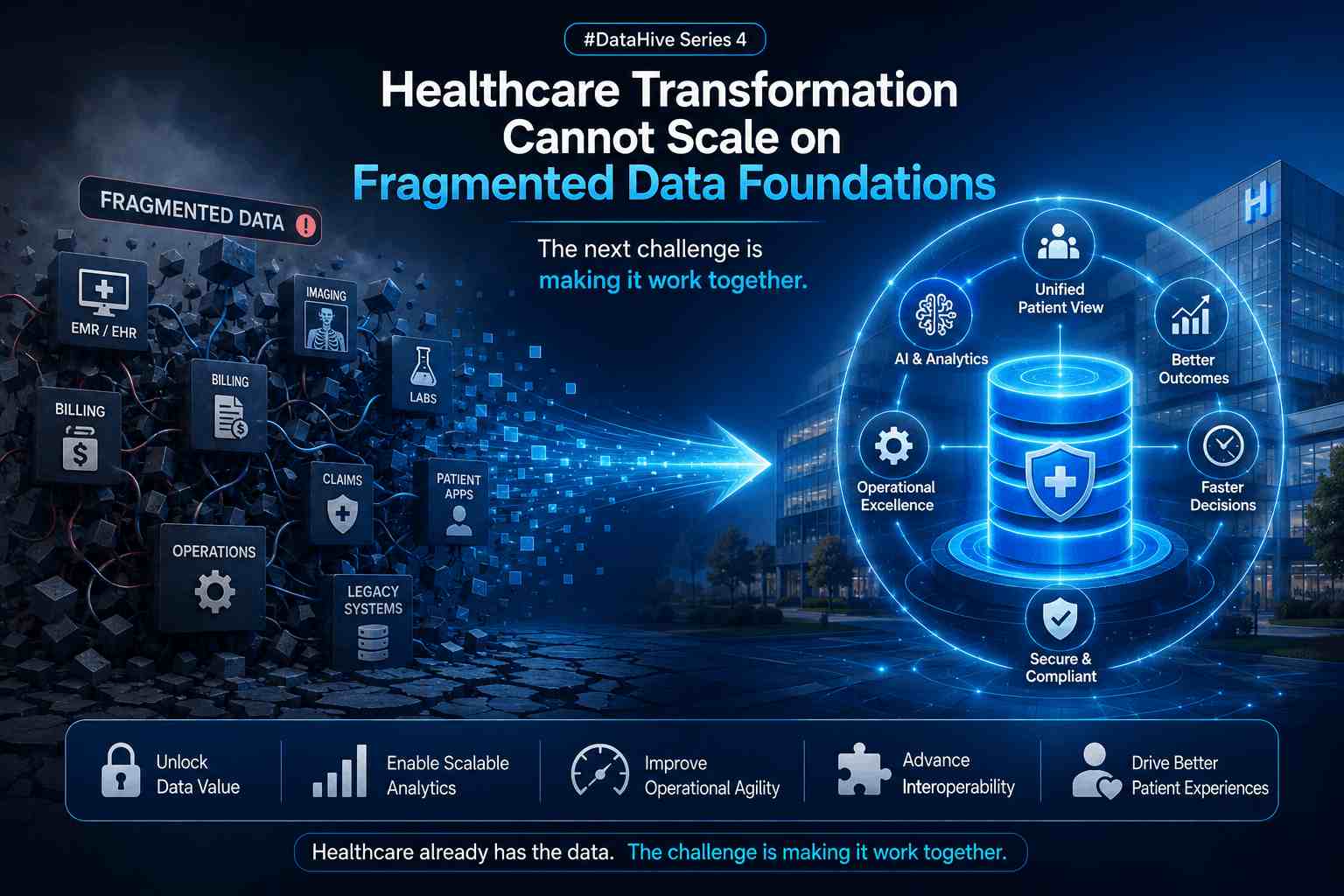
Healthcare Transformation Cannot Scale on Fragmented Data Foundations
Healthcare organizations are entering one of the most data-intensive periods in their history.
Every patient interaction, diagnostic event, operational process, financial transaction, clinical observation, and administrative workflow contributes to an expanding digital footprint.
📊 Electronic Medical Records (EMRs), Electronic Health Records (EHRs), ERP systems, imaging platforms, laboratory systems, claims platforms, patient engagement applications, research repositories, and external data exchanges collectively generate enormous volumes of information every day.
Yet despite this unprecedented growth in data, many healthcare organizations continue to encounter a surprising reality:
⚠️ Their ability to generate outcomes is not growing at the same pace as their data.
Healthcare has not reached a data generation problem.
Healthcare has reached a data utilization problem.
🎯 The challenge is increasingly becoming one of fragmentation.
🔄 The Evolution of Healthcare Data—and the Complexity It Created
Most health systems evolved gradually over years or decades.
✅ Applications were implemented to solve immediate operational needs.
✅ Departments adopted specialized systems.
✅ Legacy platforms remained operational for regulatory or business continuity requirements.
✅ Mergers and acquisitions introduced new technologies and overlapping workflows.
✅ New compliance requirements increased retention obligations.
✅ Cloud transformation initiatives introduced additional environments.
As a result, healthcare organizations today often operate across hundreds of interconnected—and sometimes disconnected—data sources.
What emerges is not a single healthcare platform.
🌐 It becomes a healthcare data landscape.
One where critical information may exist across:
🏥 Clinical applications
📁 Historical EMR repositories
🖥️ Imaging and PACS archives
💳 Billing and revenue cycle platforms
🔬 Research and population health systems
⚙️ Operational and administrative databases
📄 Scanned and unstructured records
🔗 Third-party data exchanges
🗄️ Legacy archival environments
Individually, these systems continue functioning.
Collectively, they create increasing operational complexity.
⚠️ The Cost of Fragmentation Extends Beyond Technology
Data fragmentation is often viewed as an IT challenge.
In reality, it affects nearly every dimension of healthcare performance.
👩⚕️ Clinical Impact
Fragmented information creates challenges in building a complete understanding of patient journeys.
📋 Historical records may exist but remain difficult to access.
🔄 Clinical context may be distributed across multiple systems.
📚 Patient histories become harder to reconstruct longitudinally.
As care becomes more connected and data-driven, incomplete visibility creates operational inefficiencies and decision delays.
⚙️ Operational Impact
Healthcare operations increasingly depend on integrated information.
When data remains fragmented:
⏳ Teams spend time locating information rather than acting on it
📈 Reporting cycles become longer
🔄 Data reconciliation becomes manual
🛡️ Governance processes become increasingly complex
🚧 Transformation initiatives move slower than expected
Organizations often discover that significant portions of project effort are spent preparing and organizing data rather than generating value from it.
💰 Financial Impact
Fragmentation introduces measurable business challenges.
Organizations may experience:
📉 Higher operational costs
📊 Extended analytics and reporting programs
🔄 Delays in integration following acquisitions
💡 Lower return on transformation investments
📋 Increased administrative burden
🎯 Reduced ability to derive strategic insights
Data may exist.
But inaccessible data rarely generates value.
🤖 Why Healthcare AI and Analytics Require More Than Data Volume
Healthcare organizations are rapidly accelerating investments in:
🧠 Artificial Intelligence
✨ Generative AI
📈 Predictive Analytics
🏥 Clinical Intelligence
🌍 Population Health
⚙️ Operational Optimization
🔬 Real World Evidence initiatives
🤝 Automation and decision support
But there is an important misconception:
⚠️ AI readiness is not determined by how much data exists.
✅ It is determined by whether data is usable.
Successful AI and analytics initiatives depend on foundations that support:
🔍 Accessibility
Can information be retrieved efficiently?
📏 Standardization
Can data from different environments be interpreted consistently?
🧩 Context
Can information maintain relationships across patient journeys?
🛡️ Governance
Can usage remain compliant and controlled?
🔗 Interoperability
Can information move across systems without excessive transformation?
Without these layers, organizations risk accelerating complexity instead of outcomes.
🔄 Interoperability Alone Does Not Solve Fragmentation
Interoperability has become a central focus across healthcare transformation.
Standards and exchange frameworks continue improving connectivity across ecosystems.
However, connectivity alone does not guarantee usability.
Organizations frequently discover that even after systems exchange information:
❌ Data structures remain inconsistent
❌ Historical records remain inaccessible
❌ Context remains fragmented
❌ Duplicate representations emerge
❌ Governance challenges persist
Interoperability is an important layer.
But utilization requires additional layers of:
✅ Normalization
✅ Governance
✅ Accessibility
✅ Long-term data strategy
🚀 The Shift Healthcare Organizations Are Beginning to Make
Leading healthcare organizations are increasingly changing how they think about data.
The conversation is moving from:
❓ How do we collect more information?
➡️ To:
💡 How do we unlock more value from the information we already have?
This shift requires moving beyond traditional storage and toward connected data ecosystems designed to support:
🎯 Longitudinal patient understanding
👁️ Cross-system visibility
📊 Analytics readiness
🛡️ Governance and compliance
🤖 Responsible AI adoption
⚡ Faster decision-making
🌱 Sustainable digital transformation
The objective is not centralization for the sake of centralization.
The objective is creating an environment where healthcare data becomes:
✅ Reusable
✅ Trusted
✅ Capable of driving measurable outcomes
🌟 The Future of Healthcare Depends on Better Data Utilization
Healthcare organizations already possess extraordinary amounts of information.
The opportunity ahead is not creating more data.
🎯 It is reducing friction between data and outcomes.
Organizations that address fragmentation will be better positioned to:
🚀 Improve operational agility
💡 Accelerate innovation initiatives
📈 Strengthen decision-making
📊 Enable scalable analytics
🔗 Advance interoperability goals
🤝 Create more connected healthcare experiences
Because transformation does not fail from lack of ambition.
More often, it slows because the foundation beneath it remains fragmented.
💬 Healthcare already has the data.
🔗 The next challenge is making it work together.
Stay tuned to learn more about how DataHive by Santeware is helping healthcare organizations build connected, scalable, and AI-ready healthcare data ecosystems.
Get in touch with www.santeware.com or teams@santeware.com to learn more.