















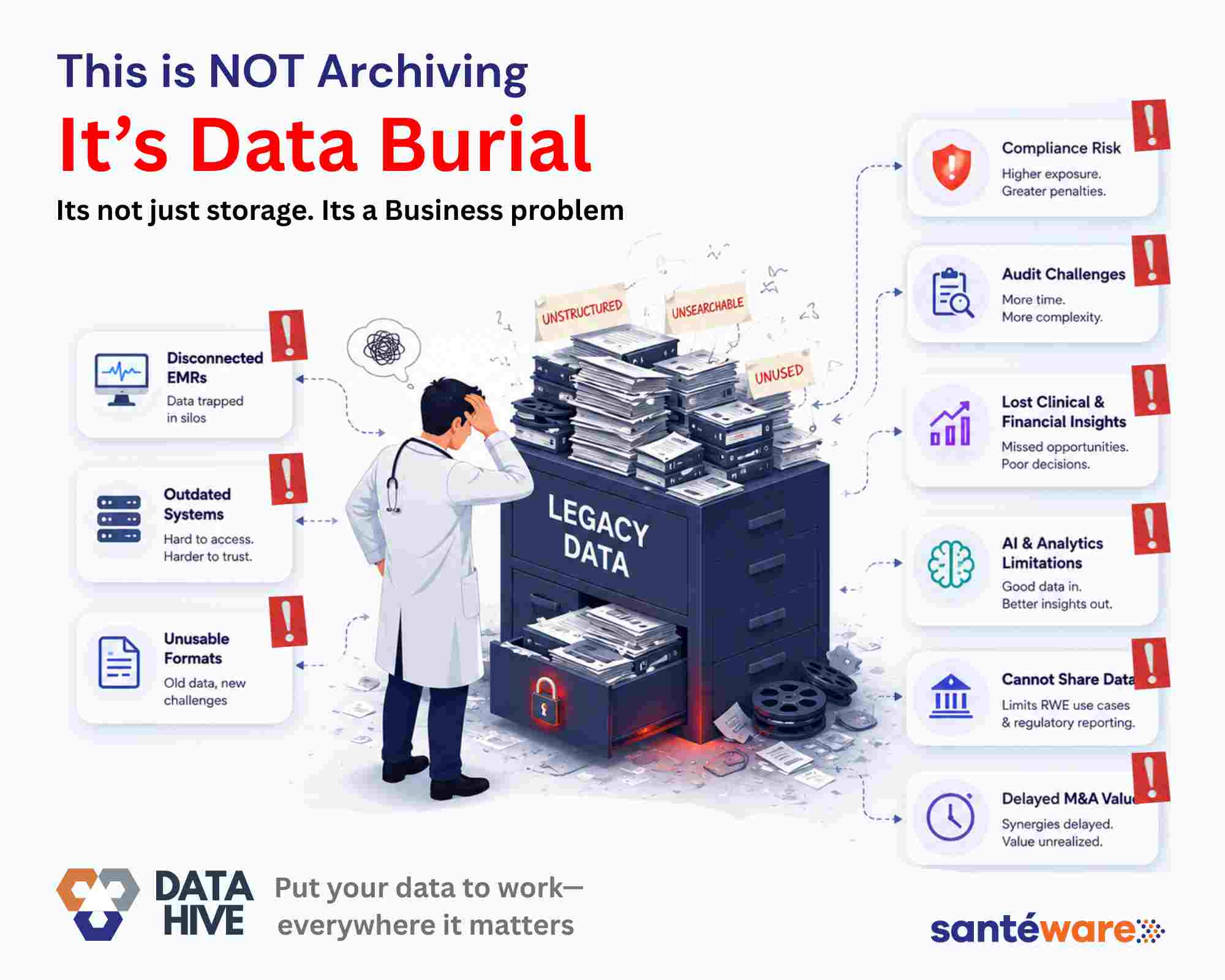
For years, healthcare organizations have approached archival with a simple mindset:
📦 Store old data somewhere safe and retrieve it only when needed.
At one point, that approach may have been enough.
But healthcare has changed.
Today, historical healthcare data is expected to support:
🩺 Clinical decisions
📋 Compliance reporting
📊 Analytics
🔗 Interoperability initiatives
🤖 AI programs
🤝 Mergers and acquisitions
📈 Long-term operational intelligence
The problem is that much of this data is no longer truly usable.
It exists.
But it is buried.
🖥️ Buried inside disconnected EMRs.
🏚️ Buried inside outdated applications.
🗂️ Buried across fragmented archival systems.
📄 Buried in unstructured documents and inaccessible formats.
And while organizations continue storing this information, they are increasingly struggling to unlock value from it.
⚠️ This is no longer just a storage challenge.
🚨 It is becoming a serious business problem.
When Archived Data Stops Creating Value
Most healthcare organizations today are managing years — sometimes decades — of accumulated clinical, operational, and financial data.
Over time, systems evolve.
🖥️ New EMRs are introduced.
🔄 Applications are replaced.
🏥 Hospitals merge.
⚙️ Workflows change.
🤝 Vendors come and go.
But the data never disappears.
Instead, organizations continue carrying historical information across multiple legacy systems and disconnected environments.
📂 The Result
A healthcare ecosystem where massive amounts of information technically still exist — but are difficult to:
🔑 Access
🔎 Search
✅ Validate
📊 Utilize effectively
This creates what many organizations do not initially recognize:
⚠️ A growing gap between data retention and data usability.
And that gap becomes more expensive every year.
The Hidden Operational Cost of Data Burial
One of the biggest consequences of buried healthcare data is operational inefficiency.
Healthcare teams frequently spend unnecessary time trying to locate and reconcile information that already exists somewhere within the organization.
🩺 Clinical staff may need to navigate multiple systems to understand patient history.
📋 Compliance teams often struggle to retrieve historical audit records from aging platforms.
📊 Operational and financial teams may work with inconsistent or incomplete datasets spread across disconnected applications.
🕒 What should be simple workflows gradually become slower and more resource-intensive.
And unlike visible technology failures, these inefficiencies grow quietly in the background.
Over time, they impact:
📉 Productivity
✅ Reporting accuracy
🤝 Collaboration
🧠 Decision-making across the organization
📦 The organization continues storing more data every year — while becoming progressively less capable of using it efficiently.
It’s a structural problem in how healthcare data is managed.
The Compliance Problem Nobody Talks About Enough
Healthcare organizations operate under increasing pressure to maintain:
🛡️ Strong governance
📋 Auditability
🔐 Data security
But buried healthcare data creates significant compliance complexity.
When historical records are spread across disconnected systems, maintaining consistent governance becomes extremely difficult.
⚠️ Organizations often struggle with:
📉 Incomplete audit visibility
🔑 Inconsistent access controls
📄 Difficulty validating historical records
🧬 Limited data lineage tracking
🏥 Fragmented PHI monitoring
📝 Challenges during audits and regulatory reporting
🚨 The problem becomes even more serious during:
🤝 Mergers
🏢 Acquisitions
⚖️ Legal reviews
🔄 Large-scale migration projects
Healthcare organizations are not just managing active data environments anymore.
📦 They are managing years of historical risk.
And the older and more fragmented the ecosystem becomes, the harder governance becomes to maintain.
Why Buried Data Limits AI and Analytics
Healthcare organizations everywhere are investing heavily in:
🤖 AI
📊 Analytics
⚙️ Automation
🔮 Predictive technologies
But many initiatives fail to scale successfully.
⚠️ The reason is often not the AI model itself.
It is the condition of the underlying data.
AI systems require:
📁 Structured and normalized information
🔍 Searchable historical records
🩺 Longitudinal patient context
📋 Consistent coding standards
🔗 Connected datasets across systems
🚫 Buried healthcare data creates the opposite conditions.
Organizations frequently deal with:
🖥️ Disconnected systems
🏚️ Outdated formats
🔁 Duplicate records
🗂️ Siloed archives
📄 Massive amounts of unstructured information locked away in inaccessible repositories
Without proper normalization and accessibility, even advanced AI initiatives struggle to deliver reliable outcomes.
💡 This is why many healthcare organizations are beginning to realize a critical truth:
📌 Before AI readiness comes data readiness.
The Real Difference Between Archival and Utilization
Traditional archival strategies focused on retention.
🕰️ Modern healthcare requires utilization.
That difference is becoming increasingly important.
Healthcare organizations no longer benefit simply from storing historical information.
💡 They benefit when historical healthcare data becomes:
🔍 Searchable
🛡️ Governed
🔗 Interoperable
🤖 AI-ready
🩺 Clinically accessible
⚙️ Operationally usable
Because healthcare data becomes most valuable when it contributes to:
📊 Ongoing decisions
💡 Insights
📋 Compliance
🚀 Innovation
⚠️ Data that cannot be effectively utilized eventually becomes organizational weight instead of organizational value.
Moving Beyond Data Burial with DataHive by Santeware
This is where Santeware’s DataHive is designed to help.
🧠 DataHive by Santeware
DataHive by Santeware is built as a scalable healthcare data foundation that helps organizations transform fragmented and buried healthcare data into connected, usable, and intelligent healthcare information.
Rather than functioning as another passive archival repository, DataHive acts as a:
⚙️ Processing layer
🧠 Intelligence layer
across:
🖥️ EMR systems
💰 ERP platforms
📊 RCM environments
🏥 HIS systems
🗂️ Legacy healthcare applications
✅ The platform enables healthcare organizations to:
🔍 Improve accessibility of historical healthcare data
🩺 Create longitudinal patient-centric views
🔗 Support HL7 and FHIR interoperability
🤖 Enable AI-powered and NLP-driven search
🛡️ Improve governance and auditability
📊 Support analytics-ready healthcare data ecosystems
🏚️ Reduce dependency on aging legacy platforms
💡 Most importantly, it helps organizations shift from simply storing healthcare data… to actually utilizing it.
The Future of Healthcare Data Is Not Storage
Healthcare organizations already possess enormous amounts of valuable information.
📊 The challenge is no longer collecting data.
⚠️ The challenge is making it continuously usable.
Organizations that continue relying on fragmented archival environments will increasingly face:
📉 Rising operational inefficiencies
🔒 Greater compliance complexity
🐢 Slower analytics initiatives
🤖 AI readiness limitations
👁️ Reduced organizational visibility
🌐 Organizations that build connected healthcare data foundations will be far better positioned for the future.
Because in modern healthcare:
💡 Data only creates value when it can actually be used.
Looking Ahead
In the next post in the DataHive Series, we’ll explore:
Why many healthcare AI initiatives struggle to scale — and why the real challenge often lies in the underlying healthcare data foundation.
Stay tuned to learn more about how DataHive by Santeware is helping healthcare organizations build connected, scalable, and AI-ready healthcare data ecosystems.
Get in touch with www.santeware.com or teams@santeware.com to learn more.