











Introduction
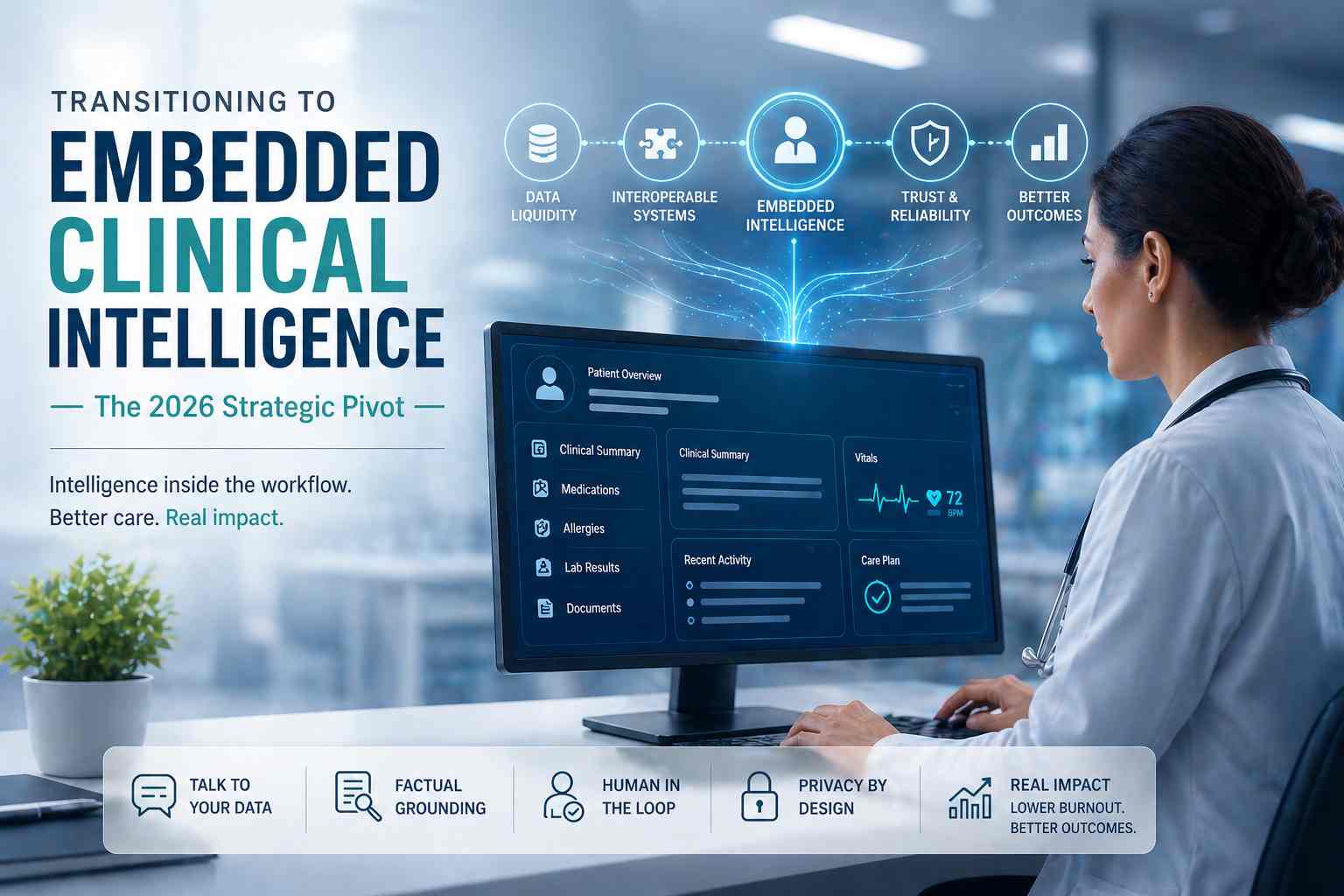
The landscape of healthcare delivery in 2026 has undergone a fundamental transformation, moving decisively from the era of “Experimental AI” – characterized by isolated pilot programs and fragmented point solutions – to a regime of “Embedded Clinical Intelligence.” Where the preceding years focused on the novelty of generative capabilities, the current environment prioritizes operational utility, reliability, and seamless integration into the clinical workflow. The central challenge for health systems is no longer the acquisition of artificial intelligence but the orchestration of these tools within the high-stakes environment of patient care, where administrative burden has reached a critical inflection point.
Santeware Healthcare Solutions has been part of this movement by emphasizing “Utility over Hype,” focusing on the “Bottom Line” of clinical operations: reducing clinician burnout and reclaiming thousands of staff hours previously lost to electronic health record (EHR) inefficiencies.
The transition to embedded clinical intelligence represents a departure from the “bolt-on” AI models of the early 2020s. In 2026, the industry has realized that AI must be woven into the fabric of care, functioning directly within authorization and documentation processes. Santeware’s approach involves operationalizing AI inside the EMR to reduce clinical documentation burden without creating new systems, screens, or cognitive overhead for the provider.
The Technical Foundation: Architectural Specialization and Model Selection
The technical underpinnings of the 2026 healthcare AI environment are defined by a move toward specialized models. The industry has reached a consensus that general-purpose large language models (LLMs) often lack the clinical nuance required for high-stakes medical decision-making. Consequently, the adoption of Small Language Models (SLMs) has surged, providing a more cost-effective, private, and domain-focused alternative for clinical settings.
SLMs vs. LLMs: Efficiency and Privacy at the Edge
Small Language Models (SLMs) are increasingly favoured for task-specific workflows such as document summarization, coding assistance, and internal knowledge retrieval. These models require significantly less computational power, allowing for on-device or edge deployment, which is critical for maintaining patient privacy.
| Feature | Large Language Models (LLMs) | Small Language Models (SLMs) |
| Architectural Scope | Generalized, billions of parameters | Task-tuned, millions to a few billion parameters |
| Operational Cost | High (Cloud-based, high token cost) | Low (Capability for on-premise/edge deployment) |
| Latency | Higher (Seconds for generation) | Millisecond responses 7 |
| Training Basis | Massive, diverse web-scale data | Curated, domain-specific medical datasets 6 |
| Security Profile | Higher risk of external API leakage | Tighter control over sensitive clinical data 7 |
| Task Complexity | Creative, cross-domain reasoning | High-precision specific clinical tasks 8 |
Santeware’s Approach to AI Architecture
At Santeware, the shift in healthcare AI is viewed as an evolution of system design rather than just tool adoption. Modern architectural decisions increasingly rely on vector databases to enable semantic search across clinical records, gRPC/FHIR to improve real-time data exchange, and modular architectures to simplify regulatory audits. This allows for the retrieval of meaning from clinical narratives that traditional SQL databases often miss.
Data Liquidity and “Talking to Your Data”: The Santeware Specialism
The realization of AI’s potential is inextricably linked to data liquidity – the ability of information to flow seamlessly across systems. Santeware specializes in bridging the gap between raw healthcare data and intelligent application through its unified data platform”
Legacy to FHIR Transformation
Using LLMs to map unstructured historical data into FHIR resources is a cornerstone of the 2026 data strategy. Santeware addresses the data fragmentation problem by extracting and converting data from over 70+ different EMR,ERP, CRM, RCM systems worldwide, including legacy platforms built on CACHE/Mumps databases. These extraction capabilities encompass structured, discrete, and unstructured “blog” data, ensuring a longitudinal patient record.
DataHive and DataFusion: Unified Data Ecosystems
Santeware’s DataHive is designed as a unified healthcare data platform that collects, transforms, and analyzes clinical data from multiple systems simultaneously. It addresses the interoperability gap at the data access layer by normalizing HL7v2, FHIR, and custom APIs into a single standardized platform. Complementing this, DataFusion provides advanced interoperability capability and AI-ready pipelines, allowing organizations to centralize and de-identify patient data for real-time insights and smarter resource allocation.
NLQ (Natural Language Querying): Talking to Data
Natural Language Querying (NLQ) represents another fundamental shift in how non-technical staff interact with clinical databases. Santeware is using LLMs to bridge the gap between human questions and complex databases in it’s DataHive platform, NLQ enables users to “talk to their data” in plain English; Instead of manual reporting, users can ask questions like “Show me patient admissions by risk category” or “What were the patient’s last lab results?”, democratizing data access across the organization
Safety, Reliability, and the Trust Mandate
Retrieval-Augmented Generation (RAG), the Human-in-the-loop mandate, and the strategic separation of deterministic and probabilistic logic.
RAG and Factual Grounding
Retrieval-Augmented Generation (RAG) is the primary technique used to eliminate “hallucinations” in clinical AI. By grounding AI responses in verified medical journals and internal hospital protocols, RAG ensures that output is traceable to an authoritative source.10 RAG-enhanced models show substantial gains in faithfulness, often reaching scores near 99.5%.
Conclusion
In the healthcare environment of 2026, the value of AI lies in its “embeddedness.” By providing a unified data access layer through platforms like DataHive and DataFusion, Santeware helps healthcare organizations transition from being “data entry clerks” to “health strategists,” ensuring that the future of care is human-centric and truly intelligent.
We at Santeware Healthcare can offer a Data Quality Assessment for your Implementations—helping you identify gaps before they impact your system. We help healthcare teams turn complex ideas into production-ready systems.
Whether you’re modernizing an EMR, migrating clinical data, or building interoperable solutions using HL7/FHIR, we bring the delivery governance, QA discipline, and healthcare expertise needed to build secure, scalable, and compliant platforms that hold up at scale.
Get in touch with www.santeware.com or teams@santeware.com to learn more.
Works cited
- Medical AI Implementation | Santeware | Engineering Healthcare Data, accessed April 22, 2026, https://santeware.com/tag/medical-ai-implementation/
- Healthcare Agentic AI Trends for 2026 – TATEEDA | GLOBAL, accessed April 22, 2026, https://tateeda.com/blog/agentic-ai-in-healthcare-trends-and-types
- The Role of Healthcare Tech in Reducing Clinician Burnout – HLTH, accessed April 22, 2026, https://hlth.com/insights/articles/the-role-of-healthcare-tech-in-reducing-clinician-burnout-2025-11-04
- Fine-Tuned Medical LLMs for Clinical Coding & Documentation – Ailoitte, accessed April 22, 2026, https://www.ailoitte.com/blog/fine-tuned-medical-llm-for-clinics/
- What is Natural Language Querying? | Graphwise Fundamentals, accessed April 22, 2026, https://graphwise.ai/fundamentals/what-is-natural-language-querying/
- What Is Natural Language Query (NLQ)? Meaning, Use Cases & Analytics, accessed April 22, 2026, https://www.orbitanalytics.com/blog/mastering-natural-language-query-transforming-data-analytics/
- SLM vs LLM: A Practical Guide for Enterprises Adopting Generative AI – NextGen Invent, accessed April 22, 2026, https://nextgeninvent.com/blogs/slm-vs-llm-a-practical-guide/
- SLMs vs. LLMs: Why Smaller AI Models Win in Business – The New Stack, accessed April 22, 2026, https://thenewstack.io/slms-vs-llms-why-smaller-ai-models-win-in-business/
- UI/UX Design for AI Products: A Complete Guide for Modern Applications, accessed April 22, 2026, https://www.aalpha.net/blog/ui-ux-design-for-ai-products/
- Retrieval Augmented Generation (RAG) for Evaluating Regulatory Compliance of Drug Information and Clinical Trial Protocols – PMC, accessed April 22, 2026, https://pmc.ncbi.nlm.nih.gov/articles/PMC12917324/
- Retrieval augmented generation for large language models in healthcare: A systematic review | PLOS Digital Health – Research journals, accessed April 22, 2026, https://journals.plos.org/digitalhealth/article?id=10.1371/journal.pdig.0000877
- DPDP India 2026 Handbook | Complete Guide to the Digital Personal Data Protection Act, accessed April 22, 2026, https://www.levo.ai/resources/blogs/the-dpdp-india-2026-handbook—the-complete-guide-to-indias-new-data-protection-era
- Grounding Large Language Models in Clinical Evidence: A Retrieval-Augmented Generation System for Querying UK NICE Clinical Guidelines – arXiv, accessed April 22, 2026, https://arxiv.org/html/2510.02967v1
- AI Compliance for UK companies: Guide for 2026 – GDPR Local, accessed April 22, 2026, https://gdprlocal.com/ai-compliance-uk-companies/
- Understanding System Concepts and Types | PDF | System | Decision Making – Scribd, accessed April 22, 2026, https://www.scribd.com/document/833698190/MIS-FULL-NOTES
- The International Lawyer’s Guide to Data Privacy Laws in 2026: Navigating 50+ Jurisdictions, accessed April 22, 2026, https://globallawlists.org/insights/international-lawyers-guide-data-privacy-laws-2026-navigating-50-plus-jurisdictions
- Open Source PHI De-Identification: A Technical Review – IntuitionLabs, accessed April 22, 2026, https://intuitionlabs.ai/pdfs/open-source-phi-de-identification-a-technical-review.pdf
- SLM vs LLM: How Small Language Models Are Different – Rapidops, accessed April 22, 2026, https://www.rapidops.com/blog/slm-vs-llm/
- AI Architecture In Healthcare: Vector Database Vs SQL, REST Vs …, accessed April 22, 2026, https://santeware.com/ai-architecture-in-healthcare-vector-database-vs-sql-rest-vs-grpc-and-system-design-choices-that-scale/
- Santeware | Engineering Healthcare Data | Exceeding Expectations, accessed April 22, 2026, https://santeware.com/