









🧠 How the Databricks Lakehouse Platform supports secure, scalable and compliant analytics, AI and Gen AI across the healthcare ecosystem?
🔒 Healthcare Does Not Have a Data Shortage. It Has a Data Fragmentation Problem.
Claims sit in one system and clinical records in another. Imaging, lab feeds, IoT devices, ERP platforms and genomics data each live in their own silo, and each is governed differently. Healthcare organizations have to unify all of it while meeting strict security and compliance requirements. They are also being asked to deliver AI and Generative AI on top of it.
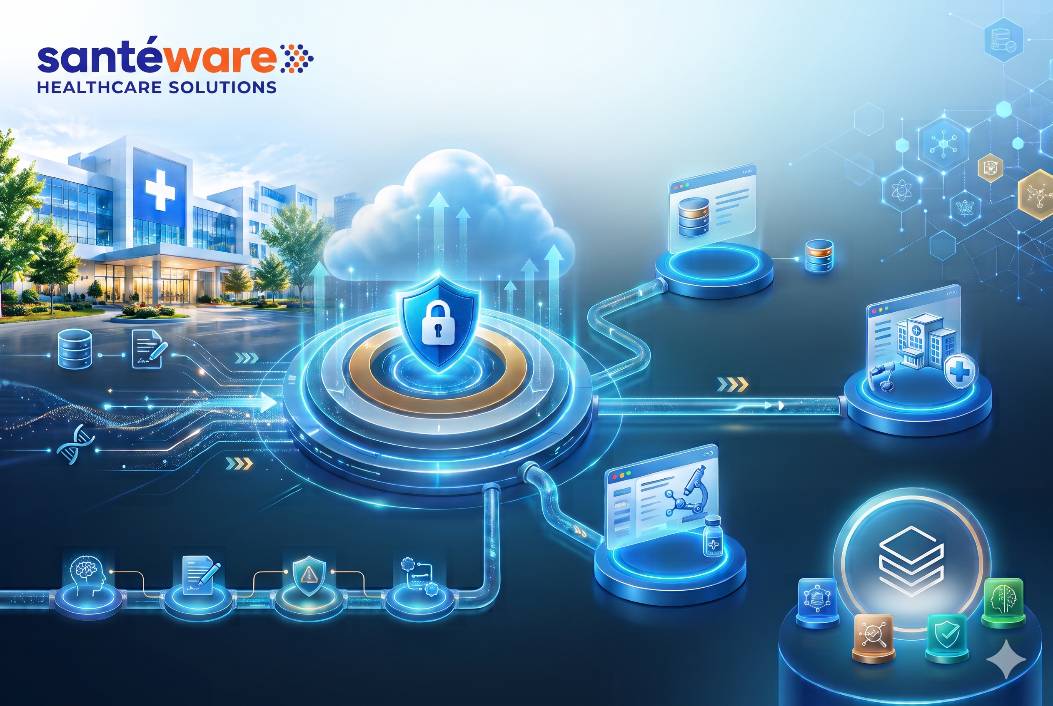
The Databricks Lakehouse Platform was built for this challenge. It unifies structured, semi-structured and unstructured data in a single governed environment, and it supports analytics, machine learning and Gen AI on the same foundation.
Ecosystem Blueprint: This guide covers three key segments of the healthcare ecosystem: Payers (P1), Providers and Health Systems (P2), and Pharma, Life Sciences and Medical Devices (P3).
🛠️ The Foundation: Databricks Lakehouse Reference Architecture
Across all three segments, the architecture follows the same patterns:
🗄️ Data sources: EHR/EMR, claims, SAP, IoT, imaging, CTMS and genomics
⚡ Ingestion: batch and streaming pipelines using Delta Live Tables
🏅 Storage: Delta Lake with the Medallion Architecture (Bronze, Silver and Gold layers), so data is progressively refined from raw to analytics-ready
🛡️ Governance: Unity Catalog for lineage, auditability and fine-grained access controls
📊 Analytics: Databricks SQL and BI tools
🤖 AI and Gen AI: Mosaic AI, MLflow, vector databases and Retrieval-Augmented Generation (RAG)
🔗 Secure data sharing: Delta Sharing, for sharing data without copying it
In healthcare, governance is a design requirement from day one. A single platform with built-in lineage and access control makes compliance and audit readiness part of the architecture, not an afterthought.
🏦 Payers (P1): Managing Cost, Quality and Compliance
Payers operate in one of the most data-intensive environments in the industry. They balance cost containment, quality measures, regulatory compliance and member experience, often across several core platforms.
Use cases
🔹 Claims analytics and claims repair (FHIR, HL7, X12)
🔹 Risk adjustment (HCC and RAF optimization)
🔹 Utilization management and care management analytics
🔹 Fraud, waste and abuse (FWA) detection using machine learning
🔹 Provider lifecycle management (PLM)
🔹 Appeals and grievances sentiment analytics
Value delivered
✅ A single source of truth through the Lakehouse
✅ An estimated 30–40% faster analytics onboarding
✅ AI-driven compliance and audit readiness
📥 Data sources: Core claims systems (including NTT Xcelys, Trizetto QNXT and Facets, HealthEdge and Plexis), EHR/EMR integrations, and CMS, HEDIS, Stars and Social Determinants of Health (SDOH) data.
🏥 Providers and Health Systems (P2): Unifying Clinical, Operational and Financial Data
Providers must connect clinical, operational and financial data while reducing the documentation burden on clinicians. When these views stay separate, every decision is made with partial information.
Use cases
🔹 Clinical outcomes and population health analytics
🔹 Revenue cycle management (RCM)
🔹 Patient flow and capacity optimization
🔹 Readmission prediction models
🔹 Clinical NLP on unstructured physician notes
Value delivered
✅ Real-time clinical insights
✅ Improved patient outcomes
✅ Reduced operational inefficiencies
📥 Data sources: Epic, Oracle-Cerner and MEDITECH; imaging, lab and IoT medical devices; scheduling, billing and supply chain systems.
🧪 Pharma, Life Sciences and Medical Devices (P3): Accelerating Data-Driven Innovation
Data drives every stage of the value chain in this segment, from R&D and clinical trials to manufacturing and commercialization. Regulatory expectations apply at every one of those stages.
Use cases
🔹 Clinical trial data management and Real World Evidence (RWE)
🔹 Drug discovery using GenAI and ML
🔹 Pharmacovigilance and safety signal detection
🔹 Manufacturing quality and IoT analytics
🔹 Sales and market access analytics
Value delivered
✅ Faster time-to-market
✅ Regulatory-grade data governance
✅ AI-powered innovation pipelines
📥 Data sources: Clinical Trial Management Systems (CTMS), genomics and omics data, and SAP, LIMS and ERP platforms.
🧠 Gen AI and Agentic AI in Regulated Environments
Healthcare leaders are rightly cautious about Gen AI. Databricks supports enterprise-grade Generative AI and Agentic AI workflows with governance and access controls built in, which matters when the data is sensitive and the stakes are high.
| Segment | Gen AI and Agentic AI use cases |
|---|---|
| Payers (P1) | Automated claims explanation (EOB) generation; appeals and grievances summarization; risk adjustment documentation gap analysis |
| Providers (P2) | Clinical note summarization and ambient documentation; personalized patient discharge instructions; capacity planning assistants |
| Pharma / Med Devices (P3) | Clinical trial protocol summarization; safety signal detection via NLP; intelligent regulatory submissions |
🚀 From Blueprint to Production: How Santeware Helps
A reference architecture is a starting point. The harder work is connecting it to the systems an organization actually runs, such as claims platforms, EHRs and ERPs, and scaling it beyond a pilot.
As a Databricks Bronze SI & Consulting Partner, Santeware helps healthcare organizations design, deploy and scale Lakehouse-based data solutions. Our work is shaped by deep experience in healthcare data and interoperability, and it covers:
📁 Data foundation: integrating payer, provider and life sciences source systems into a governed Medallion architecture
📈 Use case acceleration: moving from the use cases above to production analytics and ML, using reusable accelerators
🛡️ Governance and compliance: Unity Catalog-based lineage and access controls designed for regulated environments
🧬 Gen AI readiness: building the data foundation that enterprise Gen AI and Agentic AI depend on
☑️ Key Takeaways
💡 Healthcare's central data challenge is fragmentation. A unified, governed platform addresses it at the root.
🏛️ The same Lakehouse architecture serves payers, providers and life sciences organizations, and the use cases differ by segment.
🔐 Governance is built in, so compliance and audit readiness are part of the design.
⚙️ Gen AI is only as reliable as the data foundation beneath it.
Get in touch to learn more.
Want to explore how this blueprint applies to your organization? Visit www.santeware.com or email teams@santeware.com to start the conversation.
📩 Contact us today to schedule a consultation and discover how we can help digitize and connect your healthcare ecosystem.