













Healthcare Data | FHIR Interoperability | Artificial Intelligence | Healthcare Automation
Introduction
Healthcare organizations today rely on multiple systems to manage patient information, clinical encounters, laboratory results, medications, diagnostic reports, claims, and remote patient monitoring data. Although these systems generate valuable information, connecting it and making it useful across different healthcare workflows remains a significant challenge.
At the same time, healthcare organizations are exploring Artificial Intelligence (AI) to improve clinical intelligence, operational efficiency, and patient engagement.
How can healthcare organizations transform fragmented health data into actionable insights using FHIR and AI?
FHIR (Fast Healthcare Interoperability Resources) provides a standardized approach to exchanging healthcare information, while AI can help process suitable data into meaningful summaries, predictive insights, and intelligent workflows.
By combining healthcare interoperability with AI-driven processing, organizations can build a foundation for more connected and intelligent healthcare solutions.
Healthcare data integration, interoperability, analytics, and automation are important areas in supporting digital healthcare transformation. The following sections explain how FHIR and AI work together and where they can be applied.
How FHIR + AI Works in Healthcare
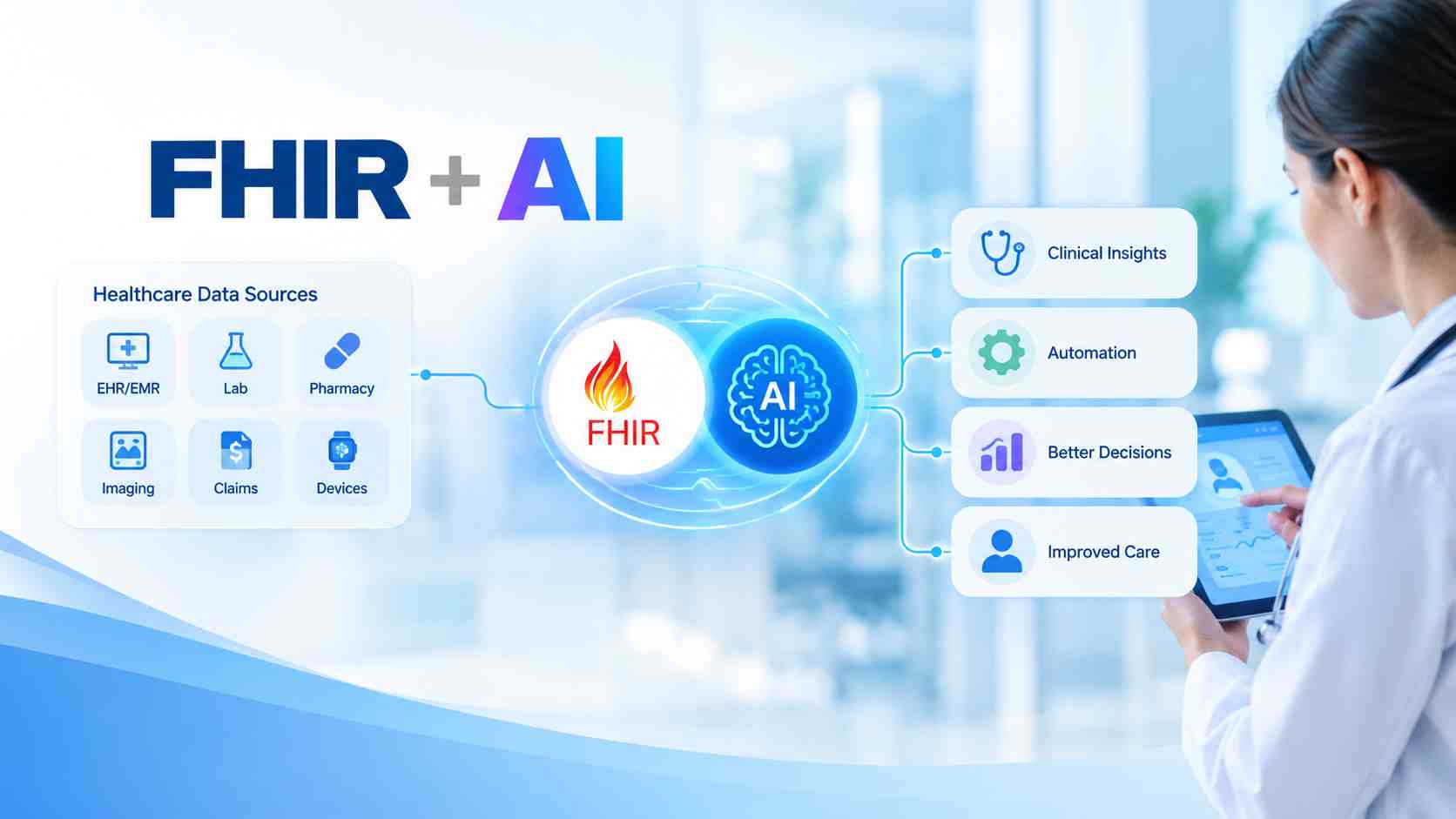
A FHIR + AI solution combines healthcare data sources, a standardized interoperability layer, AI processing capabilities, and applications that deliver actionable outcomes. A practical implementation involves several important components.
- Connecting Healthcare Data Sources – Healthcare information originates from EHR and EMR platforms, Laboratory Information Systems (LIS), pharmacy applications, Picture Archiving and Communication Systems (PACS), Revenue Cycle Management (RCM) platforms, Health Information Exchange (HIE) systems, and Remote Patient Monitoring (RPM) devices. Connecting relevant sources helps make information available to authorized applications.
- Establishing a FHIR Interoperability Layer – FHIR resources such as Patient, Encounter, Observation, Condition, MedicationRequest, DiagnosticReport, Claim, and Practitioner provide standardized structures for exchanging healthcare information. Integration may also involve FHIR APIs, SMART on FHIR, OAuth 2.0 / OIDC, FHIR profiles, validation, and healthcare terminology mapping.
- Preparing Data for AI Processing – Before healthcare data is used by AI applications, its structure, completeness, terminology, and relevance should be assessed. Data validation and appropriate access controls help establish a more reliable foundation for downstream processing.
- Applying AI Intelligence – Different AI technologies support different healthcare tasks. Retrieval-Augmented Generation (RAG) can retrieve relevant information from authorized sources, Large Language Models (LLMs) can summarize information, AI agents can support defined workflows, and predictive models can analyze risks and trends. Terminology mapping can help align healthcare concepts across systems.
- Generating Intelligent Healthcare Outcomes – The resulting applications can support clinical intelligence, revenue cycle management, operational automation, and patient engagement. Examples include patient summaries, claim validation, documentation assistance, prior authorization support, personalized education, and follow-up reminders.
- Maintaining Appropriate Oversight – Healthcare AI applications should preserve source information, apply suitable security controls, monitor output quality, and include human review wherever required by the intended use.
Key Use Cases of FHIR + AI
The combination of FHIR interoperability and AI can support multiple clinical and operational applications.
Clinical Intelligence: AI-assisted patient summaries, SOAP note preparation, and clinical decision support can help organize relevant information for clinical review.
Healthcare Interoperability: Mapping HL7 v2, CDA, and other healthcare data formats to appropriate FHIR resources can support data exchange and validation across compatible systems.
Revenue Cycle Management: Claim validation, denial risk analysis, coding suggestions, and accounts receivable insights can support administrative workflows.
Laboratory Intelligence: Laboratory result interpretation and LOINC mapping can help standardize observations and support appropriate analysis.
Pharmacy Intelligence: Medication reconciliation and medication safety workflows can help identify discrepancies that require review.
Chronic Care Management: Remote patient monitoring, risk identification, and follow-up coordination can support ongoing care workflows.
Prior Authorization: Evidence extraction and documentation support can help organize information for prior authorization processes.
Example: AI-Powered Patient Summary from FHIR Data
Consider a healthcare workflow in which relevant patient information is distributed across several systems. An AI-enabled application can retrieve authorized FHIR resources and organize the available information into a structured patient summary.
This summary may include documented conditions, recent laboratory results, medication information, previous encounters, and potential follow-up considerations.
For example, information associated with diabetes, hypertension, and hyperlipidemia could be organized alongside relevant observations, such as HbA1c, creatinine, and LDL cholesterol results, where those records are available.
The application can then present the information in a format that is easier to review, while identifying missing data and distinguishing documented facts from AI-generated interpretations.
Such a workflow can support clinical information review, but AI-generated recommendations should remain subject to appropriate clinical oversight.
Why FHIR + AI Matters for Intelligent Healthcare
The value of FHIR + AI lies in combining standardized data exchange with the ability to process and interpret suitable information.
Key benefits include:
- Unified Health Data – Improve access to relevant information across connected healthcare systems.
- Faster Insights – Support more efficient retrieval and summarization of healthcare information.
- Improved Decisions – Make relevant clinical and operational information easier to review.
- Higher Efficiency – Automate selected repetitive administrative tasks.
- Clinical Intelligence – Support patient summaries, care recommendations, and clinical decision-support workflows.
- Operational Automation – Assist with documentation, claims, prior authorization, and workflow coordination.
- Better Patient Care Support – Enable more coordinated information access and follow-up processes.
Actual outcomes depend on data quality, integration design, the selected AI technology, workflow adoption, and appropriate governance.
Security and Data Quality in FHIR + AI Implementations
Healthcare information requires careful handling throughout integration, preparation, AI processing, and delivery.
Successful implementations should consider appropriate authentication and authorization, data minimization, secure transmission and storage, audit logging, terminology validation, and AI output monitoring.
FHIR standardizes healthcare information exchange, but it does not automatically guarantee data completeness, security, or regulatory compliance. These requirements must be addressed through the overall solution architecture and operating processes.
How Santeware Supports Healthcare Data and Interoperability Initiatives
Healthcare organizations need a reliable approach to connecting data sources, modernizing integrations, and preparing information for analytics and intelligent applications.
Relevant service areas include:
- Healthcare integration and interoperability using HL7, FHIR, and APIs.
- EMR extraction and conversion.
- Healthcare analytics and reporting.
- Healthcare data modernization.
- Healthcare automation and workflow improvement.
These capabilities can support organizations exploring connected healthcare data environments and AI-enabled applications, depending on their existing infrastructure and requirements.
Building Smarter Healthcare Through FHIR + AI
The future of intelligent healthcare depends on more than adopting AI tools. It requires accessible data, consistent information exchange, suitable processing technologies, and workflows that translate insights into practical outcomes.
FHIR provides a foundation for standardized healthcare data exchange, while AI can help transform suitable information into summaries, analytics, and automation opportunities.
For healthcare organizations planning interoperability initiatives, healthcare data modernization, or AI-enabled applications, combining these capabilities can be an important step toward a more connected digital healthcare environment.
Get in touch to learn more.
Visit www.santeware.com or email teams@santeware.com.
📩 Contact us today to schedule a consultation and discover how we can help digitize and connect your healthcare ecosystem.