









Enterprise migrations are often viewed as technology projects. In reality, the most critical part of any migration isn’t the extraction, transformation, or loading of data—it’s the cutover.
Whether you’re migrating from a legacy Electronic Medical Record (EMR) to a modern healthcare platform, or moving from Oracle E-Business Suite (EBS), SAP, Microsoft Dynamics, or other legacy ERP systems to a cloud-based ERP, the cutover phase determines whether your go-live becomes a success story or a costly business disruption.
At Santeware Healthcare, we’ve delivered complex healthcare and enterprise data migration projects where millions of patient records and decades of financial, HR, supply chain, and operational data had to be migrated with minimal downtime. One lesson remains consistent across every engagement:
A migration project is only as successful as its cutover strategy.
What Is a Migration Cutover?
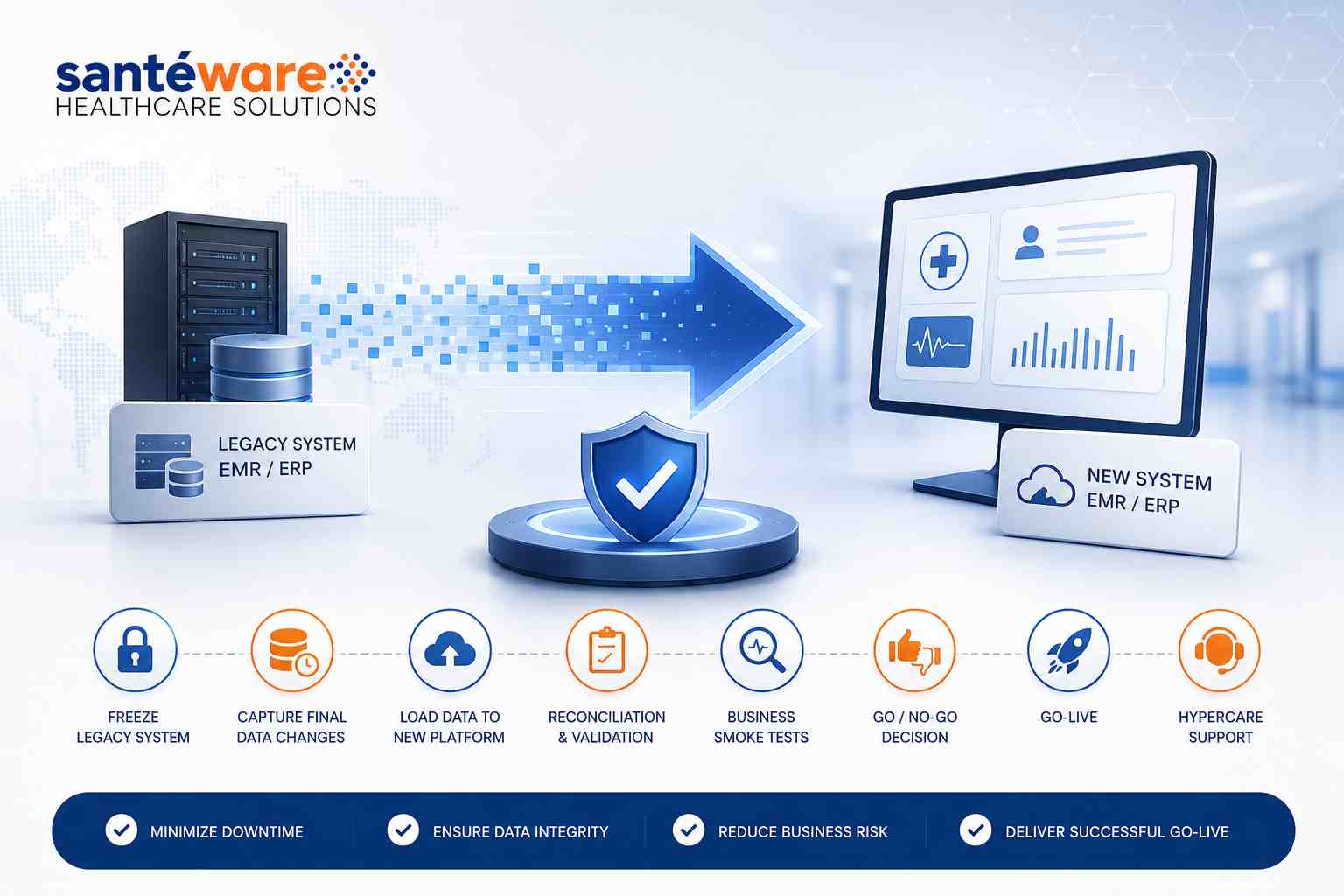
A cutover is the carefully planned period during which the legacy system is frozen, the final data is migrated, validated, and the new system officially becomes the system of record.
Think of it as changing the engines of an aircraft while preparing it for takeoff. Everything before the cutover is preparation. Everything during the cutover is executed with precision because there’s very little room for error.
A typical cutover steps includes:
🧊 Freezing transactions in the legacy system
📥 Capturing the final data changes
🚀 Loading production data into the new platform
✅ Performing reconciliation and validation
🧪 Executing business smoke tests
🚦 Making the Go/No-Go decision
🔓 Opening the new system for users
🤝 Hypercare support immediately after go-live
For hospitals, this could mean ensuring clinicians have uninterrupted access to patient histories and clinical documentation. For ERP systems, it means ensuring finance, procurement, payroll, and supply chain operations continue without interruption.
Why Is Cutover the Highest-Risk Phase?
During the cutover window:
⏸️ Business transactions are temporarily paused
🚫 Users cannot work in either system
⏱️ Every minute of downtime impacts operations
⚠️ Any mistake can delay go-live and significantly increase costs
Unlike earlier migration activities, there are very few opportunities to “fix it later.”
That’s why successful organizations spend months planning a cutover that may last only a few hours or a weekend.
The Two Things That Separate Successful Cutovers from Failed Ones
1. Mock Cutovers (Dress Rehearsals)
The biggest mistake organizations make is treating the first production cutover as the first real test. Instead, perform one or more Mock Cutovers using production-scale data.
Think of it as a full dress rehearsal before opening night. By the final rehearsal, every stakeholder should know exactly what happens minute by minute.
2. Reconciliation Gates
Data migration should never rely on optimism. It should rely on evidence.
Every major milestone should include predefined reconciliation checkpoints before proceeding. Eg:
For EMR Projects:
👥 Patient counts match
🔄 Encounter counts reconcile
📄 Clinical documents migrated successfully
💊 Allergies, medications, diagnoses and observations reconcile
🧪 Laboratory and radiology records validate
📎 Document attachments are accessible
✅ User acceptance testing passes
For ERP Projects:
📒 General Ledger balances reconcile
💳 Accounts Payable and Receivable match
📦 Inventory balances reconcile
🏢 Fixed Assets validate
💰 Payroll totals match
🛒 Purchase Orders migrate successfully
📊 Financial reports balance to the source system
Only when reconciliation passes should the project move to the next stage.
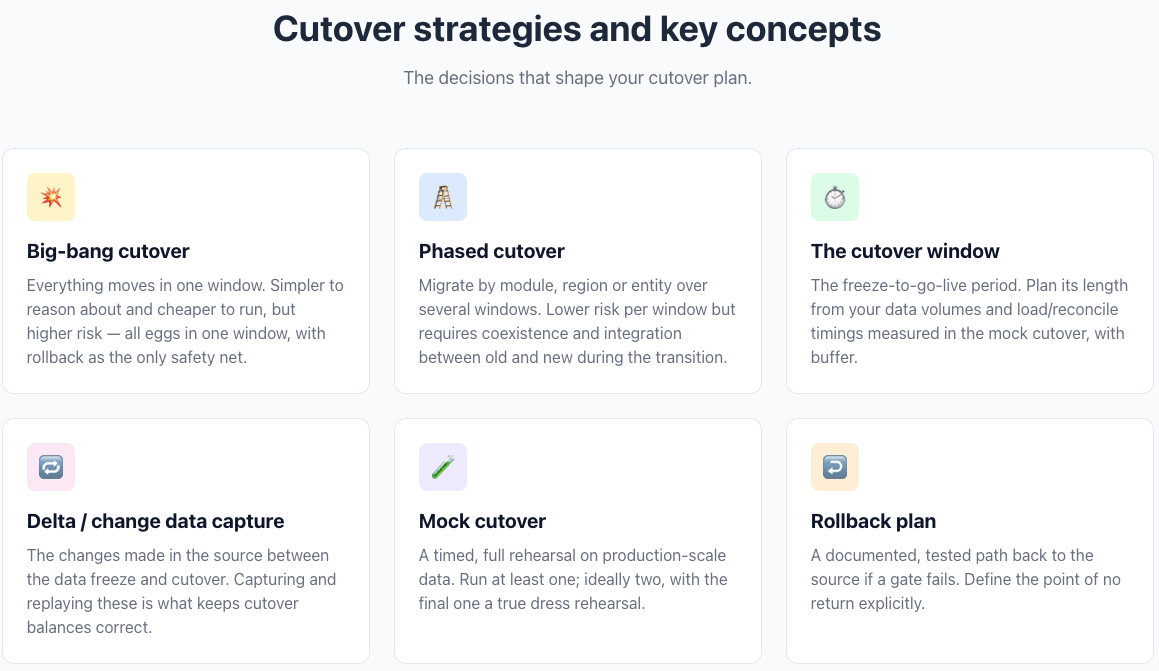
Common Cutover Strategy?
How Santeware Helps
At Santeware Healthcare , data migration is more than moving records from one system to another. We help organizations reduce migration risk by combining deep technical expertise with disciplined execution.
Our capabilities include:
📤 Enterprise data extraction from legacy EMR and ERP systems
🗄️ Legacy data archival and decommissioning
🔄 EMR and ERP data migration
📅 Cutover planning and execution
🎭 Mock cutovers and dress rehearsals
✅ Automated reconciliation and validation
🔁 Delta migration and Change Data Capture (CDC)
↩️ Rollback strategy design
🤝 Hypercare and post-go-live support
📊 Data warehouse and analytics enablement
We have experience working with complex healthcare ecosystems, including major EMR platforms, as well as enterprise ERP migrations involving Oracle, SAP, Microsoft Dynamics, and other business-critical applications.
Whether you’re modernizing a hospital information system, consolidating multiple legacy applications, or transitioning from Oracle EBS to Oracle Fusion Cloud, our structured approach helps minimize downtime, preserve data integrity, and ensure business continuity.
Plan Your Next Migration with Confidence
Whether you’re planning an EMR modernization, hospital system consolidation, or an ERP transformation, a well-designed cutover strategy can make the difference between a seamless transition and a costly disruption.
At Santeware Healthcare , we specialize in enterprise data extraction, migration, archival, reconciliation, and analytics for complex healthcare and business environments. From strategy and mock cutovers to production go-live and hypercare, we help organizations execute migrations with confidence and minimal business disruption.
Ready to plan a low-risk migration?
Get in touch with www.santeware.com or teams@santeware.com to learn more.Let’s build a migration strategy that protects your data, minimizes downtime, and delivers a successful go-live—right the first time.
📩 Contact us today to schedule a consultation and discover how we can help digitize and connect your healthcare ecosystem.