














🚀 Choosing the Right AI Model in 2026
AI has moved well past the “let’s experiment” phase in healthcare. From revenue cycle management to clinical documentation, health systems are now making real buying decisions around Large Language Models (LLMs) and the stakes are high.
🩺 Why Healthcare AI Is a Different Beast
Healthcare generates a staggering amount of unstructured data every day — physician notes, insurance communications, prior authorization forms, lab reports, and EHR records. Manually processing all of that is slow and expensive.
Key Requirements
✔ HIPAA compliance
✔ PHI handling
✔ Auditability
✔ Clinical safety
✔ Human oversight
These aren’t optional : they’re the baseline.
🤖 The Four Big Players (And Where Each Shines)
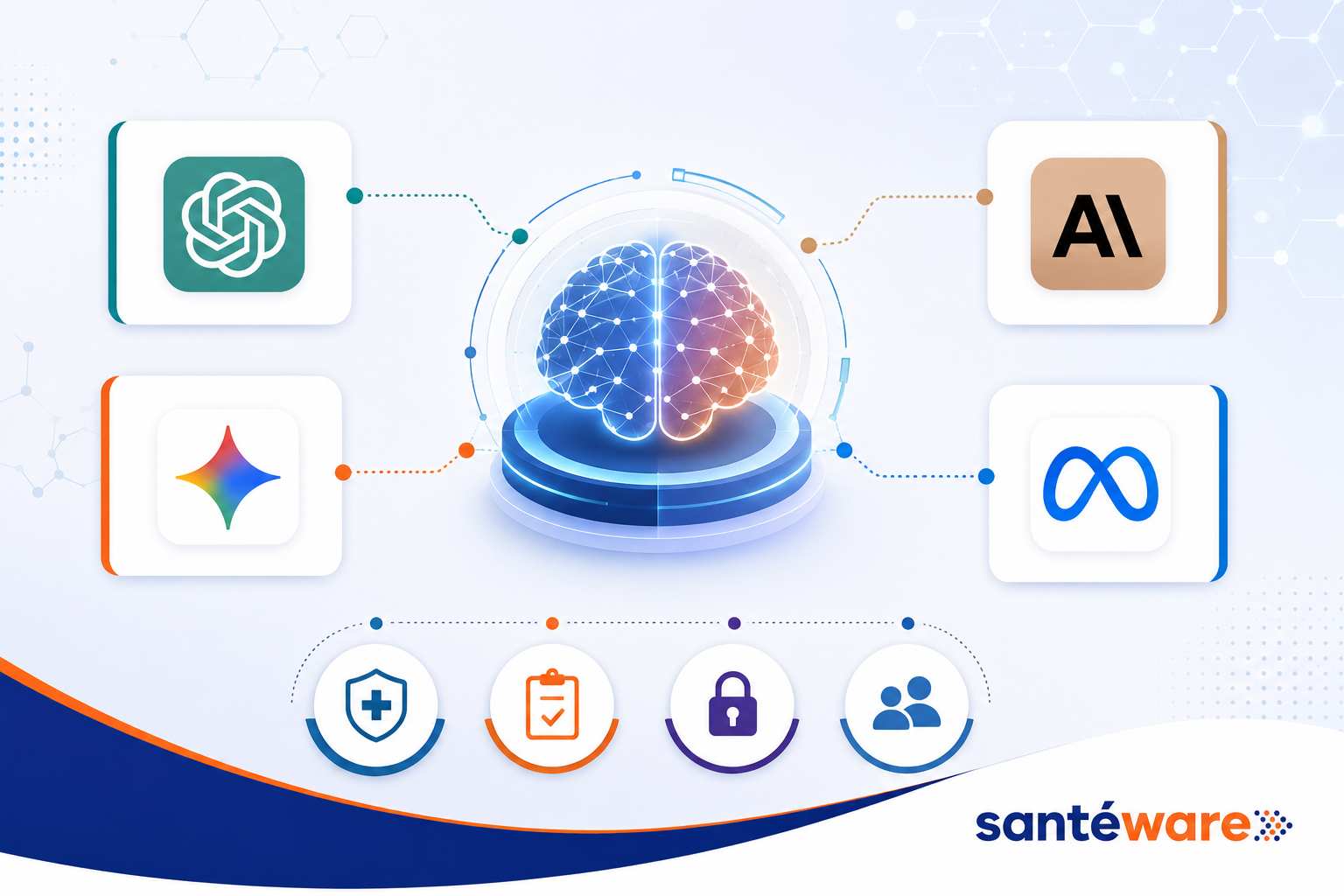
ChatGPT (OpenAI) – Best for Automation & Workflow Tooling
ChatGPT remains one of the most widely used LLMs in healthcare operations, largely because of its mature API ecosystem and developer tooling. It’s a go-to for clinical documentation (SOAP notes, discharge summaries), revenue cycle management and denial analysis, and patient engagement chatbots and intake automation.
⚠️ Watch out for: Vendor dependency and API pricing variability. Strong governance guardrails are non-negotiable.
Gemini (Google) – Best for Multimodal Healthcare Workflows
Healthcare data rarely arrives clean and structured. Scanned intake forms, radiology documents, handwritten records — Gemini handles the messy, mixed-format reality of healthcare data better than most. It’s particularly strong for medical research summarization and literature reviews where image plus text processing matters.
⚠️ Watch out for: Output consistency can vary across Gemini’s fast-evolving releases. Validate rigorously before production deployment.
Claude (Anthropic) – Best for Long-Document Reasoning & Compliance
If your team spends hours navigating lengthy payer policies, audit documentation, or medical necessity guidelines, Claude is worth a serious look. Its large context window means it can maintain coherence across thousands of words without losing the thread. Common use cases include compliance review, long EHR summarization, and policy interpretation workflows.
⚠️ Watch out for: It’s strongest in document-heavy, analytical workflows. Pair it with solid human review processes.
Llama (Meta) – Best for Private, On-Premise Deployments
For hospitals, insurers, or government healthcare programs that can’t send PHI to a third-party cloud, Llama’s open-weight architecture is a genuine differentiator. You control the infrastructure, you control the fine-tuning. The trade-off is complexity — you’ll need AI engineering expertise, GPU infrastructure, and ongoing model governance.
⚠️ Watch out for: This isn’t a plug-and-play solution. Operational maturity matters here.
Other Healthcare AI Models Worth Knowing
The big four get most of the attention, but they’re not the whole picture.
🔬 Med-PaLM was one of the first LLMs built specifically for medical reasoning and QA. Its real-world production adoption is still limited, but its academic influence on how we think about healthcare-specific AI has been significant.
🧬 ClinicalBERT & BioGPT are purpose-built biomedical models that quietly power a lot of medical NLP work behind the scenes — entity extraction, literature analysis, and focused healthcare pipelines where a general-purpose LLM would be overkill.
🩺 Hippocratic AI is carving out a niche in patient-facing, safety-first conversational AI. It reflects a broader shift toward domain-specific healthcare models rather than general AI adapted for healthcare.
⚡ Mistral & DeepSeek are gaining traction for cost-efficient inference and lightweight deployments. Several healthcare startups use them internally for experimentation and to reduce infrastructure costs – not as primary clinical tools, but as practical engineering workhorses.
⚠️ The Hallucination Problem (And Why It Matters More in Healthcare)
Every LLM can hallucinate — generating inaccurate summaries, fabricated citations, or misleading information. In most industries, that’s an inconvenience. In healthcare, it’s a liability.
The most responsible healthcare AI deployments treat LLMs as workflow assistants, not autonomous clinicians. That means:
✔️ Human-in-the-loop review
✔️ Confidence scoring and audit logging
✔️ Layered validation systems
✔️ Clear workflow restrictions
📊 Quick Comparison
| Model | Best For | Key Advantage | Main Consideration |
|---|---|---|---|
| 🤖 ChatGPT | Automation, copilots, documentation | Mature ecosystem | Governance & vendor dependency |
| 🖼️ Gemini | Multimodal workflows | Image + text handling | Validation consistency |
| 📄 Claude | Compliance & long-doc analysis | Large context reasoning | Workflow specialization |
| 🔒 Llama | Private infrastructure | Full infrastructure control | Engineering complexity |
| 🔬 Med-PaLM | Medical reasoning research | Healthcare specialization | Limited enterprise deployment |
| ⚡ Mistral/DeepSeek | Lightweight enterprise AI | Cost efficiency | Enterprise maturity |
The Trend Worth Watching: Multi-Model Architectures
More healthcare organizations are moving away from single-model strategies. Instead, they’re combining models — one for summarization, another for policy analysis, another for private document processing. It’s more flexible, more resilient, and easier to govern.
🎯 Bottom Line
There’s no single ‘best’ AI model for healthcare. The right choice depends on your workflows, your compliance environment, your infrastructure, and your team’s capacity to manage AI responsibly.
The organizations making the most progress with healthcare AI aren’t chasing the newest model. They’re implementing AI inside real operational workflows with oversight, measurable outcomes, and a long-term governance strategy.
🏥 At Santeware, healthcare AI initiatives are approached with a focus on operational integration, interoperability, governance, workflow optimization, and scalable implementation strategies designed specifically for healthcare environments.
Get in touch with www.santeware.com or teams@santeware.com to learn more.