












Why healthcare data models matter
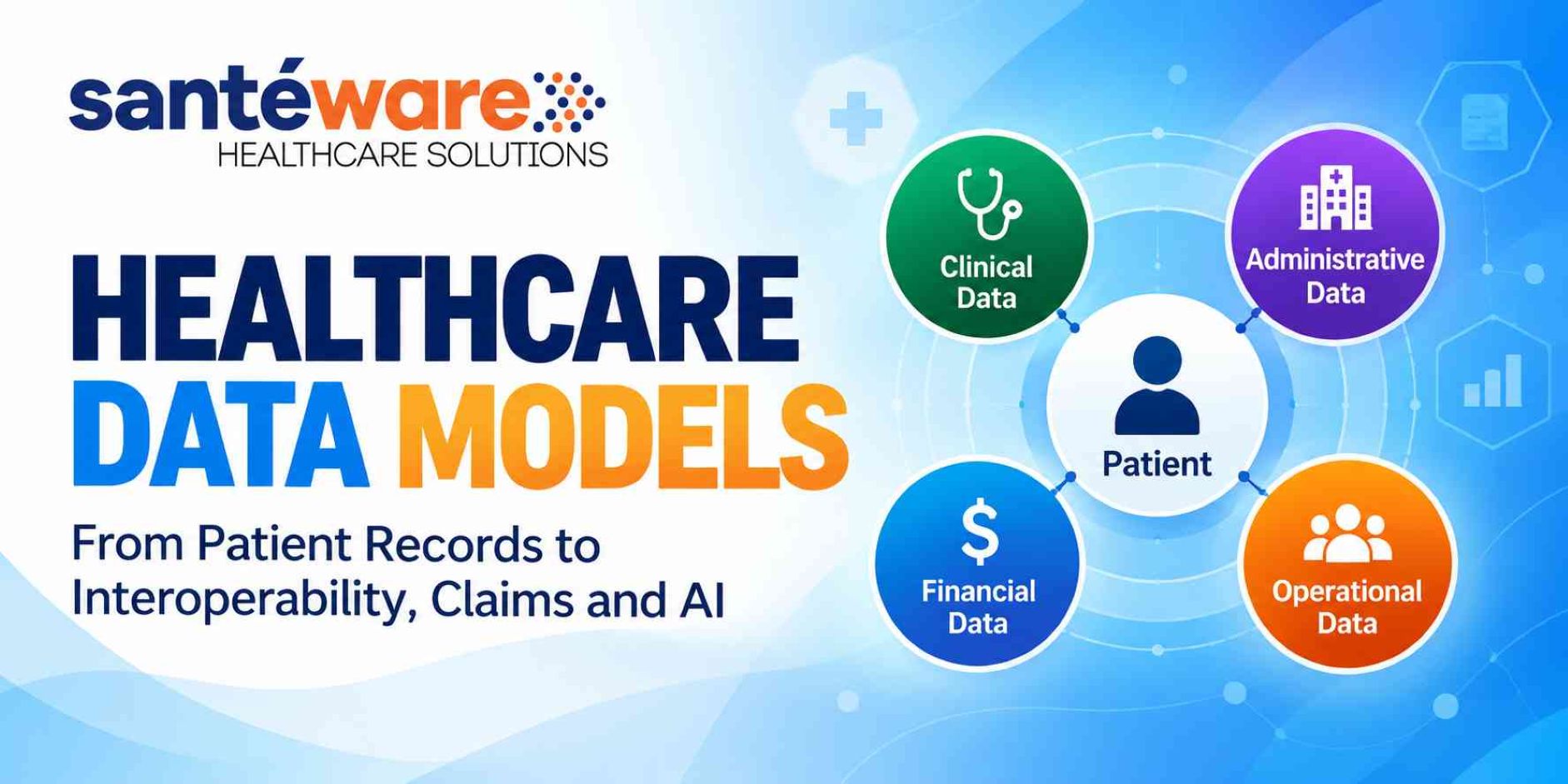
Healthcare information is created across electronic health records, laboratories, imaging systems, pharmacies, billing platforms, insurers and research databases. Each system may structure and describe information differently. Healthcare data models help organize that information so it can be stored, exchanged, compared and used consistently.
A data model defines how information is represented and how its parts relate to one another. Standards and exchange formats help systems communicate, while terminology systems provide shared meanings for diagnoses, laboratory tests, medicines and procedures.
No single standard covers every healthcare need. Clinical data exchange, research analytics, medical imaging and financial transactions have different requirements. Organizations often combine several models and standards in one data environment.
Common healthcare data models and standards
The following models and standards serve different purposes. Some are designed for exchanging messages or resources, some provide common structures for research, and others focus on administrative data or medical imaging.
| Model or standard | Type | Purpose and use case |
|---|---|---|
| HL7 FHIR | Resource-based exchange standard | Clinical and administrative interoperability using resources and APIs. |
| HL7 v2 | Message standard | Event-driven messaging between healthcare systems, such as admissions, orders and results. |
| openEHR | Clinical information architecture | Representing detailed, longitudinal clinical records using reusable clinical models. |
| OMOP CDM | Research data model | Standardizing observational healthcare data for research and analytics. |
| PCORnet CDM | Research data model | Supporting distributed, patient-centred clinical research. |
| i2b2 | Research data platform/model | Clinical data warehousing, querying and cohort discovery. |
| USCDI | Data element set | Defining standardized categories of health data for US health information exchange. |
| X12 EDI | Transaction standards | Administrative and financial transactions, including eligibility, claims and remittance. |
| DICOM | Imaging standard | Medical imaging information and related metadata, including image exchange and storage. |
Healthcare enterprise data architecture
A typical healthcare data architecture connects source systems to an integration layer and then routes standardized information to the operational, analytics, research and reporting environments that need it. The flow below illustrates the main components and how they fit together.
How information moves through the architecture
- Capture: source systems create clinical, operational, imaging or financial information.
- Exchange: systems send data using suitable interfaces, messages, APIs or transaction formats.
- Validate and transform: the integration layer checks data quality and maps fields, formats and codes.
- Store and organize: information is routed to operational stores, data warehouses, research environments or reporting platforms.
- Use: authorized users and applications use the resulting information for care delivery, operations, analytics or research.
Core healthcare data model: key entities
A healthcare data model represents people, care events, clinical findings, treatments and financial transactions as related entities. The exact structure varies by system and standard, but the following entities are common examples.
| Entity | Example attributes | Typical relationships |
|---|---|---|
| Patient | Patient identifier, name, date of birth, gender and contact details. | Linked to encounters, conditions, observations, coverage and claims. |
| Encounter | Encounter identifier, type, date, facility and provider. | Associated with a patient, provider, organization and clinical activities. |
| Condition | Condition identifier, code, onset and status. | Associated with a patient and potentially an encounter; may use ICD or SNOMED CT codes. |
| Observation | Code, result value, unit, date and status. | Associated with a patient and sometimes an encounter; may use LOINC codes. |
| Medication Request | Medication, dose, frequency, status and authored date. | Links the patient and prescribing practitioner to a medication request. |
| Procedure | Procedure code, date, status and performer. | Associated with a patient, encounter and responsible practitioner. |
| Claim | Claim identifier, type, total and status. | Connects a patient, coverage, provider and billed services. |
| Claim Diagnosis | Diagnosis code and sequence. | Links a claim to diagnoses used in the claim context. |
| Coverage | Payer, plan, policy number and coverage period. | Identifies insurance coverage associated with a beneficiary. |
| Payment | Payment identifier, amount, date and status. | May relate to claims, remittance records or other financial transactions. |
These relationships make it possible to connect clinical activity with the patient and care setting, and to connect administrative activity with coverage, claims and payments. Actual entity names and relationships depend on the selected data model and implementation.
FHIR data model: resource-based healthcare information
Fast Healthcare Interoperability Resources (FHIR) is an HL7 standard for representing and exchanging healthcare information. It organizes data into modular resources that can be used through defined interfaces, commonly RESTful APIs.
Each resource represents a particular type of information. Resources can be referenced and combined to support broader clinical and administrative workflows. FHIR implementations also define how resources are profiled, validated, secured and exchanged.
Demographic and administrative details used to identify a person receiving care.
Information about a visit, admission or other interaction with a healthcare provider.
Clinical conditions, problems and diagnoses, including their status and relevant timing.
Measurements and findings such as vital signs, laboratory results and other clinical observations.
A request or order for medication, including instructions and prescribing details.
Information about a clinical procedure, including its status, timing and performer.
Insurance or other coverage details relevant to a patient or beneficiary.
Information submitted for adjudication of healthcare services or financial benefits.
Information about claim processing and the benefits determined by a payer.
Why resource-based design matters
A modular approach allows applications to exchange the resources relevant to a particular workflow instead of requiring every system to use one identical internal database. For example, an application might retrieve Patient, Encounter and Observation resources to support a clinical view.
FHIR does not automatically guarantee that two systems interpret every field in the same way. Implementations still need appropriate profiles, terminology bindings, identity matching, authorization and data quality checks.
ICD, SNOMED CT, LOINC, RxNorm and other terminologies
Consistent data structures are only part of interoperability. Terminologies and code systems help describe clinical concepts consistently, so that information recorded in one system can be interpreted by another.
| Terminology or code set | Purpose and examples |
|---|---|
| ICD-10-CM | Diagnosis classification used in the United States, including codes for specific diseases and conditions. |
| ICD-11 | WHO’s international disease classification for recording and reporting health conditions. |
| SNOMED CT | Detailed clinical terminology for concepts such as conditions, findings, procedures and other clinical information. |
| LOINC | Identifying laboratory tests, measurements, observations and related clinical information. |
| RxNorm | Standardized names for clinical drugs, supporting medication information exchange in the United States. |
| CPT / HCPCS | Procedure, service and supply coding used in relevant healthcare billing workflows in the United States. |
| CDT | Code set for dental procedures and services. |
| NDC | National Drug Code identifiers used for drug products in the United States. |
How terminology mapping works
Different systems may use different codes or descriptions for related concepts. Terminology mapping identifies the relationship between those representations and applies the mapping rules appropriate to the use case. Depending on the concept, a mapping may be exact, broader, narrower or require review.
Terminology services can support code validation, search, translation and value-set expansion. Mappings should be governed and reviewed, especially when codes influence clinical decisions, reporting, reimbursement or research results.
Use cases across healthcare
Well-designed data models support multiple parts of the healthcare ecosystem. The value comes from making information understandable and usable for the specific workflow, while maintaining appropriate quality, privacy and governance.
Clinical care
Connect patient records, encounters, diagnoses, laboratory findings and medication information to support care coordination.
Revenue cycle management
Organize charges, claims, coverage, remittance and payment information to support billing and financial workflows.
Population health
Combine appropriately standardized data to study populations, monitor measures and support risk stratification.
Research and AI
Prepare consistent datasets for observational studies, cohort discovery, analytics and carefully governed AI applications.
Interoperability
Exchange relevant information across EHRs, laboratories, pharmacies, hospitals, payers and other connected systems.
Reporting and operations
Create consistent reporting structures for operational monitoring, service planning and organizational decision-making.
Choosing the right healthcare data model
Start with the intended use, the systems involved and the information that must be exchanged or analyzed. Consider whether the priority is operational interoperability, longitudinal clinical records, research standardization, imaging or administrative transactions.
| Requirement | Potential fit | What to consider |
|---|---|---|
| API-based clinical data exchange | HL7 FHIR | Profiles, implementation guides, terminology bindings, authorization and API compatibility. |
| Established event-driven messaging | HL7 v2 | Message types, interface agreements, acknowledgements and local implementation rules. |
| Longitudinal clinical records | openEHR or suitable clinical models | Clinical archetypes, templates, governance and system integration. |
| Observational research and analytics | OMOP CDM | Source-to-standard mappings, terminology conventions and research requirements. |
| Patient-centred research networks | PCORnet CDM | Network specifications, data quality and participating organizations’ requirements. |
| Medical imaging | DICOM | Imaging modalities, metadata, storage and exchange workflows. |
| Claims and administrative transactions | X12 EDI | Applicable transaction types, jurisdictional requirements and payer rules. |
Many organizations use multiple standards together. For example, clinical systems may exchange information through FHIR or HL7 v2, imaging systems may use DICOM, claims workflows may use X12, and a research environment may transform selected data into OMOP CDM.
The important task is to define how the standards work together: how data is identified, validated, mapped, secured, stored and made available for the intended purpose.
Key takeaways
What to remember
- Healthcare data models provide structures for representing clinical, administrative and financial information.
- FHIR, HL7 v2, X12 and DICOM support different exchange and workflow requirements.
- OMOP CDM and PCORnet CDM support research-oriented data standardization.
- Terminologies such as ICD, SNOMED CT, LOINC and RxNorm help standardize meaning.
- Integration architecture needs validation, mapping, security and audit controls—not connectivity alone.
- The right approach depends on the use case, data sources, jurisdiction and implementation requirements.
The goal is not to force every healthcare system into one model. It is to make the right information available in a consistent, secure and meaningful form for care delivery, operations, analytics and research.
Building a connected healthcare data environment?
Healthcare interoperability and data modernization require the right mix of data models, integration standards, terminology management and architecture. Define the workflows and outcomes first, then select the standards and implementation approach that fit those requirements.
Learn more at Santeware or email teams@santeware.com.
Contact Santeware to discuss your healthcare data and interoperability requirements.