












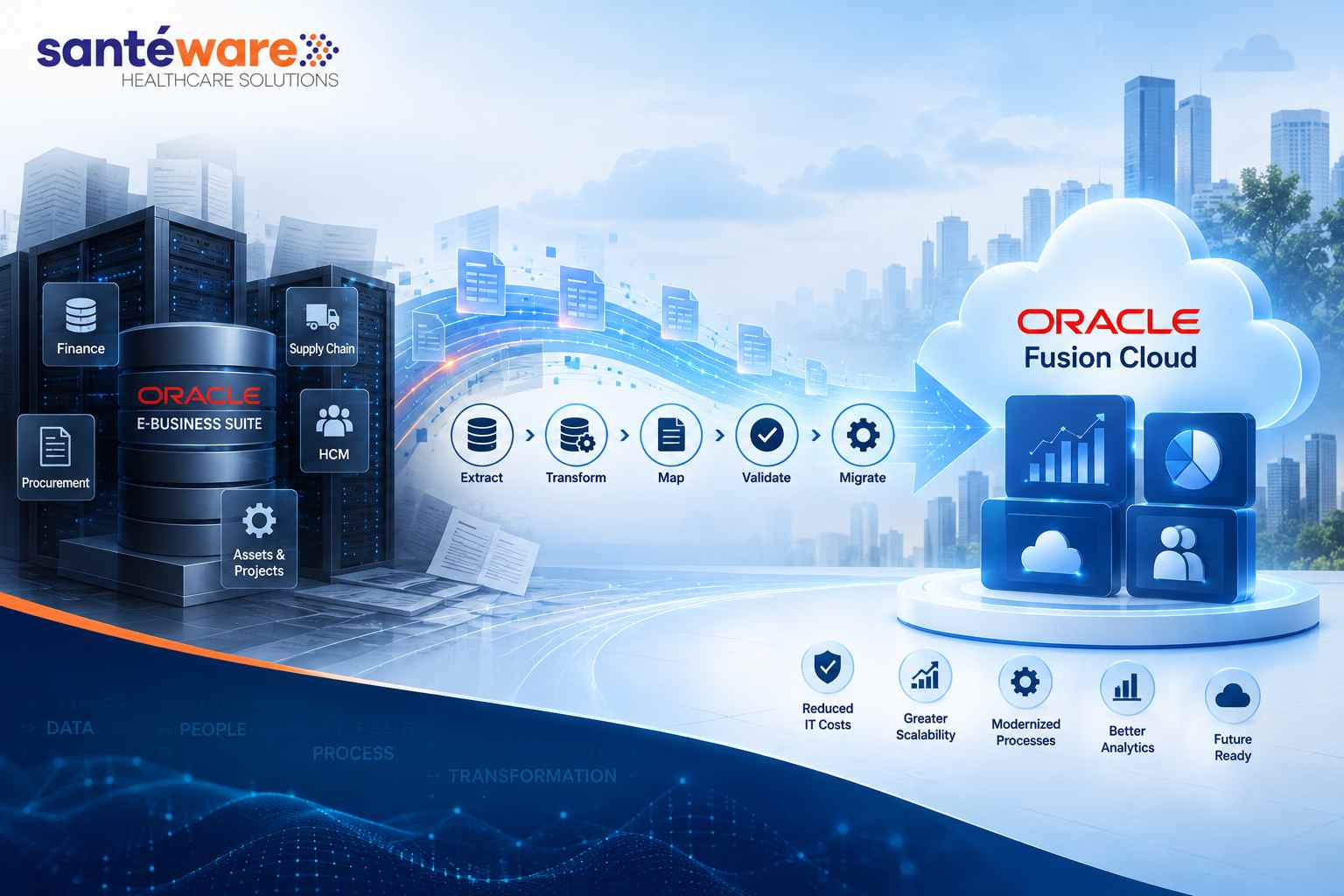
From EBS Finance, SCM & HCM extraction to Fusion-ready migration, reconciliation and legacy data archival.
Moving from Oracle E-Business Suite (EBS) to Oracle Fusion Cloud ERP/HCM is not simply a technical upgrade. It is a business transformation involving functional redesign, data conversion, integrations, reporting, security, testing, and organizational change.
For many enterprises, however, data migration remains one of the highest-risk components of the transformation.
Years of financial, supply chain, procurement, asset, project, and workforce data reside across highly customized EBS environments. 40,000+ tables, PL/SQL programs, concurrent programs, interfaces, reports, and legacy business rules can make the transition significantly more complex than simply moving records from one database to another.
Santeware Healthcare specializes in the data side of this transformation.
We help organizations assess, extract, transform, map, validate, migrate, and archive complex Oracle EBS data while preparing it for Oracle Fusion and modern enterprise analytics.
🚀 Start With a Cloud-Readiness and Data Strategy
Organizations typically move from EBS to Fusion because they want to reduce infrastructure and IT costs, eliminate technical debt, gain cloud scalability, improve analytics, simplify upgrades, and modernize business processes. Also, EBS is getting retired by Oracle by 2032 too.
But before migration begins, organizations need to answer a fundamental question:
What data actually needs to move to Fusion?
Not every historical EBS record should necessarily be migrated into the new environment.
Santeware helps organizations assess their EBS landscape, identify critical data and dependencies, determine retention requirements, and establish a migration strategy covering active data, historical data, archival, and reporting requirements.
🧠 Understand the EBS Data Across Finance and SCM
A successful migration requires understanding the business processes behind the data—not simply the underlying tables.
For Finance and Supply Chain Management, important EBS data domains can include:
Finance
📊 Record to Report (R2R)
📘 General Ledger (GL)
💳 Accounts Payable (AP)
💰 Accounts Receivable (AR)
🏢 Fixed Assets (FA)
💵 Cash Management (CM)
📁 Projects and Project Costs
Procurement & SCM
📦 Procure to Pay (P2P)
🏢 Suppliers
📍 Supplier Sites
🏦 Supplier Bank Accounts
🛒 Purchase Orders
📋 Purchase Order Lines and distributions
📥 Receipts and related transactional data
📦 Items and inventory-related master data
🔗 Other relevant SCM transactional and master data
Each domain has its own relationships, business rules, dependencies, and target Fusion objects.
For example, migrating a supplier is not simply moving a supplier record. The migration may need to account for supplier sites, addresses, contacts, payment information, bank accounts, procurement relationships, and related transactions.
The quality of this source-to-target understanding directly affects the success of the Fusion implementation.
🗄️ Functional Design Comes Before Technical Conversion
One of the most important lessons from complex EBS migrations is that functional requirements must drive technical conversion.
Oracle EBS projects commonly use structured design documents such as:
Functional Design Document (FDD) – CV040
The FDD defines what needs to be converted and why.
It typically establishes:
📦 Data objects and scope
📐 Business conversion rules
🗄️ Historical data requirements
📖 Source and target business definitions
🔄 Transformation requirements
⚙️ Functional assumptions
⚠️ Exception scenarios
The document is generally owned by functional consultants and requires business stakeholder sign-off.Technical Design Document (TDD) – CV060
The TDD defines how the conversion will technically be implemented based on the approved FDD.
It can include:
🗃️ Staging table design
📄 SQL DDL scripts
🔗 Technical mapping
📤 Extraction logic
🔄 Transformation functions
✅ Validation rules
⚙️ Custom programs
📁 File-generation logic
🏗️ Processing architecture
This separation is critical.
The FDD defines the business rules. The TDD turns those rules into an executable migration architecture.
Santeware’s data engineering approach aligns functional requirements with technical extraction and transformation frameworks, creating traceability from business requirement to migrated record.
☁️ There Is No Single Way to Load Data Into Fusion
Another common misconception is that EBS-to-Fusion migration means extracting data and loading it through one particular interface.
In reality, Oracle Fusion provides multiple mechanisms for importing legacy data, depending on the module, object, data volume, and migration requirement.
These can include approaches such as:
📁 File-Based Data Import (FBDI)
🔗 REST/SOAP APIs
📊 ADFdi
⚙️ Application-specific import programs
🔄 Other Oracle-supported data conversion mechanisms1
For high-volume Finance and SCM conversions, FBDI is one of the most commonly used approaches.
For HCM, HCM Data Loader (HDL) is a key mechanism for bulk data loading.
The correct approach therefore depends on the target Fusion object and migration scenario—not on a one-size-fits-all methodology.
Santeware designs the extraction and transformation pipeline around the target Fusion loading mechanism.
🗄️ High-Volume EBS Data Extraction
Large EBS environments can contain millions of records. Row-by-row extraction and processing can create unnecessary database overhead and significantly increase migration timelines.
Santeware leverages Oracle PL/SQL bulk processing techniques, including BULK COLLECT and FORALL, to efficiently process high-volume datasets.
BULK COLLECT allows SQL results to be fetched into collections in batches, reducing context switching between the SQL and PL/SQL engines.
FORALL can then perform bulk DML operations efficiently.
This approach is particularly useful when extracting large volumes of HCM, Finance, procurement, and SCM data.
A typical migration pipeline can follow:
📤 Extract → 🗃️ Stage → 🔄 Transform → 🗺️ Map → ✅ Validate → 📁 Generate → 📥 Load → 🔍 Reconcile
This creates a repeatable migration factory rather than a spreadsheet-driven conversion exercise.
🔄 EBS-to-Fusion Mapping Is the Core of the Conversion
EBS and Fusion have different architectures and business-object models.
A source EBS record may need to be transformed into one or more Fusion objects, with new mandatory attributes, reference data, identifiers, and business rules.
Santeware develops source-to-target mapping frameworks to establish relationships between EBS tables, custom staging structures, and Fusion objects.
For HCM, this can involve mapping EBS employee and assignment structures into appropriate Fusion HCM objects and generating files compatible with HDL.
For Finance and SCM, the same principle applies to suppliers, supplier sites, bank accounts, invoices, purchase orders, assets, projects, GL data, and other relevant objects.
The step is the key to successfully loading your data into Fusion is in how you extract that data from your old system. FBL requires you to create a series of pipe-delimited files (.dat or .csv) containing all the data you want loaded to Fusion, formatted according to Oracle’s specifications FBL then imports those files and populates the Fusion tables accordingly with the values you included for each field.
You must design a process to carefully populate the files you deem necessary, making sure that each field value is formatted and positioned correctly. If you do that, you will greatly reduce your potential load errors and remove a lot of risk and stress from the data conversion process.
The objective is not simply to move data.
The objective is to make legacy data structurally and functionally compatible with the Fusion operating model.
✅ Data Quality and Reconciliation Are Non-Negotiable
A Fusion import completing successfully does not mean the migration succeeded.
The real test is whether the business can trust the resulting data.
Santeware applies validation and reconciliation throughout the migration lifecycle, including:
🔢 Source-to-target record counts
📋 Mandatory field validation
🔗 Referential integrity
🗂️ Master data validation
💰 Financial reconciliation
🔍 Transaction-level validation
⚠️ Exception reporting
♻️ Duplicate detection
🔄 Transformation validation
✅ Post-load reconciliation
For example, if 500,000 records are extracted from EBS, the migration team should be able to explain how many were transformed, loaded, rejected, excluded, and why.
Every migrated record should have a traceable story.
🗄️ Don’t Keep EBS Alive Just to Access History
A common hidden cost after an ERP migration is continuing to maintain the legacy EBS environment simply because historical data is still required.
Organizations may continue paying for infrastructure, database administration, security, backups, support, and legacy application expertise long after business users have moved to Fusion.
Santeware can help establish a legacy ERP archival strategy that preserves required historical information in a secure, searchable, governed environment.
This allows organizations to separate:
⚙️ Operational data → Fusion
🗄️ Historical/retention data → Modern archive
📊 Analytical data → Enterprise data platform
📊 Turn Historical EBS Data Into an Analytics Asset
The EBS-to-Fusion transformation also creates an opportunity to modernize enterprise data architecture.
Historical EBS data can be combined with Fusion data to provide a longitudinal view of financial, procurement, supply chain, asset, project, and workforce performance.
Santeware can leverage Databricks Lakehouse architecture, Delta Lake, and Unity Catalog to build governed enterprise data platforms that support:
📈 Enterprise reporting
💰 Financial analytics
🛒 Procurement analytics
🚚 Supply chain intelligence
👥 Workforce analytics
📊 Historical trend analysis
🤖 AI and machine learning
🔗 Cross-system data products
This turns ERP migration from a technology replacement exercise into a broader enterprise data modernization initiative.
🚀 Migration Doesn’t End at Go-Live
A successful EBS-to-Fusion program typically moves through several stages:
🔍 Assessment → 📐 FDD → 🛠️ TDD → 📤 Extraction → 🔄 Transformation → 🔁 Conversion → 🧪 Testing → 🚀 Cutover → ✅ Reconciliation → 🗄️ Archival → 📊 Analytics
Testing should validate both technical and functional outcomes through activities such as Conference Room Pilots (CRP), System Integration Testing (SIT), and User Acceptance Testing (UAT).
After go-live, organizations also need to account for Fusion’s ongoing cloud release cycle, integrations, reporting, data governance, and continuous optimization.
⭐ Why Santeware for Oracle EBS to Fusion Data Migration?
Oracle Fusion transformation requires functional consulting, implementation, integration, and change management expertise.
But data conversion is its own specialized discipline.
Santeware combines:
📤 Oracle EBS data extraction
💼 Oracle EBS Finance & SCM expertise
👥 Oracle EBS HCM data expertise
⚙️ PL/SQL engineering
🔄 Source-to-target mapping
📐 FDD/TDD-driven conversion
📦 Bulk data processing
📁 FBDI and HDL preparation
✅ Data validation and reconciliation
🗄️ Legacy ERP archival
🏗️ Enterprise data engineering
🚀 Databricks Lakehouse capabilities
Our approach is straightforward:
Extract the right data. Transform it correctly. Load it through the right Fusion mechanism. Reconcile it completely. Preserve what shouldn’t be lost.
For enterprises preparing to retire Oracle EBS and move to Oracle Fusion Cloud, Santeware can operate as the specialized data migration and legacy data modernization partner, working alongside Oracle Fusion implementation and functional teams.
Planning Your Oracle EBS → Fusion Migration?
Before starting the conversion, understand exactly what data you have, what needs to move, how it maps to Fusion, and what should be archived.
Santeware can assess your EBS environment and help establish a practical, scalable data migration strategy across Finance, SCM, HCM, and historical data.
Your EBS data has decades of business knowledge in it. Don’t let the ERP migration become the process that loses it.
Get in touch with www.santeware.com or teams@santeware.com to learn more.Want Santeware’s help assessing your legacy application portfolio for decommissioning?