
















🔐 Why Dynamic Secrets Matter in Multi-Database Healthcare Architectures
In modern healthcare IT, data sprawl is inevitable. A single digital health platform frequently coordinates transactional patient state in PostgreSQL, complex clinical document graphs in MongoDB, real-time HL7/FHIR event queues in Redis or Kafka, and longitudinal analytics in cloud warehouses.
The Static Credential Vulnerability: When microservices store static usernames and passwords—whether in Kubernetes Secrets, config files, or CI/CD pipelines—those keys remain valid indefinitely until manually rotated. In a HIPAA-regulated environment, that latency between exposure and revocation is an unacceptable liability.
To achieve genuine Zero-Trust security without inflating operational software licensing budgets, modern healthcare engineering teams must transition from static secret vaults to identity-driven dynamic secrets engines.
⚠️1. The Multi-Database Credential Trap in Healthcare Systems
Managing credentials across interconnected microservices and heterogeneous databases exposes engineering teams to three recurring critical failure points:
👥 Shared Service Accounts: To reduce friction, services frequently reuse generic database accounts (e.g., ehr_backend_user). If an unauthorized query occurs, attribution is impossible: was it the billing service, an analytics extractor, or a compromised sidecar?
🔒 The “Secret Zero” Dilemma: Storing database passwords in standard secret key-value stores protects data at rest, but microservices still require persistent credentials to authenticate and decrypt those values.
🔄 Operational Friction of Manual Rotation: Coordinating database user password rotation across dozens of microservices requires scheduled downtime, rolling redeployments, and connection pool draining. Consequently, rotation schedules are often delayed, leaving environments vulnerable.
🔑2. Enter Dynamic Secrets: Ephemeral, Just-in-Time Database Access
Dynamic secrets replace persistent database credentials with short-lived, programmatically generated accounts that self-destruct upon lease expiration.
Instead of storing static credentials:
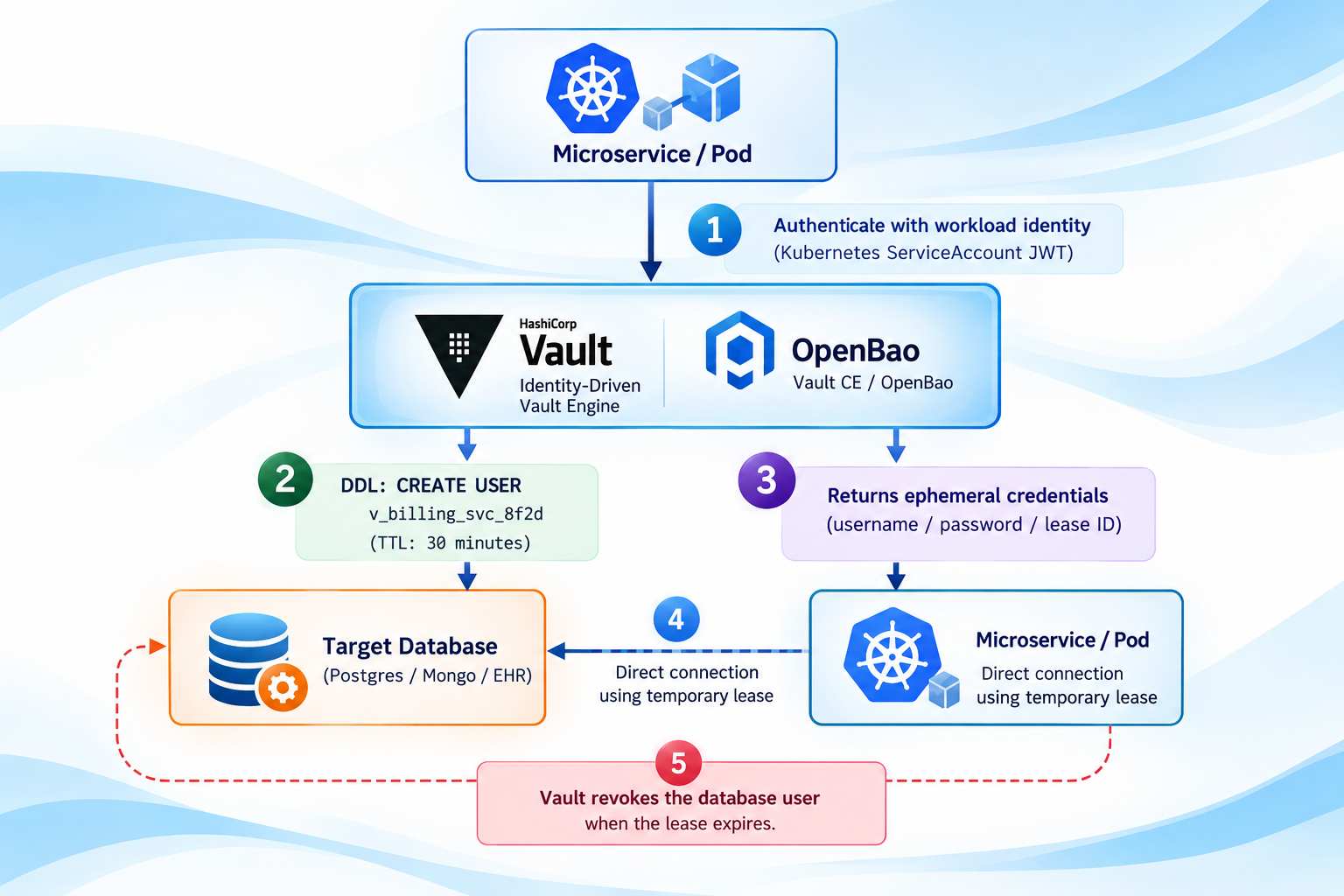
- Workload Authentication: A service presents its cryptographically verifiable identity (e.g., a Kubernetes ServiceAccount token) to the vault.
- Just-in-Time Generation: The vault dynamically executes DDL commands on the target database (PostgreSQL, MongoDB, Oracle, MSSQL), creating a uniquely named user with strictly scoped privileges.
- Automatic Time-To-Live (TTL): The service connects using credentials with a defined TTL (e.g., 30 minutes). When the workload completes or the lease expires, the vault automatically revokes the database user.
Architecture Flow
🛡️3. Eliminating Enterprise Licensing Costs with Open-Source Solutions
Proprietary secrets management solutions from hyperscalers or enterprise SaaS vendors often impose pricing structures based on secret counts, active API tokens, or high annual enterprise tiers.
For engineering teams balancing tight operational budgets with enterprise compliance, battle-tested open-source and community editions—specifically HashiCorp Vault Community Edition (CE) and its community-governed Linux Foundation fork, OpenBao—provide dynamic secrets capabilities at zero software licensing cost.
🗄️ Native Multi-DB Dynamic Engines: Out-of-the-box, turnkey engines for PostgreSQL, MySQL, MSSQL, Oracle, MongoDB, Couchbase, Cassandra, and OpenLDAP.
🔄 Automated Revocation Hierarchies: Lease cancellation and revocation trees across specific workloads during incident response drills.
🔐 Transit Encryption as a Service: Encrypting and decrypting ePHI payloads in-flight without exposing master cryptographic keys to edge application pods.
📋 HIPAA § 164.312(b) Audit Compliance: Structured audit logs tracking every credential issuance, lease renewal, and revocation event. Auditability depends on correct configuration, retention, integrity controls, and operational procedures.
🏥4. How We Implement This at Santeware Healthcare Solutions
At Santeware, we do not view credential security as an optional bolt-on; it is engineered directly into our core product lifecycle and client delivery architectures:
🚫 Zero Static Secrets in Deployment Pipelines: Our microservices and CI/CD pipelines run completely devoid of hardcoded database connection strings or API keys. Workloads authenticate using ephemeral identity tokens mapped directly to least-privilege database roles.
🎯 Granular Blast Radius Containment: Across multi-tenant health systems integrating legacy relational stores and modern FHIR data lakes, credentials are partitioned per service and transaction. A compromised workload instance exposes only an ephemeral identity that expires within minutes.
📊 Tamper-Evident Access Telemetry: Centralizing credential generation via self-hosted vault infrastructure produces audit trails for client compliance reviews, demonstrating which service accessed patient records and under which authorization context.
💰 Optimized Client TCO: By implementing self-hosted high-availability (Raft) vault clustering, Santeware can deliver strong security architectures without passing along heavy third-party vendor licensing fees. Infrastructure, operations, and support costs still apply.
✅Dynamic Identity: The Foundation of Modern HealthTech Security
Relying on static database credentials in systems handling Electronic Protected Health Information (ePHI) is a technical debt healthcare organizations can no longer afford. Dynamic secrets transform static, high-value targets into ephemeral credentials that can be revoked automatically at lease expiry.
Through our implementation of self-hosted vault architectures, Santeware Healthcare Solutions helps client platforms strengthen data protection, maintain developer velocity, and optimize total cost of ownership.
Get in touch to learn more.
Visit www.santeware.com or email teams@santeware.com.
📩 Contact us today to schedule a consultation and discover how we can help digitize and connect your healthcare ecosystem.