














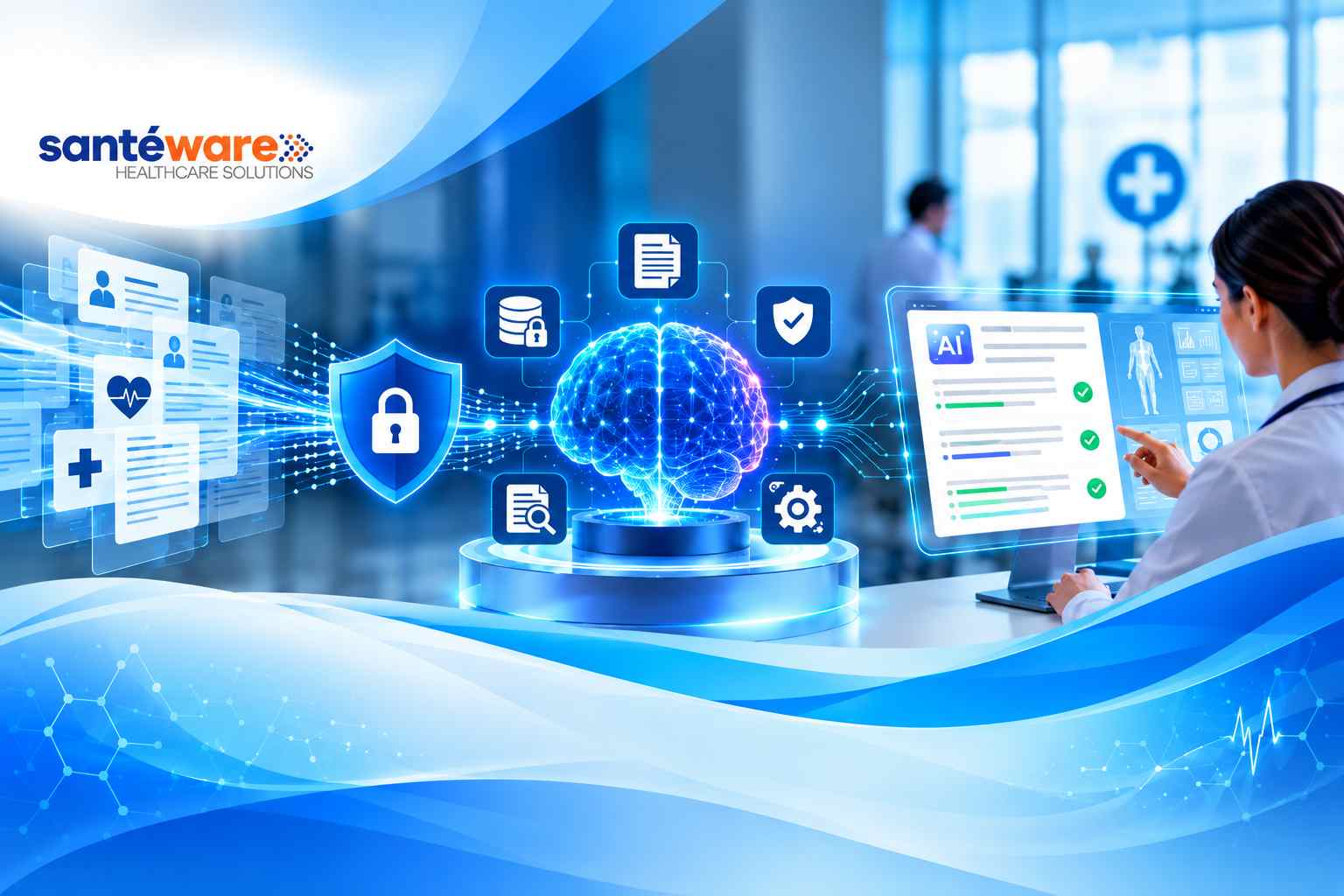
The Core Engineering Challenge: How do we introduce a non-deterministic, probabilistic engine into an industry where a single hallucination or exposed SSN can trigger regulatory sanctions or compromise patient care?
🔐Zero-Trust Ingestion: Real-Time PHI Scrubbing at Line Rate
Sending raw clinical notes directly to any LLM endpoint—public, dedicated, or private cloud—without an inline sanitization layer is an unacceptable compliance risk. Under HIPAA’s Safe Harbor method, 18 distinct identifiers must be scrubbed before data leaves your protected boundary. Relying on an LLM system prompt like “Please remove any patient names” is fundamentally flawed; models fail unpredictably on edge cases such as non-traditional name formats or nested addresses.🛡️ PHI Scrubbing Workflow
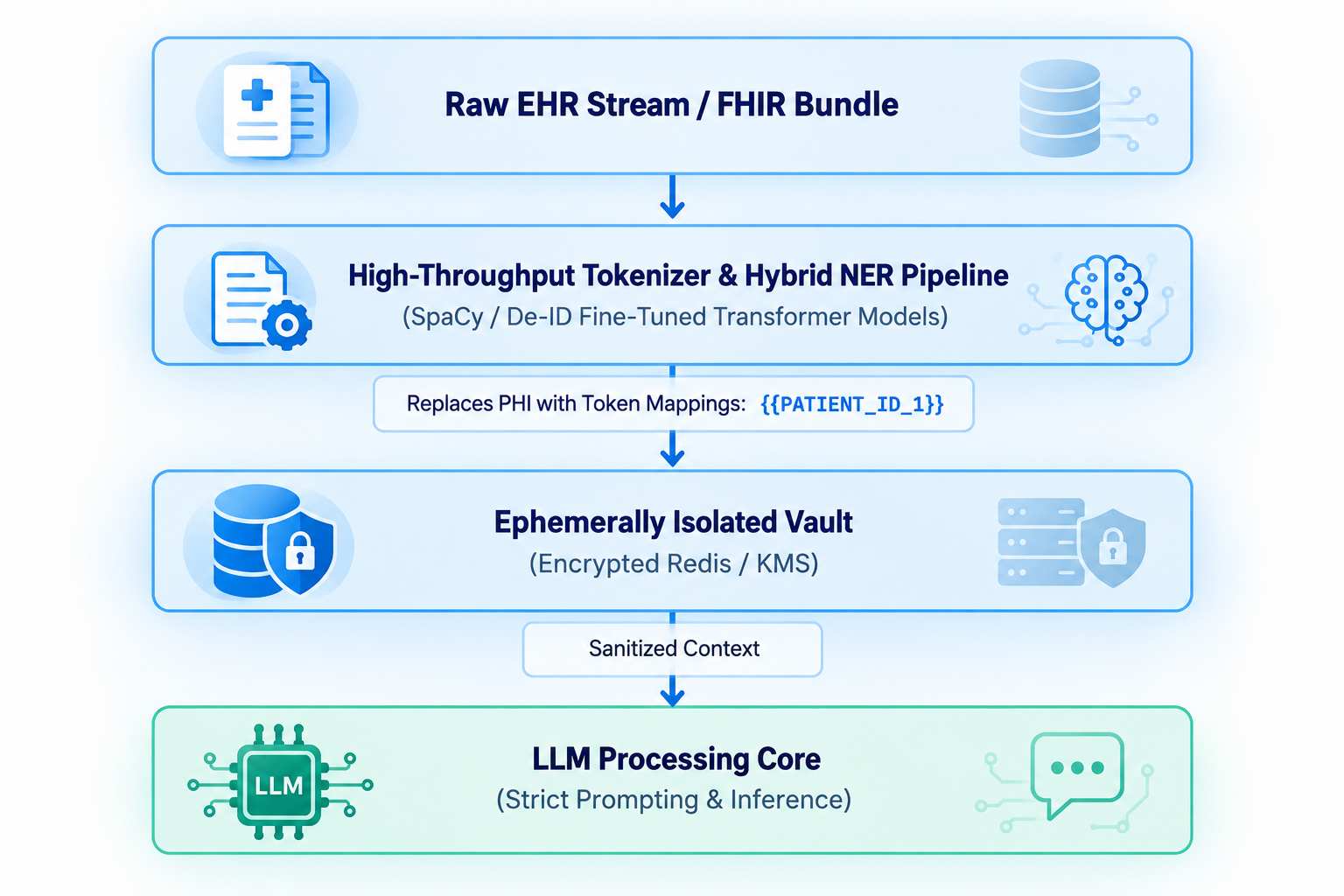
🧩 Architectural Pattern: The Engineering Implementation
🔑 Tokenized Surrogates: Deploy an edge-hosted Named Entity Recognition (NER) pipeline that intercepts and masks names, MRNs, dates, and geographic locations before vectorization or LLM ingestion.
🔐 Deterministic Vaulting: Store actual identities in an isolated, encrypted key-value cache (with strict TTL). Pass only structured tokens ([PATIENT_1], [DATE_A]) into the model.
🔄 Re-Identification Proxy: Once the model returns its structured summary, a reverse proxy safely re-hydrates tokens back into the final EHR payload inside the secure tenant perimeter.
🧠Preventing Hallucinations: Scoped RAG Over Parametric Memory
LLMs inherently optimize for conversational continuity, making them prone to fabricating plausible clinical details when faced with ambiguous documentation. In medical software, “creative completion” is a fatal defect. To enforce deterministic behavior, clinical AI systems must rely on strict Retrieval-Augmented Generation (RAG) anchored directly to verified electronic health records:🔒 Strict Patient Partitioning: Vector databases cannot function as unpartitioned data lakes. Embeddings must be scoped by multi-tenant, cryptographically verified partition keys tied to authenticated patient consent records. A query for Patient A must physically never query vector chunks from Patient B.
📌 Grounding via Citation Spans: Force models to output structured JSON with mandatory source citations. Every assertion made in a clinical note must reference the explicit chunk_id and character offsets from the clinical transcript or FHIR resource.
🚫 Zero Parametric Fallback: If retrieved context does not contain the answer, configure prompt constraints and temperature parameters (T ≤ 0.1) to trigger an explicit fall-through error rather than letting the model speculate.
👩⚕️The Human-in-the-Loop Feedback Loop (Active Verification)
Engineering deterministic guardrails isn’t about replacing clinician judgment—it’s about streamlining workflow safety. Automated outputs should never automatically commit directly to the EHR database.📊 Confidence-Scored UI Components: Color-code generated clinical notes by model confidence score to provide immediate visual cues on where clinician scrutiny is required.
🔎 Interactive Source Tracing: Highlight cited references so physicians or nurses can hover over a generated sentence to view the exact source paragraph in lab reports or clinical notes.
🔁 Structured Telemetry: Log clinician edits as telemetry. When clinicians consistently adjust specific generated medication syntax or terminology, that signal automatically routes back into the engineering validation test suite.
⭐The Santeware Perspective: Safety is Built, Not Prompted
Generative AI holds enormous promise for eliminating administrative burnout and accelerating patient care transitions. However, clinical-grade AI cannot rely on wishful prompt engineering. As engineering teams, our mission is to build the deterministic, HIPAA-compliant scaffold—de-identification proxies, isolated vector stores, semantic validation checks, and real-time audit pipelines—that allows clinicians to harness the power of AI without compromising trust or data security.📩 Contact us today to schedule a consultation and discover how we can help digitize and connect your healthcare ecosystem.