












Introduction
Healthcare organizations across globally are investing heavily in EMR and HIS transformations. New systems promise better workflows, improved patient care, and data-driven decision-making and also implementation of AI tools on top of it.
Yet, many implementations face the same challenge shortly after go-live:
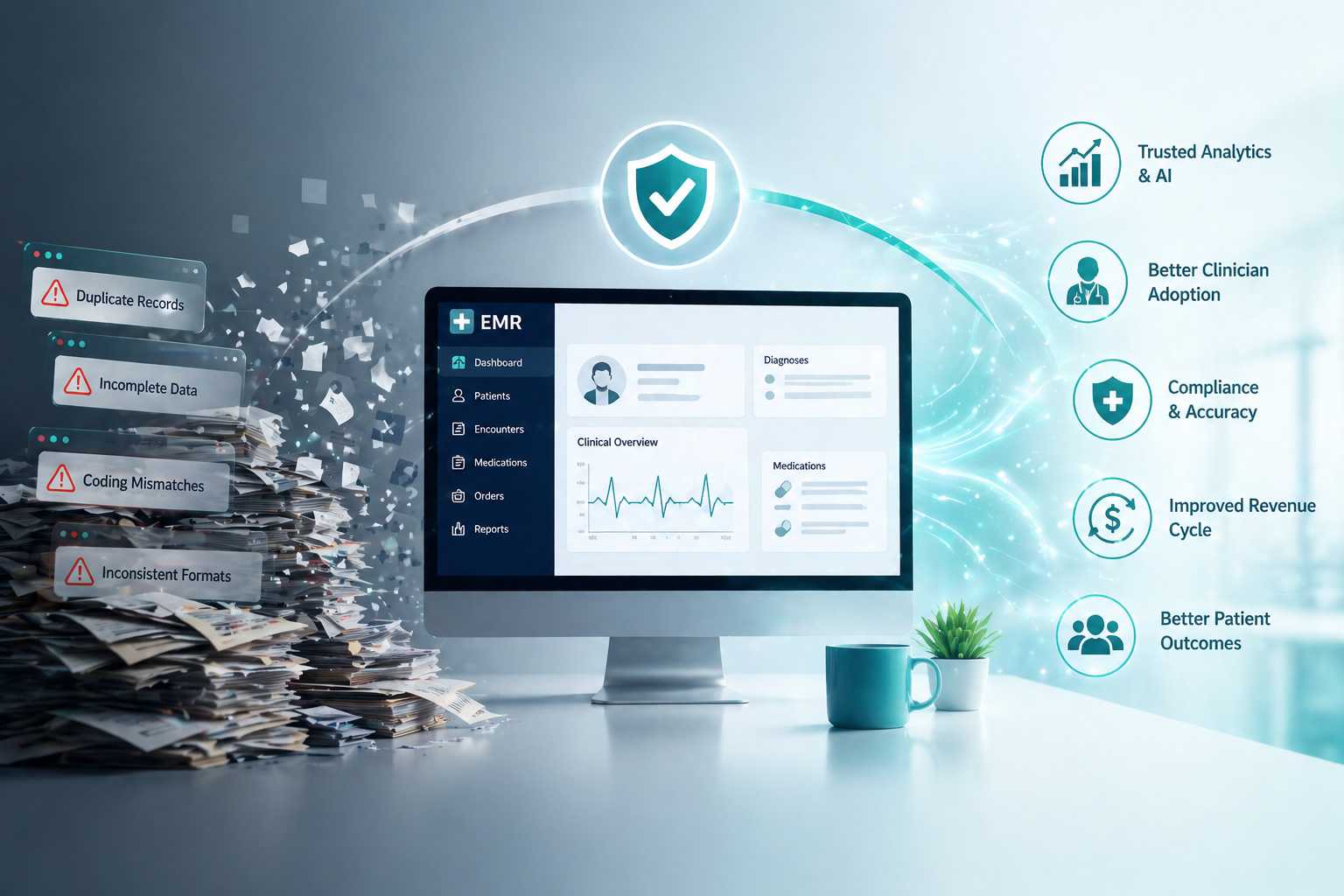
- Partial migration or mapping issues
- Incomplete records or inconsistent patient formats
- Coding mismatches impacting billing (ICD, CPT, SNOMED)
- Poor clinician adoption due to documentation quality
- Data foundation delayed for analytics and reporting
The common assumption is that the system is at fault. In reality, the problem is far more fundamental:
The data going into the system isn’t compliant, ready or accurate.
The Hidden Risk: Data Availability Without Data Validation
During EMR implementations, large volumes of legacy data are migrated from multiple systems—EMR, billing, lab systems, and spreadsheets. This process often focuses on moving data, not validating it.
As a result:
- Errors are carried forward
- Inconsistencies multiply across systems
- Critical gaps go unnoticed until after go-live
By the time issues surface, they are harder and more expensive to fix—impacting both clinical workflows and revenue cycles. Data Cleanup Isn’t Optional — It’s Foundational
Successful digital transformation in healthcare depends on one critical factor: Clean, validated, and standardized data Without it:
- Clinicians lose trust in the system
- Claims get denied due to inaccurate coding
- Compliance risks increase
- Analytics and AI initiatives fail to deliver value
Data quality is not just an IT concern—it directly affects patient care and financial performance.
How DataHive Solves This
DataHive (by Santeware) acts as a Data Quality and Validation Layer for healthcare systems—before, during, and after EMR implementation.
It helps organizations in all (Pre Go-Live, Migration, Go-Live & Post Go-Live) stages:
- Validate Data Before Go-Live
Ensure migrated data matches source systems and is complete, consistent, and accurate.
- Standardize Clinical & Financial Data
Normalize ICD, CPT, and clinical data across systems to improve billing and reporting.
- Identify Gaps in Documentation
Use NLP to detect missing or inconsistent clinical information.
- Resolve Duplicate Patient Records
Clean up EMPI issues to create a unified patient view.
- Enable Trusted Analytics & AI
Provide clean, structured data ready for reporting and advanced use cases. Most organizations focus on moving data, However as per our experience organizations should focus on preparing data.
Final Thought
EMR systems are only as good as the data they run on. If you want:
- Smooth go-lives and/or Less re-work post Go-lives
- Better clinician adoption
- Fewer billing issues
- Reliable analytics
Start with data quality.
Want to Assess Your Data Readiness?
We at Santeware Healthcare can offer a Data Quality Assessment for EMR Implementations—helping you identify gaps before they impact your system. We help healthcare teams turn complex ideas into production-ready systems.
Whether you’re modernizing an EMR, migrating clinical data, or building interoperable solutions using HL7/FHIR, we bring the delivery governance, QA discipline, and healthcare expertise needed to build secure, scalable, and compliant platforms that hold up at scale.
Get in touch with www.santeware.com or teams@santeware.com to learn more.