














Introduction
Healthcare interoperability has been a persistent challenge for over three decades. Despite the adoption of standards like HL7 International and modern frameworks like FHIR, most healthcare systems still operate in silos.
At Santeware Healthcare Solutions, we are observing a clear shift in 2025–2026:
Interoperability is no longer just about data exchange—it is about real-time, unified data access across fragmented ecosystems.
Legacy messaging (HL7v2), modern APIs (FHIR), and custom integrations coexist—but rarely integrate seamlessly. The result is partial interoperability, not complete system intelligence.
Why Healthcare Interoperability Still Breaks
Healthcare systems today operate across:
EMRs/EHRs
Lab systems (LIS)
Radiology systems (RIS/PACS)
Billing and claims platforms
Wearables and remote monitoring devices
Each system speaks a different “language” of data exchange.
The Core Problem
| Challenge | Impact |
|---|---|
| Multiple standards (HL7v2, FHIR, APIs) | Data inconsistency |
| Hybrid data formats | Integration complexity |
| Legacy systems | Limited adaptability |
| Regulatory constraints (HIPAA) | Restricted data flow |
Even though standards exist, interoperability is fragmented by design.
HL7 standards were created to enable systems to communicate, but real-world implementations vary widely. wikipedia
Understanding HL7v2: The Backbone of Legacy Interoperability
What is HL7v2?
HL7 Version 2 (v2), introduced in the late 1980s, remains the most widely used healthcare messaging standard.
Characteristics
Message-based (pipe-delimited format)
Event-driven (ADT, ORM, ORU messages)
Highly flexible—but inconsistently implemented
Strengths
Deep adoption across hospitals
Reliable for transactional workflows (admissions, lab results)
Mature ecosystem
Limitations
No standard API layer
Custom implementations vary across systems
Difficult to scale for modern use cases
Key Insight
HL7v2 ensures systems can send data, but not necessarily understand it semantically.
Understanding FHIR: The Modern Interoperability Standard
What is FHIR?
FHIR is a modern interoperability standard developed by HL7 to enable API-driven healthcare data exchange. ONC Health IT
Core Design
Resource-based model (Patient, Observation, Medication)
RESTful APIs
JSON/XML support
Real-time data access
Why FHIR Matters Now (Temporal Signal: 2024–2026)
Widely adopted in digital health platforms
Mandated in several national interoperability frameworks
Increasingly used in AI and analytics pipelines
FHIR enables fast, efficient exchange of clinical and administrative data using APIs.
Strengths
Developer-friendly
Real-time interoperability
Standardized APIs
Limitations
Requires transformation from legacy systems
Not universally implemented across all providers
Still evolving (R4 → R5 maturity)
APIs in Healthcare: Beyond Standards
APIs are often misunderstood as “standards.” They are not.
What APIs Actually Are
Custom interfaces for data access
Can be REST, SOAP, or proprietary
Often built on top of HL7 or FHIR
Reality in Healthcare Systems
Many vendors expose custom APIs
These APIs:
Lack standardization
Require custom integration
Increase maintenance overhead
Insight
APIs enable connectivity—but without standards like FHIR, they do not guarantee interoperability.
HL7v2 vs FHIR vs APIs: A Practical Comparison
Dimension | HL7v2 | FHIR | Custom APIs |
|---|---|---|---|
| Era | Legacy | Modern | Variable |
| Data Format | Message-based | Resource-based | Arbitrary |
| Communication | Event-driven | Request/response (REST) | Depends |
| Real-time Access | Limited | High | Depends |
| Standardization | Low consistency | High | Low |
| AI Readiness | Poor | High | Medium |
Key Takeaway
HL7v2 moves data.
FHIR structures data.
APIs expose data.
None of them unify data across systems.
The Hidden Gap: Fragmentation Across Standards
Even with FHIR adoption:
HL7v2 continues to power hospital workflows
FHIR powers modern apps
APIs connect vendor ecosystems
This creates a multi-layered fragmentation problem:
Result
Duplicate integrations
Data inconsistencies
High operational overhead
Delayed clinical insights
Where Compliance Fits: HIPAA and Interoperability
Regulations such as HIPAA impose strict controls on:
Data privacy
Access management
Auditability
FHIR explicitly aligns with secure data exchange requirements and supports compliance-driven architectures.
Implication
Interoperability is not just technical—it is regulated infrastructure.
The Shift: From Integration to Unified Data Access
The industry is moving from:
Point-to-point integrations → to
Platform-based data unification
This is where most architectures fail today.
Introducing DataHive: Unified Access Across Fragmented Systems
At Santeware, we built DataHive to address the real interoperability gap—not at the protocol level, but at the data access layer.
What DataHive Solves
Instead of choosing between HL7v2, FHIR, or APIs, DataHive:
Integrates all three simultaneously
Normalizes structured and unstructured data
Provides a unified access layer
Core Capabilities
HL7v2 ingestion and transformation
Native FHIR resource compatibility
API orchestration layer
Semantic data indexing for AI use cases
Compliance-ready architecture (HIPAA-aligned)
Architectural Advantage
HL7v2 + FHIR + APIs → DataHive → Unified Data Access Layer → Applications / AI
Outcome
No duplication of integrations
Real-time data availability
Consistent data models across systems
Faster deployment of healthcare applications
What This Enables in Practice
Using a unified interoperability platform like DataHive:
EMR modernization without system replacement
Real-time patient data aggregation
AI-driven clinical insights
Scalable HL7/FHIR transformation pipelines
Reduced integration costs
The Real Lesson: Interoperability is a Data Architecture Problem
HL7v2, FHIR, and APIs are not competing solutions.
They are partial layers of the same system.
The real challenge is not data exchange—it is data unification across standards.
Where This Applies in Healthcare
This approach supports:
Health Information Exchanges (HIEs)
Digital health platforms
AI-driven clinical decision systems
Remote patient monitoring ecosystems
Multi-provider care coordination
Frequently Asked Questions
📁 What is the difference between HL7v2 and FHIR?
HL7v2 is a message-based standard for data exchange, while FHIR is a modern API-driven standard using structured resources for real-time interoperability.
🚀 Is FHIR replacing HL7v2?
No. FHIR complements HL7v2. Most healthcare systems use both simultaneously.
⚙️Are APIs enough for healthcare interoperability?
Most should start with a modular monolith and transition to microservices only when scaling demands it.
🔐 How does interoperability align with HIPAA?
Any interoperability solution must ensure secure data exchange, access control, and auditability as required by HIPAA.
🧠 Why is unified data access important?
Because fragmented standards lead to incomplete patient views. Unified access enables accurate analytics, AI, and clinical decision-making.
Final Perspective
Healthcare interoperability is entering a new phase:
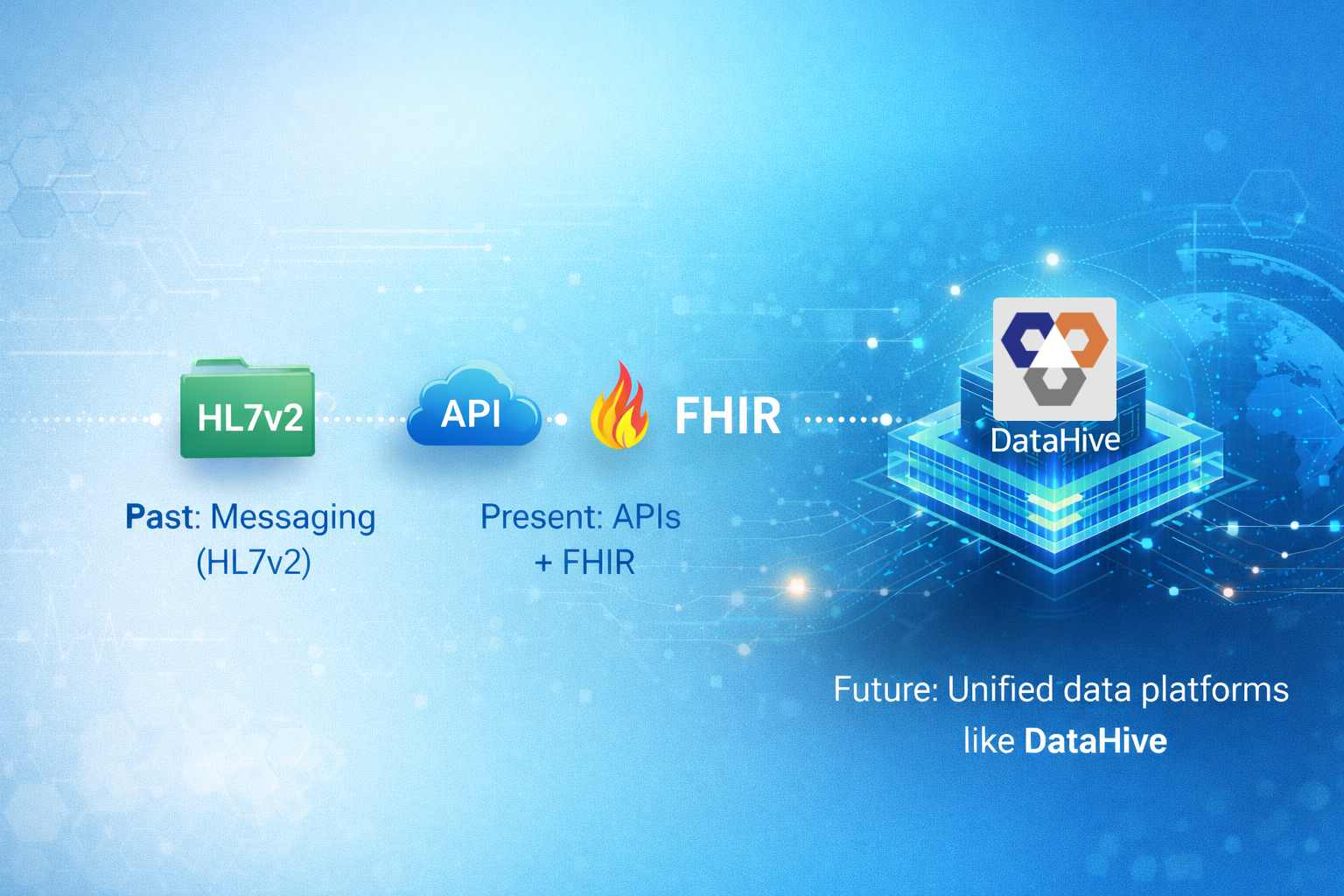
Past: Messaging (HL7v2)
Present: APIs + FHIR
Future: Unified data platforms
Organizations that continue to treat interoperability as an integration problem will struggle. Those that approach it as a data architecture problem—solved through platforms like DataHive—will lead the next decade of healthcare innovation.
Santeware Healthcare Solutions brings the engineering depth, clinical understanding, and delivery governance required to implement it responsibly.