













Real-Time Discharge and Bed Readiness Tracking Platform for Hospital Operations Optimization
About the Client
The client is a large healthcare ecosystem responsible for managing hospital operations across multiple facilities. With high patient volumes and continuous admission-discharge cycles, efficient bed management is critical to maintaining care quality and operational flow.
To address delays and improve coordination across departments, the client partnered with Santeware to design a centralized system for tracking discharge progress and bed readiness in real time.
Problem Overview
Hospital discharge processes typically involve multiple departments—each working in silos—which leads to delays, poor visibility, and inefficient bed utilization.
The client needed a way to bring all of this into a single, trackable workflow that staff could rely on during day-to-day operations.
Key Challenges:
-
-
- Lack of a unified view of discharge and bed readiness status
- Delays caused by poor coordination between departments
- No real-time visibility into pending and completed discharge steps
- Inefficient communication during handovers
- Limited ability to track and improve turnaround time
- Difficulty in identifying bottlenecks across departments
-
Technology Architecture
| Layer | Technology |
|---|---|
| Backend | Node.js |
| Databases | PostgreSQL |
| Mobile Application | Android |
| Integration | HL7 Integration Engine |
| API Layer | REST-based APIs |
| Architecture | Microservices-based |
| Notifications | Mobile-based alerts |
| Interfaces | SAP, Pharmacy, Cleaning Systems |
The platform integrates with existing hospital systems through HL7 and API layers, creating a single operational view of discharge workflows across departments.
What Santeware Built
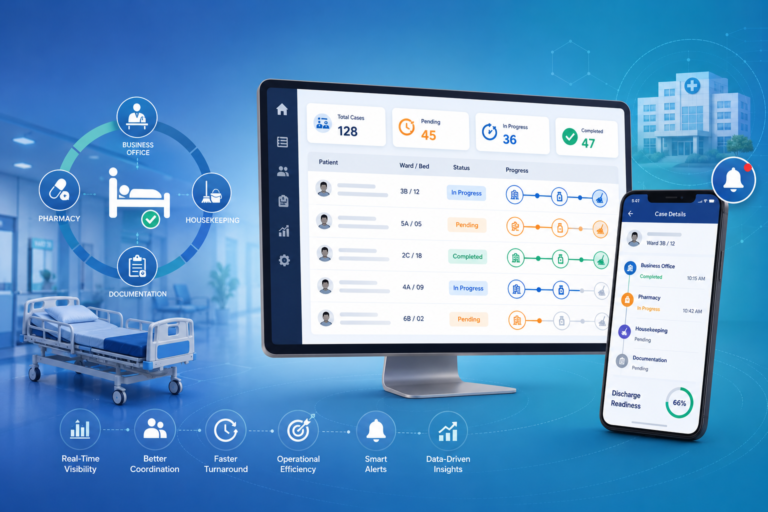
Santeware developed a real-time discharge and admission readiness tracking system that provides a centralized view of patient discharge progress and bed availability across hospital departments.
Unified Discharge Tracking Interface
The system provides a single screen where staff can monitor the status of all discharge cases.
Key capabilities included:
-
-
- Real-time list of patient discharge cases with ward and bed details
- Clear indication of pending and completed cases
- Automatic and manual data refresh options
- Visual indicators showing progress across departments
- Filtering and sorting based on operational needs
-
This replaced fragmented tracking with a consistent and accessible view for all stakeholders.
Department-Level Workflow Visibility
Each discharge case is broken down into actionable steps across departments
Capabilities included:
-
-
- Tracking of tasks across business office, pharmacy, and housekeeping
- Status indicators (not started, in progress, completed)
- Identification of outstanding actions for each departmentAlerts to notify teams of pending tasks
- Alerts to notify teams of pending tasks
-
This made it easier to pinpoint exactly where delays were occurring.
Case-Level Detail and Audit Trail
The platform provides detailed visibility into each discharge case.
Capabilities included:
-
-
- Complete list of outstanding and completed tasks per patient
- Timestamped activity logs with user identifiers
- Access to discharge-related documents
- Real-time progress indicators for each case
-
This ensured accountability and traceability throughout the discharge process.
Structured Status Updates and Data Integrity
To maintain consistency, the system enforces controlled updates from users.
Capabilities included:
-
-
- Predefined workflow steps for each department
- Automatic capture of timestamps and user details
- Restricted editing to prevent data manipulation
- Free-text remarks for contextual updates
-
This balanced structured data capture with flexibility for operational notes.
Operational Dashboard and Analytics
A dashboard was introduced to help teams monitor performance and identify improvement areas.
Capabilities included:
-
-
- Visual breakdown of case statuses across departments
- Tracking of turnaround time against defined targets
- Ward-level performance metrics
- Filtering by facility, date, and business unit
-
This allowed management teams to move from reactive tracking to proactive optimization.
Integrated and Scalable Architecture
The system was designed to fit into the existing hospital IT ecosystem without disruption.
Capabilities included:
-
-
- Integration with hospital systems via HL7 interfaces
- API-based communication across services
- Mobile and web access for operational flexibility
- Modular architecture supporting future expansion
-
This ensured the solution could scale across multiple hospitals and departments.
The Impact
The platform improved both operational efficiency and coordination across hospital teams.
-
-
- Reduced delays in discharge and bed turnaround
- Improved visibility into discharge progress across departments
- Faster identification of operational bottlenecks
- Better coordination between clinical and non-clinical teams
- More efficient use of hospital bed capacity
- Enhanced patient experience through smoother discharge processes
-
Conclusion
Santeware delivered a practical and scalable solution that brings clarity and structure to hospital discharge workflows.
By centralizing discharge tracking and enabling real-time visibility across departments, the platform helps hospitals reduce delays, improve coordination, and make better use of available capacity.
It now serves as a foundational system for operational efficiency in high-volume healthcare environments.