












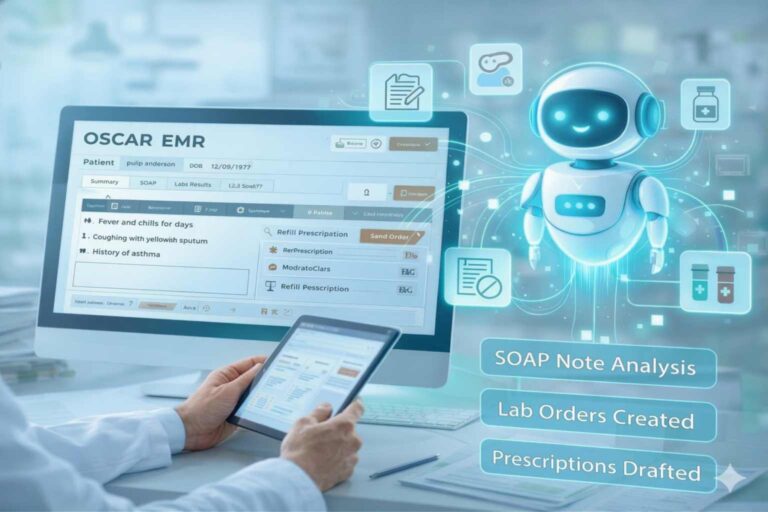
AI-Powered Clinical Workflow Assistant Embedded Inside OSCAR EMR
About the Client
The client is a healthcare technology organization supporting primary care clinics that operate on OSCAR EMR, a widely used electronic medical record platform across Canadian healthcare systems. The organization sought to enhance physician productivity by reducing administrative overhead and improving clinical workflow efficiency within the EMR environment. To achieve this, the client partnered with Santeware to design and implement an AI-powered assistant embedded directly into OSCAR EMR, enabling clinicians to automate routine clinical tasks while maintaining full control of patient care decisions.
Problem Overview
Physicians often spend significant time navigating multiple EMR tabs, searching for forms, and manually entering repetitive information for prescriptions, lab orders, referrals, and documentation. Key operational challenges included:
-
-
- Manual form completion for prescriptions, labs, and referrals
- Frequent switching between patient notes and clinical action screens
- Time-consuming documentation and administrative tasks
- Increased cognitive load during patient consultations
- Limited automation within traditional EMR interfaces
-
The client required an intelligent assistant capable of analysing clinician notes and triggering appropriate actions within the EMR—without disrupting the existing interface or workflow.
Technology Architecture
| Layer | Technology |
| Frontend | React + TypeScript |
| Backend | Django |
| AI Engine | OpenAI GPT APIs |
| Integration | OSCAR EMR Web Components |
| Communication | window.postMessage |
| Form Automation | DOM polling & mutation observers |
The solution was designed to operate safely within the OSCAR EMR web environment while maintaining secure data communication between the assistant and the EMR interface.
What Santeware Built
Santeware developed an embedded AI assistant that functions as an intelligent workflow layer within the OSCAR EMR interface. The system analyses clinician-entered SOAP notes in real time and dynamically suggests or initiates relevant clinical actions.
Intelligent Clinical Action Detection
Using AI-driven natural language processing, the assistant analyses SOAP notes and identifies relevant clinical tasks.
Capabilities include:
-
-
- Detecting when prescriptions, labs, referrals, or patient education materials are needed
- Activating contextual action tabs dynamically
- Reducing unnecessary interface clutter by displaying only relevant options
-
This allows clinicians to move directly from documentation to action without manual navigation.
Automated Form Prefilling
The assistant automates form completion by generating structured data from clinical notes. Key capabilities include:
-
-
- Automatic prescription generation with medication details, dosage, and instructions
- Lab and diagnostic requisition prefilling based on identified tests
- Referral letter generation including specialist information and clinical context
- Patient education handout generation based on consultation topics
-
Forms are opened and populated automatically within OSCAR EMR, allowing clinicians to review and approve before submission.
Seamless EMR Integration
The system was built with modular components to support future expansion.
Capabilities include:
-
-
- React-based modular UI components for clinical task workflows
- Dynamic prompt generation for different clinical actions
- Structured JSON outputs for labs, prescriptions, referrals, and summaries
- Intelligent form selection based on detected clinical intent
-
The architecture allows the assistant to evolve with additional clinical workflows and integrations.
Modular and Scalable Architecture
The system was built with modular components to support future expansion.
Capabilities include:
-
-
- React-based modular UI components for clinical task workflows
- Dynamic prompt generation for different clinical actions
- Structured JSON outputs for labs, prescriptions, referrals, and summaries
- Intelligent form selection based on detected clinical intent
-
The architecture allows the assistant to evolve with additional clinical workflows and integrations.
The Impact
The AI assistant significantly improved clinical workflow efficiency and reduced administrative burden for physicians.
-
-
- Up to 40% reduction in documentation and form-filling time
- Improved completeness of follow-up actions during patient visits
- High clinician adoption due to seamless EMR integration
- Reduced risk of missed labs, referrals, or prescriptions
- Scalable architecture capable of supporting additional specialties and EMR platforms
-
The solution enabled clinicians to focus more on patient care rather than administrative tasks.
Conclusion
Santeware delivered an embedded AI assistant that transforms the OSCAR EMR experience by combining real-time clinical intelligence with workflow automation.
By integrating AI-driven note analysis, automated form prefilling, and seamless EMR interaction, the system streamlines clinical workflows while preserving physician oversight and patient safety.
This implementation demonstrates how embedded AI can modernize EMR systems and significantly enhance efficiency in primary care environments.