












HL7 Integration and Mirth Support for Seamless Lab–Hospital Data Exchange
The Challenge
Healthcare providers rely heavily on efficient communication between Electronic Health Record (EHR) systems and Laboratory Information Management Systems (LIMS) to ensure accurate ordering, processing, and reporting of diagnostic tests. However, laboratory systems and hospital EMRs often operate on different platforms, requiring reliable interoperability to exchange clinical information.
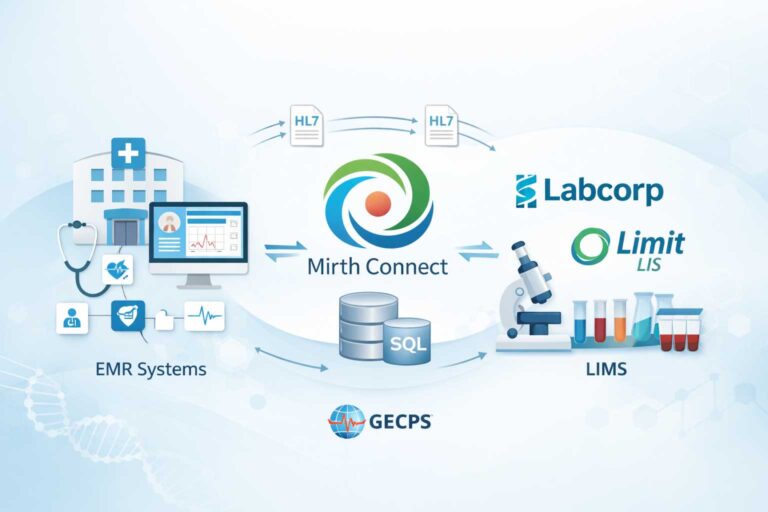
A healthcare organization needed a robust integration framework that could facilitate the seamless transfer of laboratory orders and results between hospital EMR systems and laboratory systems such as LabCorp and Limit LIS. The integration required the ability to process multiple HL7 message types, manage incoming and outgoing data streams, and ensure accurate synchronization of laboratory orders and test results.
The organization also required ongoing monitoring, support, and maintenance of the integration infrastructure to maintain uninterrupted communication between systems and ensure reliable data delivery.
The Solution
Santeware implemented a comprehensive HL7 integration and maintenance framework using the Mirth Connect integration engine to enable seamless communication between EHR systems and laboratory systems.
The solution processes HL7 v2 messages generated by hospital EMR systems, transforms and validates the data, and routes it to the appropriate laboratory systems. Incoming laboratory results are then received, aggregated, and stored in a relational database for further processing and reporting.
By orchestrating HL7 data flows through Mirth Connect, the system ensures reliable bidirectional communication between healthcare systems while maintaining data integrity and traceability.
In addition to building the integration workflows, Santeware also provided continuous support and maintenance services to monitor HL7 interfaces, troubleshoot issues, and optimize performance.
Core Technology Stack
| Category | Technology / Systems |
|---|---|
| Integration Engine | Mirth Connect |
| Database | SQL |
| Interoperability Standard | HL7 v2 Messaging |
| Integrated Systems | LabCorp |
| Integrated Systems | Limit LIS |
| Integrated Systems | GECPS |
| Integrated Systems | Hospital EMR Systems |
Key Capabilities Delivered
1. HL7 Message Processing and Transformation
The system receives HL7 v2 messages from hospital EMR systems and processes various message types related to laboratory orders, results, and patient data. Messages are validated, transformed, and routed to appropriate laboratory systems.
2. Laboratory Order and Result Integration
Healthcare providers can electronically send laboratory test orders from the EMR to laboratory systems. Once tests are completed, results are transmitted back to the hospital systems, ensuring accurate and timely reporting.
3. Data Aggregation and Storage
Incoming HL7 messages are aggregated and stored in a relational database, allowing organizations to maintain a centralized repository for laboratory data and enabling easier reporting and analytics.
4. Reliable Integration Monitoring and Support
Santeware provided ongoing monitoring and maintenance of HL7 interfaces to ensure uninterrupted system communication. This includes troubleshooting message failures, maintaining channel configurations, and optimizing performance.
5. Scalable Healthcare Integration Architecture
The Mirth-based architecture allows healthcare organizations to scale integrations as additional laboratory systems or EMR platforms are introduced.
The Impact
The HL7 integration framework significantly improved the reliability and efficiency of laboratory data exchange between healthcare systems.
Key outcomes included:
-
-
- Seamless electronic transfer of laboratory orders and results
- Reliable processing of HL7 v2 messages between EMR and LIMS platforms
- Centralized storage of aggregated laboratory data
- Improved visibility and traceability of diagnostic test workflows
- Reduced manual intervention in laboratory data exchange
- Continuous monitoring and support for integration channels
-
Healthcare providers were able to streamline laboratory workflows while maintaining reliable communication across their clinical systems.
Why It Worked
Standards-based interoperability The use of HL7 v2 ensured compatibility with hospital EMRs and laboratory systems.
Robust integration engine Mirth Connect provided flexible message transformation, routing, and monitoring capabilities.
Data orchestration architecture Aggregating HL7 data within a relational database enabled improved reporting and system transparency.
Dedicated support and maintenance Continuous monitoring and support ensured that laboratory interfaces remained stable and operational.
Outcome
The result is a reliable HL7 integration framework that enables seamless communication between hospital EMRs and laboratory systems, ensuring accurate and timely exchange of laboratory orders and test results.
Laboratory data was no longer isolated within individual systems. It was orchestrated through a unified integration framework that supports efficient clinical workflows.