














Enterprise-Scale Allscripts SCM Data Extraction & Archival Modernization Program
Overview
Santeware partnered with a leading healthcare organization in Southeast Asia to execute a large-scale legacy EMR extraction and archival modernization initiative involving Allscripts Sunrise Clinical Manager (SCM) v15.3.
The objective of the engagement was to design and implement a highly scalable extraction, normalization, and archival framework capable of securely migrating more than a decade of historical clinical and administrative data from Allscripts SCM into a next-generation archival ecosystem.
This was not a standard migration engagement. The initiative involved building a comprehensive healthcare data preservation and continuity framework that ensured long-term accessibility of critical patient records while supporting the organization’s broader EMR transformation strategy.
The project required deep expertise in:
-
-
- Legacy EMR architecture
- Healthcare data engineering
- Clinical data normalization
- Large-scale archival workflows
- Validation and reconciliation frameworks
- Regulatory and governance-driven healthcare migrations
-
The Challenge
The healthcare organization was operating a highly mature clinical environment built on Allscripts SCM, containing more than 12 years of longitudinal patient data spanning multiple clinical and operational domains. The organization required a robust extraction and archival strategy that would preserve historical patient data while supporting future modernization initiatives.
The complexity of the engagement stemmed from several factors:
1. Large-Scale Legacy EMR Complexity
The Allscripts SCM environment contained highly interconnected clinical datasets spread across complex relational SQL database structures. Many workflows involved tightly coupled dependencies between:
-
-
- Clinical notes
- Orders
- Flowsheets
- Nursing documentation
- Medication administration workflows
- Imaging and laboratory systems
- Admission/discharge records
-
The project required accurate extraction while preserving all contextual and relational dependencies between datasets.
2. Multi-Domain Clinical Data Preservation
The archival scope extended across a broad spectrum of clinical and operational domains including:
-
-
- Patient demographics
- Patient visit information
- Clinical notes
- Flowsheets
- Medications and allergies
- Laboratory results
- Imaging records
- Orders and procedures
- Problem lists and diagnoses
- Vital signs
- Nursing documentation
- Admission/discharge workflows
- Medical certificates
- Worklist management records
- External document attachments
-
3. Historical Data Volume & Longitudinal Continuity
The engagement involved extraction and preservation of over a decade of healthcare data dating back to 2012. Maintaining continuity of care across longitudinal patient histories introduced significant complexity around:
-
-
- Data lineage
- Historical relationship mapping
- Referential integrity
- Cross-module reconciliation
- Chronological clinical sequencing
-
4. Zero Data Loss Requirements
Because the archival platform would serve as the organization’s long-term historical reference system, the project demanded extremely high levels of extraction accuracy.
The solution required:
-
-
- Row-level reconciliation
- Column-level validation
- Mirror-to-mirror verification against SCM front-end screens
- Clinical validation across sampled MRNs
- End-to-end extraction QA reporting
-
5. Regulatory, Security & Governance Constraints
As part of a large healthcare enterprise environment, the engagement required adherence to strict security and governance controls including:
-
-
- HIPAA-aligned handling of PHI
- VPN-restricted access
- AES-256 encryption standards
- Secure SFTP transfer mechanisms
- Controlled offshore delivery processes
- Governance-led signoff workflows
-
The Solution
Santeware engineered a multi-stage enterprise archival extraction and normalization framework specifically designed for high-volume legacy EMR modernization initiatives.
The solution combined:
-
-
- Deep database analysis
- Metadata-driven mapping
- Incremental extraction pipelines
- Clinical normalization workflows
- Large-scale QA automation
- Delta extraction orchestration
- Governance-led validation processes
-
The architecture was built to support both:
-
-
- Initial archival onboarding
- Ongoing delta synchronization until EMR cutover
-
Core Solution Components
1. Enterprise Discovery & Legacy System Assessment
Santeware conducted a comprehensive discovery phase focused on:
-
-
- Allscripts SCM source structures
- Data quality analysis
- Table relationships and dependencies
- Destination archival schemas
- Crosswalk definition between source and destination systems
-
A detailed Data Mapping (DM) Analysis document was created for every data domain to establish precise source-to-destination mapping logic.
2. Metadata-Driven Crosswalk & Normalization Framework
The team designed a scalable normalization framework capable of:
-
-
- Mapping SCM datasets into archival-compatible structures
- Standardizing inconsistent legacy data formats
- Preserving clinical relationships and encounter hierarchies
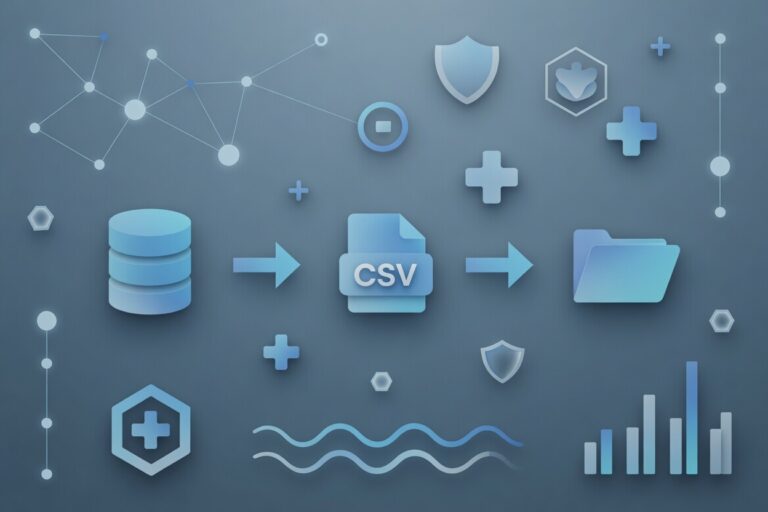
- Converting extracted data into ingestion-ready CSV structures
-
This framework supported:
-
-
- Structured normalization
- Relationship preservation
- Historical continuity mapping
- Destination-specific formatting rules
-
3. Advanced Extraction & Transformation Pipelines
Santeware developed modular extraction scripts for all in-scope clinical and operational datasets.
The extraction framework included:
-
-
- Database-level extraction logic
- Dynamic query optimization
- Incremental data extraction workflows
- Structured CSV generation
- Batch processing orchestration
- Error handling and recovery logic
-
The extraction pipelines were designed to support:
-
-
- Sample extractions
- Bulk historical loads
- Delta extraction cycles
- Reconciliation and replay processing
-
4. Multi-Level Validation & Reconciliation Architecture
Given the criticality of healthcare data integrity, Santeware implemented a highly rigorous validation framework.
The validation architecture included:
-
-
- Row-level count verification
- Column-level reconciliation
- Clinical screen-to-database validation
- Mirror-to-mirror patient data comparison
- QA reporting across every data element
- Validation artifacts for sampled MRNs
-
The solution also generated:
-
-
- Extraction inspection reports
- Validation screenshots
- Data completeness reports
- QA reconciliation documents
-
while preserving clinical context and accessibility.
5. Delta Load & Cutover Synchronization Framework
To support the broader EMR transition strategy, Santeware designed a delta extraction framework enabling synchronization between SCM and the archival platform during cutover periods.
This included:
-
-
- Incremental extraction orchestration
- Delta load identification
- Synchronization workflows
- Cutover simulation support
- Final reconciliation processes before go-live
-
6. Governance-Led Migration Execution Model
The engagement followed a structured governance model involving:
-
-
- Incremental milestone-based delivery
- Steering committee reviews
- Weekly status reporting
- Risk and dependency tracking
- UAT-led signoff workflows
- Controlled change management processes
-
The project execution model ensured alignment between:
-
-
- Technical teams
- Clinical stakeholders
- Governance committees
- Data validation teams
-
Implementation Strategy
Phase 1: Discovery & Data Analysis
-
-
- Analysis of Allscripts SCM source systems
- Review of archival destination structures
- Data quality and dependency assessment
- Identification of all in-scope clinical domains
-
Phase 2: Data Mapping & Crosswalk Definition
-
-
- Creation of detailed source-to-target mappings
- Definition of transformation and normalization rules
- Relationship modeling and metadata capture
-
Phase 3: Sample Extraction & Validation
-
-
- Extraction of sample MRNs across key clinical domains
- Validation of extracted datasets against SCM application views
- Initial archival ingestion and reconciliation testing
-
Phase 4: Full Script Development & Large-Scale Testing
-
-
- Development of extraction pipelines for all data elements
- Iterative testing and refinement cycles
- Validation across large-scale datasets
-
Phase 5: Bulk Historical Data Extraction
-
-
- Full-scale extraction of all historical patient datasets
- Normalization and archival-ready formatting
- High-volume data processing and QA verification
-
Phase 6: Delta Extraction & Go-Live Support
-
-
- Incremental synchronization until final cutover
- Go-live validation and stabilization
- Warranty and post-implementation support
-
Data Domains Covered
The extraction and archival framework supported highly diverse clinical and operational datasets including:
-
-
- Patient Demographics
- Patient Visit Information
- Clinical Notes & Narratives
- Flowsheets & Care Assessments
- Allergies & Medication Administration
- Laboratory Results
- Imaging & Radiology Records
- Orders & Procedures
- Problem Lists & Diagnoses
- Vital Signs
- Nursing Documentation
- Admission, Discharge & Transfer Records
- Medical Certificates
- Worklist Manager Data
- Immunization Records
- External Clinical Attachments
-
Key Outcomes
-
-
- ✅ Successful archival extraction of more than 12 years of Allscripts SCM healthcare data
- ✅ Preservation of longitudinal patient history across multiple clinical domains
- ✅ High-accuracy mirror-to-mirror validation framework ensuring data integrity
- ✅ Scalable bulk and delta extraction architecture supporting EMR transition
- ✅ Reduced operational and clinical risk during archival onboarding
- ✅ Reusable migration framework for future legacy EMR modernization initiatives
- ✅ Governance-driven execution ensuring compliance and audit readiness
-
Technologies Used
| Category | Details |
|---|---|
| EMR System | Allscripts Sunrise Clinical Manager (SCM v15.3) |
| Database Systems | SQL Server / Legacy EMR Database Systems |
| Data Processing | Healthcare ETL & Data Normalization Frameworks |
| Archival Pipelines | CSV-Based Archival Transformation Pipelines |
| Infrastructure | Secure VPN & SFTP Infrastructure |
| Security & Compliance | AES-256 Encryption & HIPAA-Aligned Security Controls |
| Quality Assurance | QA & Reconciliation Reporting Frameworks |
| Additional | …and many more |
Business Impact
The initiative enabled the healthcare organization to establish a highly scalable and future-ready archival ecosystem while preserving critical historical healthcare data from Allscripts SCM. By implementing a robust extraction and normalization framework, the organization significantly reduced the complexity and risk associated with large-scale EMR modernization.
The solution also created a repeatable migration and archival methodology that can support future legacy system onboarding initiatives across healthcare environments.
Why Santeware
Santeware’s deep expertise in legacy EMR systems, healthcare interoperability, clinical data extraction, and archival modernization enabled the successful execution of a highly complex enterprise healthcare data initiative. Our ability to combine large-scale extraction engineering with rigorous healthcare validation frameworks ensured a secure, scalable, and clinically reliable archival transformation program.