















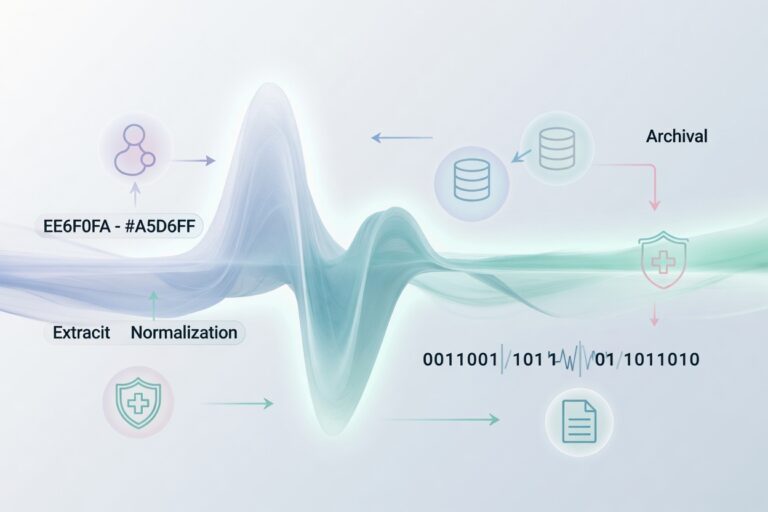
Enterprise GE Perinatal Data Extraction & Clinical Archival Transformation Program
Overview
Santeware partnered with a healthcare interoperability and archival solutions organization to execute a highly specialized enterprise data extraction initiative involving legacy GE Perinatal EMR systems.
The engagement focused on designing and implementing a scalable extraction, transformation, and archival-ready data delivery framework capable of handling highly sensitive maternal and fetal healthcare datasets from legacy clinical environments.
Unlike traditional EMR extraction projects, this initiative required handling a combination of:
-
-
- Structured clinical data
- High-frequency fetal monitoring datasets
- Flowsheet-driven obstetric records
- Scanned clinical documents
- Image-based monitoring strips
- Complex encounter-level maternal and neonatal relationships
-
The objective was to preserve critical longitudinal maternal and neonatal clinical history while enabling ingestion into a modern healthcare archival and interoperability ecosystem.
The project required deep expertise in:
-
-
- GE Perinatal systems
- Healthcare ETL engineering
- Legacy clinical data extraction
- Maternal-fetal healthcare workflows
- Flowsheet data normalization
- High-volume healthcare archival frameworks
- Clinical metadata mapping and reconciliation
-
The Challenge
The source GE Perinatal environment contained highly specialized maternal and fetal clinical datasets accumulated across multiple care episodes, encounters, and monitoring workflows.
Unlike conventional EMR systems, perinatal environments generate large volumes of:
-
-
- Time-series monitoring data
- Flowsheet-based observations
- Fetal monitoring strips
- Dynamic nursing documentation
-
This introduced significant complexity in extraction, normalization, and archival preservation.
Key Challenges
1. Highly Specialized Maternal & Fetal Clinical Data Structures
The GE Perinatal environment contained interconnected maternal and neonatal datasets involving:
-
-
- Mother-baby demographic relationships
- Admission and delivery workflows
- Labor progression monitoring
- Continuous fetal monitoring observations
- Clinical assessments
- Obstetric procedure tracking
-
The migration required preservation of:
-
-
- Maternal-neonatal relationships
- Encounter chronology
- Monitoring continuity
- Clinical context across labor and delivery workflows
-
2. Extraction of High-Frequency Monitoring & Flowsheet Data
One of the most complex aspects of the project involved handling:
-
-
- Flowsheet datasets
- Fetal Heart Rate (FHR) monitoring
- Contraction monitoring records
- Pain assessment trends
- Vaginal examination documentation
- Nursing assessment notes
-
These datasets were highly granular and generated at frequent intervals, requiring specialized extraction and transformation logic to preserve chronological sequencing and clinical integrity.
3. Complex Legacy EMR & SQL-Based Extraction Requirements
The legacy GE Perinatal system relied heavily on SQL-based healthcare repositories with tightly coupled clinical relationships.
The extraction initiative required:
-
-
- Deep schema analysis
- Reverse engineering of application relationships
- Metadata-driven extraction logic
- Mapping of source structures into archival-ready formats
-
The challenge increased further due to:
-
-
- Limited documentation of legacy relationships
- Specialized obstetric workflows
- Dynamic assessment structures
- Variability in historical datasets across encounters
-
4. Scanned Documents & Fetal Monitoring Strip Extraction
A major technical challenge involved extraction and preservation of non-discrete healthcare content including:
-
-
- Scanned clinical documents
- Fetal monitoring strips
- Image-based assessment records
- Historical labor and delivery attachments
-
Many of these records existed as binary objects or image-based clinical artifacts requiring specialized extraction methodologies.
Specialized Binary & Image Extraction Framework
Santeware engineered dedicated workflows capable of:
-
-
- Extracting binary healthcare objects from source repositories
- Reconstructing scanned clinical files into usable formats
- Preserving image integrity and resolution
- Maintaining patient and encounter associations
- Linking extracted strips and images back to maternal care episodes
-
This was particularly critical for fetal monitoring strips, where chronological continuity and image fidelity were essential for future clinical reference and archival compliance.
5. Clinical Relationship & Metadata Preservation
The project required preservation of highly sensitive clinical relationships including:
-
-
- Mother-baby linkage
- Encounter-based monitoring continuity
- Assessment sequencing
- Provider documentation relationships
- Timestamp integrity across monitoring workflows
-
The migration framework had to ensure that downstream archival systems could accurately reconstruct the complete labor and delivery timeline.
6. Validation & Data Integrity Complexity
Because the extracted datasets would support long-term archival and future clinical reference, the project required rigorous validation and reconciliation processes including:
-
-
- Clinical dataset verification
- Format validation
- Metadata reconciliation
- Chronological data checks
- Monitoring sequence validation
- Clinical review of extracted datasets
-
The engagement also required close coordination between:
-
-
- Data extraction teams
- Implementation specialists
- Validation stakeholders
- Healthcare SMEs
-
The Solution
Santeware designed and implemented a multi-stage healthcare extraction and archival transformation framework specifically optimized for GE Perinatal systems.
The architecture combined:
-
-
- SQL-based extraction pipelines
- Metadata-driven mapping frameworks
- Flowsheet normalization logic
- Binary object extraction workflows
- High-frequency clinical data transformation pipelines
- Validation and reconciliation frameworks
-
The solution was designed to support:
-
-
- Initial validation extracts
- Full production extraction cycles
- Ongoing implementation support through go-live
-
Core Solution Components
1. Enterprise Discovery & Data Mapping Framework
Santeware conducted deep analysis of:
-
-
- GE Perinatal data structures
- Clinical workflows
- Maternal-fetal monitoring datasets
- Flowsheet relationships
- Source-to-target archival mappings
-
The team developed detailed metadata and mapping documentation defining:
-
-
- Extraction scope
- Business rules
- Transformation requirements
- Archival formatting standards
-
2. Advanced Healthcare ETL & Transformation Pipelines
The project required development of specialized ETL pipelines capable of:
-
-
- Extracting structured and non-structured healthcare data
- Applying transformation and normalization logic
- Generating archival-ready datasets
- Supporting CSV and SQL-based delivery formats
-
The ETL framework handled:
-
-
- Demographics
- Encounters and admissions
- Insurance and master data
- Medications and allergies
- Clinical assessments
- Monitoring datasets
- Flowsheet observations
-
3. High-Frequency Monitoring Data Normalization
Santeware implemented specialized transformation logic for:
-
-
- Fetal Heart Rate datasets
- Contraction monitoring
- Pain trend records
- Continuous flowsheet observations
-
The framework preserved:
-
-
- Time-series continuity
- Observation sequencing
- Monitoring intervals
- Clinical event chronology
-
This ensured that monitoring records remained clinically interpretable within downstream archival environments.
4. Scanned Document & Binary Object Migration
Specialized workflows were implemented for:
-
-
- Scanned clinical documents
- Binary healthcare objects
- Fetal monitoring strip images
- Historical labor and delivery records
-
The framework supported:
-
-
- Binary reconstruction
- Metadata preservation
- Encounter-level indexing
- Secure archival packaging
- File integrity validation
-
5. Validation & Reconciliation Framework
Santeware implemented a multi-stage validation lifecycle including:
-
-
- Initial sample extraction validation
- Metadata verification
- Clinical format validation
- Full production extraction validation
- Data completeness checks
- Final archival readiness verification
-
The solution also supported:
-
-
- Issue tracking and remediation
- Feedback incorporation
- Go-live implementation support
-
Implementation Strategy
Phase 1: Discovery & Scope Definition
-
-
- Review of extraction scope and implementation workflows
- Analysis of maternal-fetal data relationships
- Identification of extraction dependencies
-
Phase 2: Metadata Mapping & ETL Development
-
-
- Creation of mapping documents
- Development of ETL extraction jobs
- Definition of business rules and transformation logic
-
Phase 3: Initial Validation Extraction
-
-
- Execution of test extraction cycles
- Validation against source system datasets
- Review and reconciliation workflows
-
Phase 4: Full Production Extraction
-
-
- Enterprise-scale extraction of complete datasets
- Transformation into archival-ready formats
- Delivery of CSV/SQL-compatible outputs
-
Phase 5: Go-Live Support & Stabilization
-
-
- Support for downstream implementation teams
- Validation of archival load processes
- Issue resolution and stabilization support
-
Data Domains Covered
The extraction framework supported a highly diverse set of maternal-fetal healthcare datasets including:
-
-
- Mother & Baby Demographics
- Extended Demographic Data
- Insurance Information
- Physician & Procedure Master Data
- Diagnosis Master Data
- Admissions & Encounters
- Active Medications & Allergies
- Vitals & Flowsheet Data
- Fetal Heart Rate Monitoring
- Contraction Monitoring
- Pain Assessment Records
- Assessment Notes
- Vaginal Examination Records
- Clinical Notes
- Scanned Clinical Documents
- Fetal Monitoring Strips
-
Key Outcomes
-
-
- ✅ Successful extraction and transformation of highly specialized GE Perinatal clinical datasets
- ✅ Preservation of maternal-fetal clinical relationships and encounter continuity
- ✅ Accurate normalization of high-frequency monitoring and flowsheet data
- ✅ Seamless extraction and reconstruction of scanned documents and fetal monitoring strips
- ✅ Archival-ready delivery of structured and non-structured healthcare content
- ✅ Reduced implementation risk during downstream archival onboarding
- ✅ Scalable extraction framework reusable for future perinatal modernization initiatives
-
Technologies Used
| Category | Details |
|---|---|
| EMR Platform | GE Perinatal EMR |
| Database | SQL-Based Legacy Healthcare Databases |
| ETL Framework | Enterprise Healthcare ETL Frameworks |
| Data Transformation | CSV / SQL Data Transformation Pipelines |
| Binary Data Processing | Binary Object & Image Reconstruction Workflows |
| Metadata Management | Metadata Mapping & Validation Frameworks |
| Infrastructure | Secure VPN & SFTP Infrastructure |
Business Impact
The initiative enabled the healthcare organization to preserve highly sensitive maternal and neonatal clinical history while modernizing access to legacy perinatal healthcare records.
By implementing scalable extraction, normalization, and archival transformation workflows, the organization significantly reduced the complexity and operational risk associated with preserving specialized obstetric and fetal monitoring datasets.
The solution also established a repeatable framework for future archival and modernization initiatives involving high-frequency clinical monitoring systems.
Why Santeware
Santeware’s expertise in healthcare interoperability, legacy EMR extraction, flowsheet-based clinical data engineering, and binary healthcare content handling enabled the successful execution of a highly specialized perinatal healthcare modernization initiative.
Our ability to combine enterprise ETL engineering, maternal-fetal workflow understanding, BLOB extraction capabilities, and healthcare archival expertise ensured a secure, scalable, and clinically reliable transformation framework for complex healthcare environments.