














Enterprise FHIR Integration Framework for Epic Interoperability Using Mirth Connect
Overview
Santeware partnered with a Singapore-based healthcare technology platform to design and implement a scalable FHIR-based integration framework enabling seamless connectivity with Epic systems. The objective was to establish a robust interoperability layer capable of consuming, transforming, and standardizing clinical and administrative data from Epic’s FHIR APIs.
The engagement focused on building a future-ready integration architecture that could evolve from sandbox validation to production-grade deployment across healthcare ecosystems.
The Challenge
The client required integration with Epic’s FHIR ecosystem to enable access to structured healthcare data. However, Epic’s interoperability framework introduces multiple technical and operational complexities.
Key challenges included:
-
-
- Establishing secure connectivity with Epic’s FHIR sandbox environment
- Implementing OAuth 2.0-based authentication workflows compliant with Epic standards
- Handling FHIR R4 resources with varying structures and dependencies
- Designing an integration layer capable of translating FHIR data into application-ready formats
- Managing transformation between JSON-based FHIR responses and relational database schemas
- Ensuring scalability for future expansion into production environments
- Building a reusable framework rather than a one-time integration
-
Additionally, the client required a solution that could serve as a foundation for broader interoperability use cases, including multi-EMR connectivity and data standardization.
The Solution
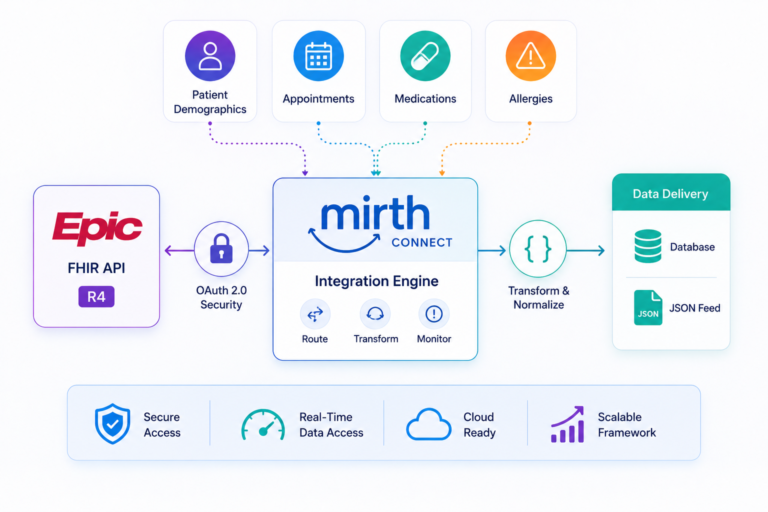
Santeware designed and implemented a modular FHIR integration framework leveraging Mirth Connect as the core integration engine.
Core solution capabilities included:
1. Secure FHIR Connectivity Layer
-
-
- Integration with Epic Open FHIR APIs using OAuth 2.0 authentication
- Implementation of secure token generation and validation workflows
- Establishment of sandbox connectivity for controlled testing and validation
-
2. FHIR Resource Ingestion Engine
-
-
- Development of integration channels within Mirth Connect to consume FHIR R4 resources
- Extraction of key healthcare data including:
- Patient demographics
- Scheduling and appointment information
- Medication data
- Allergy records
-
3. Data Transformation & Normalization Framework
-
-
- Parsing of FHIR JSON responses into structured, application-ready formats
- Creation of a normalized data model aligned with FHIR standards
- Mapping of nested FHIR resources into relational database structures
-
4. Integration Middleware Architecture
-
-
- Use of Mirth Connect as a central orchestration layer for:
- Message routing
- Data transformation
- Error handling and retries
- Design of reusable integration channels for scalability
- Use of Mirth Connect as a central orchestration layer for:
-
5. Flexible Data Delivery Mechanism
-
-
- Support for multiple output formats:
- JSON-based data feeds
- Direct database ingestion
- Configurable pipelines for downstream system integration
- Support for multiple output formats:
-
6. Cloud-Ready Deployment Architecture
-
-
- Deployment of integration engine on cloud infrastructure (AWS/Azure)
- Scalable setup supporting future production workloads
- Environment designed for secure and compliant data exchange
-
Implementation Strategy
Phase 1: Connectivity & Authentication Setup
-
-
- Configuration of Epic FHIR developer accounts and credentials
- Implementation of OAuth 2.0 workflows for secure API access
- Validation of connectivity and token generation
-
Phase 2: Integration Development & Data Ingestion
-
-
- Development of Mirth channels for consuming FHIR resources
- Parsing and transformation of patient, scheduling, medication, and allergy data
- Implementation of data pipelines for ingestion into downstream systems
-
Phase 3: Validation & Optimization
-
-
- Testing of data accuracy and completeness
- Optimization of data retrieval and transformation workflows
- Validation against FHIR standards and client requirements
-
Phase 4: Handoff & Enablement
-
-
- Delivery of fully functional integration framework
- Documentation and knowledge transfer
- Enablement of client teams for future expansion
-
Data Domains Covered
-
-
- Patient Demographics
- Scheduling & Appointment Data
- Medication Records
- Allergy Information
-
Key Outcomes
-
-
- ✅ Successful integration with Epic FHIR ecosystem
- ✅ Secure and standards-compliant API connectivity
- ✅ Real-time access to structured healthcare data
- ✅ Scalable integration framework for future EMR onboarding
- ✅ Reusable architecture for multiple interoperability use cases
- ✅ Reduced complexity in handling FHIR-based integrations
-
Technologies Used
| LAYER | TECHNOLOGY |
|---|---|
| Healthcare Standards | HL7 FHIR (R4) |
| Integration Engine | Mirth Connect (Integration Engine) |
| Authentication | OAuth 2.0 Authentication |
| API & Data Processing | RESTful APIs / JSON Processing |
| Cloud Infrastructure | AWS / Azure Cloud Infrastructure |
| Data Architecture | Healthcare Data Modeling |
Business Impact
The solution enabled the Singapore-based client to establish a strong interoperability foundation, allowing seamless access to Epic data and positioning them for expansion into broader healthcare integrations. By standardizing data ingestion and transformation, the platform significantly reduced development effort for future integrations.
This framework now serves as a critical building block for scalable healthcare data exchange, analytics, and application development.
Why Santeware
Santeware’s expertise in FHIR-based interoperability, combined with deep experience in integration engines like Mirth Connect, enabled the delivery of a scalable and future-ready solution. Our ability to design reusable architectures ensured long-term value beyond the initial implementation.