













Enterprise Data Migration & Archival Platform for Large-Scale Cerner to Epic Transformation
Overview
Santeware partnered with a healthcare organization undergoing a large-scale EMR transformation to successfully migrate clinical and administrative data from Cerner Millennium to Epic, while simultaneously implementing a comprehensive archival strategy.
This engagement was executed as a dual-track data transformation program, combining real-time interoperability, structured clinical migration, and full historical data archival. The solution ensured continuity of care, data integrity, and compliance across systems during a highly complex EMR transition.
The Challenge
The organization was transitioning between two fundamentally different EMR ecosystems—Cerner and Epic—each with distinct data models, ingestion mechanisms, and interoperability standards.
Key challenges included:
-
-
- Migrating large volumes of multi-domain healthcare data across incompatible systems
- Ensuring zero disruption to patient care during go-live transition
- Managing hybrid data exchange models (real-time interfaces, batch processing, and document-based ingestion)
- Handling multiple healthcare data formats including HL7, CCDA, and flat files
- Mapping complex Cerner data structures to Epic’s strict ingestion specifications
- Supporting both selective migration (recent clinical data) and full historical archival
- Enabling physician-level reconciliation for clinically sensitive data
- Coordinating across multiple stakeholders including EMR vendors, hospital IT teams, and integration specialists
-
The program required parallel execution of operational data synchronization and bulk historical migration, significantly increasing execution complexity and risk.
The Solution
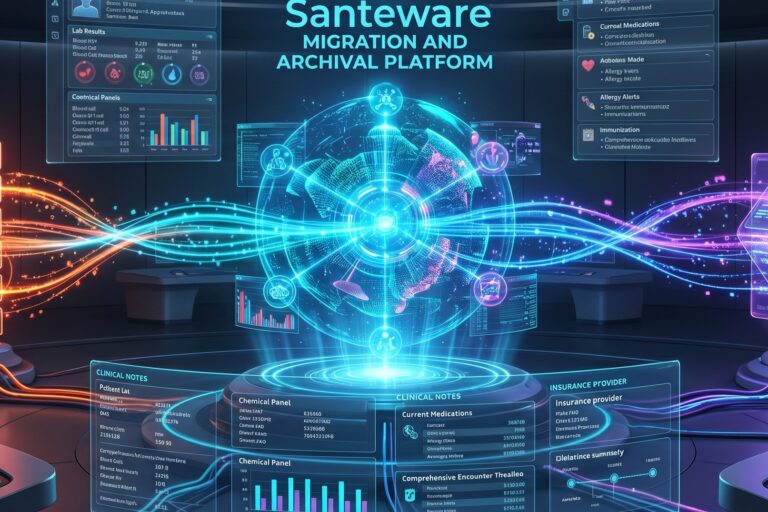
Santeware designed a multi-layered migration and interoperability framework that combined real-time integration, structured data transformation, and large-scale extraction pipelines.
Core solution capabilities included:
1. Real-Time Demographic Synchronization
-
-
- Implementation of HL7 ADT-based data exchange to maintain synchronization between Cerner and Epic
- Continuous demographic updates to ensure both systems remained aligned during transition
- Secure data exchange mechanisms to support real-time interoperability
-
2. Clinical Data Migration via HL7 Pipelines
-
-
- Extraction of structured clinical data from Cerner databases
- Transformation into HL7 message formats (including ORU and MDM)
- Automated ingestion into Epic for:
- Lab results
- Clinical notes
- Vitals
- Patient history (medical, surgical, social, and family)
-
3. CCDA-Based Clinical Data Exchange
-
-
- Extraction of CCD documents for key clinical domains including:
- Medications
- Allergies
- Immunizations
- Problem lists
- Import into Epic with physician-led reconciliation workflows
- Preservation of clinically relevant summaries and structured data
- Extraction of CCD documents for key clinical domains including:
-
4. Structured Flat File Migration
-
-
- Development of standardized datasets aligned with Epic ingestion formats
- Migration of:
- Encounters
- Appointments
- Insurance coverage
- Patient master data
-
5. Full Historical Data Archival Framework
-
-
- Extraction of complete Cerner EMR and practice management datasets
- Data normalization using mapping specifications
- Conversion into archival-ready formats
- Secure delivery into a long-term archival system for compliance and accessibility
-
Implementation Approach
Phase 1: Discovery & Data Mapping
-
-
- Detailed analysis of Cerner data structures and Epic requirements
- Creation of mapping specifications across all clinical and administrative domains
- Identification of transformation rules and data dependencies
-
Phase 2: Parallel Pipeline Development
-
-
- Development of HL7 transformation pipelines
- Setup of real-time demographic synchronization
- Creation of CCDA extraction and validation workflows
-
Phase 3: Validation & Reconciliation
-
-
- Multi-level validation against source systems
- Iterative testing with Epic ingestion workflows
- Clinical reconciliation for CCDA-imported datasets
-
Phase 4: Migration Execution
-
-
- Execution of structured clinical data migration
- Continuous synchronization during system transition
- Coordination with downstream ingestion teams
-
Phase 5: Full Archival Deployment
-
-
- Extraction of complete historical dataset
- Transformation into standardized archival formats
- Delivery and validation within archival systems
-
Phase 6: QA, Reporting & Support
-
-
- Comprehensive QA processes and validation reporting
- Issue tracking and resolution cycles
- Ongoing support during go-live and stabilization phases
-
Data Domains Covered
-
-
- Patient Demographics
- Encounters & Appointments
- Lab Results
- Clinical Notes
- Vitals & Observations
- Medications, Allergies, Immunizations
- Problem Lists & Diagnoses
- Past Medical, Surgical, Social, and Family History
- Insurance & Coverage Data
- Full Historical Dataset for Archival
-
Key Outcomes
-
-
- ✅ Successful migration of multi-domain clinical data into Epic
- ✅ Real-time synchronization of patient demographics during transition
- ✅ Seamless ingestion of HL7 and CCDA-based datasets
- ✅ Complete archival of legacy Cerner data for compliance and future access
- ✅ Minimal disruption to clinical operations during EMR transition
- ✅ Scalable migration framework reusable across facilities
-
Technologies Used
| LAYER | TECHNOLOGY |
|---|---|
| Healthcare Standards | HL7 v2 (ADT, ORU, MDM) |
| Clinical Documents | CCDA (Clinical Document Architecture) |
| Integration Engine | Mirth Connect (Interface Engine) |
| Source EMR | Cerner Millennium |
| Target EMR | Epic |
| Data Extraction | SQL-Based Data Extraction |
| Secure Connectivity | Secure VPN & SFTP |
| File Processing | CSV / Flat File Processing |
Business Impact
This initiative enabled a seamless transition from Cerner to Epic while maintaining continuity of care and ensuring data accessibility across systems. By combining real-time integration with batch migration strategies, the organization minimized operational risk and accelerated adoption of the new EMR system.
The archival strategy ensured long-term compliance, audit readiness, and access to legacy data without overloading the new platform.
Why Santeware
Santeware’s deep expertise in EMR migration, interoperability standards, and healthcare data engineering enabled the successful execution of a complex, multi-phase transformation program. Our ability to manage parallel data pipelines and align with clinical workflows ensured a reliable, scalable, and future-ready solution.