











Enabling a Smooth EMR Transition: Large-Scale Allscripts to Epic Data Migration
The Challenge
Healthcare organizations transitioning from legacy EMR systems to modern platforms often face a narrow implementation window, high data complexity, and significant risk around continuity of care.
A Florida-based health center was preparing to replace its Allscripts EMR with Epic and needed to migrate a large volume of demographic, clinical, and financial data into Epic modules while also archiving selected historical records in a newly acquired archival solution. The transition timeline was tight, with Epic go-live approaching quickly, leaving little room for delay or rework.
The migration effort involved substantial complexity. The source environment supported multiple organizations within a single Allscripts database, creating major challenges around patient matching and crosswalk identification. Existing inconsistencies within the Master Patient Index (MPI), including duplicate records and multiple MRNs assigned to the same patient across organizations, increased the risk of inaccurate migration. In addition, critical source data was not always stored in clean, structured formats, making abstraction and field-level population into Epic significantly more difficult.
The health center needed a partner that could execute quickly, maintain strict data integrity, and support a large-scale extraction, abstraction, migration, and archival initiative without compromising security, quality, or project timelines.
The Solution
Santeware partnered with the health center to deliver a structured legacy EMR data extraction, abstraction, and migration solution for the Allscripts-to-Epic transition. Rather than treating the project as a simple data transfer exercise, the engagement was approached as a highly controlled healthcare data transformation initiative designed to preserve continuity of care and ensure reliable access to legacy patient information after go-live.
A large-scale migration and archival strategy was defined in collaboration with the client’s committee to identify all in-scope data elements from the Allscripts system. This included HL7 elements, CCD elements, and archival data, with special attention to maintaining parent-child relationships across datasets so target tables could be populated correctly.
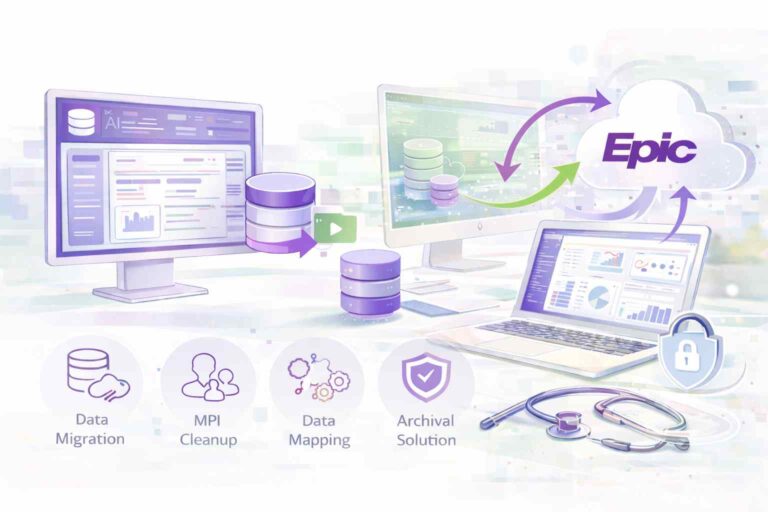
Santeware’s team combined healthcare domain expertise with deep knowledge of both source and target EMR environments to manage extraction, abstraction, mapping, validation, and migration workflows under tight deadlines. The solution leveraged a proven ETL-driven process supported by HL7 message development, CCDA document generation, Epic Patient Transporter imports, and migration of document images into the Epic repository.
Core Delivery Capabilities
1. Large-Scale Legacy Data Migration
The project scope included migration support for approximately 15,200 patient records, 772,385 closed encounters, and data associated with around 150 providers. This required careful planning to ensure that valuable clinical and financial data could be transferred accurately into Epic and archival systems within the available implementation window.
2. Data Extraction, Abstraction, and Crosswalk Mapping
Santeware managed the extraction and abstraction of source-system data from Allscripts, including the identification of crosswalks needed to align legacy structures with Epic’s target modules. Mapping work included both master and transactional tables so that source values, codes, and relationships could be transformed into formats compatible with Epic’s master tables and data model.
3. Master Patient Index Cleanup and Patient Matching
Because the source system supported multiple organizations through a single database, patient matching presented a major challenge. Santeware addressed MPI inconsistencies with detailed patient-level review, resolving duplicate records and reconciling patients who had multiple MRNs across separate organizations. This helped reduce migration risk and improve data integrity before loading records into Epic.
4. Structured Population of Epic Data Fields
One of the more difficult aspects of the project involved extracting the correct sections from RTF and other less structured source formats in order to populate defined Epic fields accurately. In cases where data resided in single text columns, Santeware split and transformed that content into the corresponding structured columns required by Epic’s well-defined screen and module layouts.
5. Archival and Continuity of Care Support
Not all historical data was intended to be loaded directly into Epic. Santeware therefore supported a dual-path strategy in which relevant data was migrated into Epic modules while additional legacy information was housed in an archival solution embedded into Epic navigators. This ensured continued access to legacy records while supporting continuity of care during and after the transition.
6. Archival and Continuity of Care Support
The project was completed with partial load testing and full load testing to validate data movement and reduce rework. This testing-supported approach helped ensure the migrated data could be accessed reliably in the target environment while maintaining expected quality standards across the implementation.
Client Requirements Addressed
The health center’s selection criteria went beyond technical migration capability. They required a partner with demonstrated Allscripts-to-Epic migration experience, fast turnaround time, strict HIPAA-compliant security infrastructure, strong healthcare domain knowledge across administrative, clinical, financial, and claims workflows, dedicated round-the-clock resources, and a cost-effective delivery model compared to industry rates. Santeware aligned its delivery approach directly to these requirements.
The Impact
The engagement enabled the Florida-based health center to complete its transition from Allscripts to Epic within the required timeframe while minimizing errors and rework. Following migration, the health system was able to access legacy EMR information either directly within Epic or through the integrated archival solution embedded in Epic navigators.
Key outcomes included:
- Successful support for migration of 15,200 patient records
- Handling of 772,385 closed encounters
- Coverage for approximately 150 providers
- Improved data quality during migration
- Reduced risk associated with duplicate MRNs and MPI inconsistencies
- Seamless access to legacy information after Epic go-live
- Increased overall client satisfaction through timely and accurate delivery
Why It Worked
Healthcare-domain-led execution
The project required more than technical ETL knowledge. Santeware combined database and migration expertise with a strong understanding of clinical, administrative, financial, and claims-related healthcare data.
Data integrity as a priority
MPI cleanup, patient matching, crosswalk identification, and structured mapping were handled with precision to reduce duplication, preserve relationships, and improve trust in the migrated data.
Continuity-of-care focus
The migration strategy was designed to support uninterrupted access to patient information during the move to Epic, including both direct Epic population and archival access embedded in clinical workflows.
Proven migration methodology
The use of ETL processes, HL7 messaging, CCDA documents, Epic Patient Transporter workflows, and repository-based image migration created a reliable framework for high-volume healthcare data conversion.
Delivery under tight timelines
With Epic go-live approaching, the project demanded speed without compromising quality. Santeware’s dedicated team structure and testing-backed execution enabled delivery within the required timeframe.
Outcome
The result was a high-confidence legacy EMR migration solution that enabled a Florida-based health center to transition from Allscripts to Epic while preserving data quality, supporting continuity of care, and maintaining access to historical patient records.
This was not just a system migration.
It was a structured healthcare data transformation initiative built to ensure accuracy, usability, and operational readiness from day one.