











Introduction
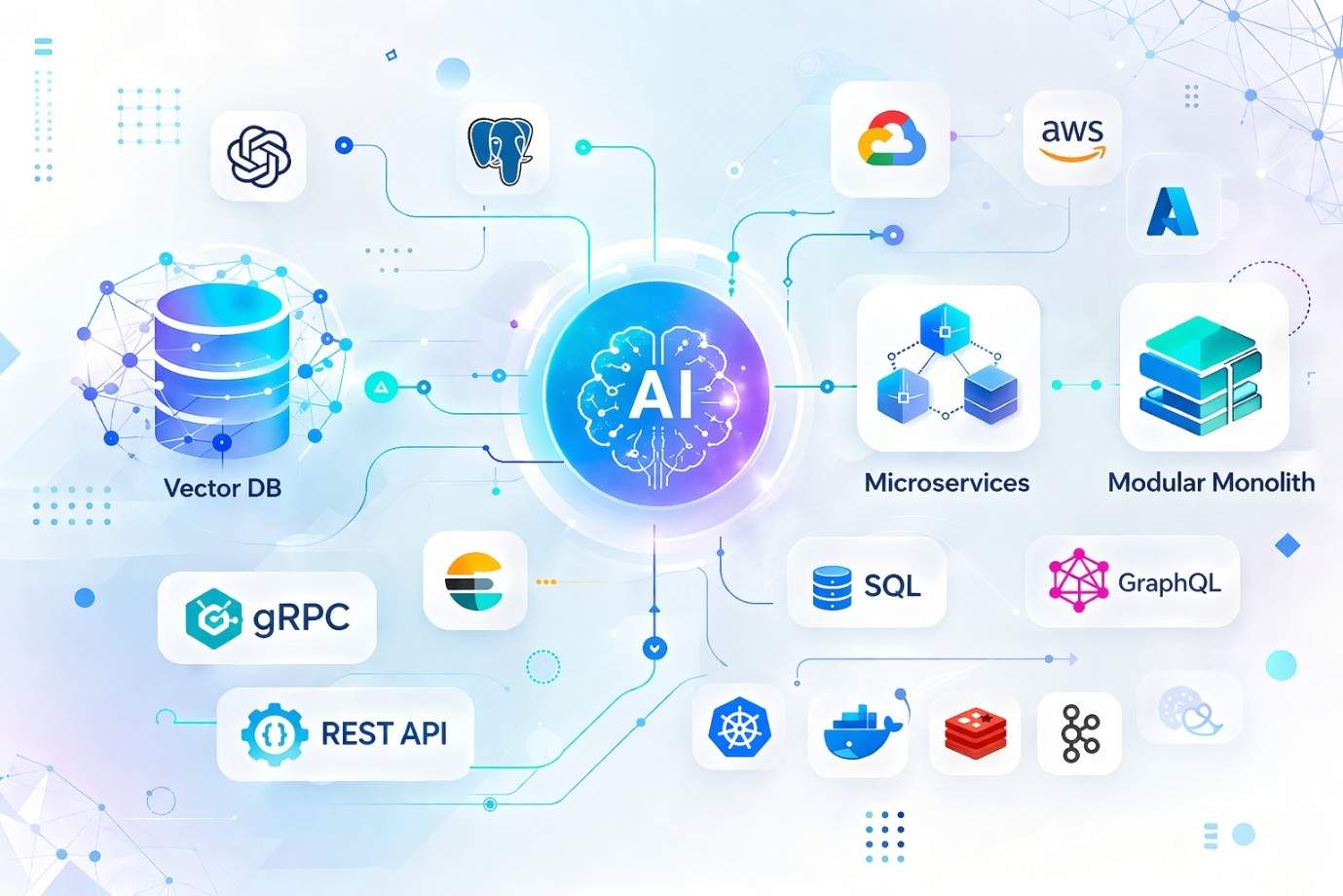
Most healthcare systems were not designed for AI. They were built for structured data, predictable workflows, and stable interfaces. For years, architectural decisions—databases, APIs, and system design—remained unchanged once implemented. That assumption is now invalid. At Santeware Healthcare Solutions, we are seeing a clear shift: AI architecture in healthcare systems is evolving faster than traditional engineering cycles can accommodate. Technologies such as vector databases, gRPC, and modular architectures are no longer experimental—they are becoming foundational. What used to be infrastructure decisions are now capability decisions.Why Traditional Architecture Breaks in AI-Driven Healthcare Systems
Healthcare platforms traditionally rely on:-
-
- relational databases (MSSQL, PostgreSQL)
- REST-based APIs
- microservices for scalability
-
-
-
- unstructured clinical data (notes, summaries, reports)
- semantic search instead of exact queries
- real-time inference pipelines
- probabilistic outputs
-
-
-
- SQL alone cannot retrieve meaning from clinical narratives
- REST APIs introduce latency in multi-step AI workflows
- distributed microservices slow down tightly coupled AI pipelines
- rigid architectures struggle to evolve with new AI capabilities
-
Designing AI Architecture in Healthcare With Constraints, Not Trends
Adopting new technologies without context leads to unnecessary complexity. Every system must be evaluated against:-
-
- Data and workload alignment Structured vs unstructured data must dictate storage and retrieval design
- Operational simplicity Systems must remain debuggable under regulatory and production constraints
- Evolution capability Architecture must support incremental upgrades without full rewrites
-
Vector Database vs Traditional Database in Healthcare AI
Traditional SQL (Relational Databases)-
-
- Optimized for structured data
- Uses indexing (B-tree, page indexing)
- Supports joins, filters, exact matches
-
-
-
- Store embeddings of text/data
- Enable semantic similarity search
- Retrieve results based on meaning
-
-
-
- Clinical notes become searchable beyond keywords
- Patient history analysis improves with contextual retrieval
- Faster discovery of relevant medical insights
-
-
-
- Vector search is approximate
- Requires embedding pipelines and additional storage
-
REST vs gRPC for AI System Communication
REST APIs-
-
- Widely adopted
- Easy to debug
- Suitable for external integrations
-
-
-
- Binary protocol (Protobuf)
- High performance, low latency
- Supports streaming
-
-
-
- rapid service-to-service calls
- real-time processing
- efficient data transfer
-
-
-
- REST remains ideal for public APIs
- gRPC is better suited for internal AI pipelines
-
-
-
- gRPC adds implementation complexity
- REST is simpler but slower
-
Microservices vs Modular Monolith in AI Systems
Microservices-
-
- Independent services
- Scalable and distributed
- Suitable for large, stable systems
-
-
-
- Increased latency across services
- Complex debugging across pipelines
- Higher operational overhead
-
-
-
- Single deployable system
- Internally modular and structured
- Faster development and debugging
-
-
-
- Start with modular monolith
- Transition to microservices only when scale demands
-
Why This Matters for Healthcare Technology Systems
Healthcare amplifies architectural risk due to:-
-
- Compliance requirements (HIPAA, auditability)
- Hybrid data (structured EMR + unstructured notes)
- Integration standards (HL7, FHIR)
- Long system lifecycles
-
-
-
- Vector databases enable semantic search across clinical records
- gRPC improves real-time data exchange in clinical workflows
- Modular systems simplify validation and regulatory audits
-
What This Enabled in Practice
Applying these architectural principles enables:-
-
- AI adoption without replacing existing healthcare systems
- hybrid retrieval (SQL + semantic search) for higher accuracy
- reduced latency in internal AI pipelines
- faster iteration cycles through modular architecture
- controlled infrastructure cost by avoiding over-engineering
-
The Real Lesson: AI Architecture in Healthcare is a System Design Problem
Vector databases, gRPC, and modular systems are not inherently superior. They are effective only when:-
-
- aligned with data characteristics
- integrated into a coherent architecture
- supported by operational discipline
-
Where This Applies in Healthcare Delivery
This approach supports:-
-
- AI-powered clinical data retrieval systems
- EMR/EHR modernization initiatives
- semantic search across patient records
- real-time analytics for healthcare data
- scalable HL7/FHIR integration architectures
-
Frequently Asked Questions
📁 What is a vector database in healthcare?
A vector database enables semantic search across clinical data by storing embeddings of text such as physician notes and reports.
🚀 Is gRPC better than REST for AI systems?
gRPC is more efficient for internal AI pipelines due to low latency and streaming support, while REST is better for external APIs.
⚙️ Should healthcare startups use microservices or monolith?
Most should start with a modular monolith and transition to microservices only when scaling demands it.
Conclusion
AI is not just introducing new tools. It is redefining how systems must be designed. Choosing between:📊 Vector database vs SQL
⚡ REST vs gRPC
🧩 Microservices vs Modular Monolith
If you are building a healthcare product or scaling an existing platform and need clarity on the right technology choices, Santeware Healthcare Solutions provides consultation grounded in real-world delivery. And if you want to work on these evolving systems—across AI, healthcare data platforms, and scalable architectures—we are open to connecting.
Santeware Healthcare Solutions brings the engineering depth, clinical understanding, and delivery governance required to implement it responsibly.
📩 Contact us today to schedule a consultation and discover how we can help digitize and connect your healthcare ecosystem.