














Introduction
Most healthcare organizations recognize the promise of AI in clinical workflows. But very few manage to operationalize it in a way that actually reduces clinician workload without creating new systems, new screens, or new cognitive overhead.
At Santeware Healthcare Solutions, we were engaged by a healthcare organization to explore a practical use of AI:
Can intelligent automation live directly inside the EMR and meaningfully reduce documentation effort?
This was not a research experiment or a proof-of-concept. It was a real delivery problem—inside a production EMR, with real clinicians, real workflows, and real constraints around safety, compliance, and usability.
The Problem: AI Without Workflow Integration Fails Quietly
The client’s clinicians were facing familiar issues:
As projects multiplied:
📝 Excessive time spent writing and structuring SOAP notes.
🔁 Manual duplication of information across prescriptions, labs, and referrals.
🖥️ Context switching between multiple EMR screens.
📄 Client approvals lacked structured test evidence.
😓 Growing documentation fatigue and declining patient-facing time.
➡️ Several AI tools had already been evaluated. Most failed for one simple reason:
they lived outside the EMR.
Anything that required separate logins, copy-paste, or parallel systems was rejected by clinicians almost immediately.
The problem was not intelligence.
It was workflow fit.
Design Principle: The EMR Must Remain the System of Record
From the beginning, three constraints shaped the architecture:
🧭 No external tools – everything must live inside the EMR..
🧠 Clinician in control – AI assists, never auto-submits..
🔐 Safety and auditability – every action must be traceable..
This meant the solution could not behave like a chatbot product.
It had to behave like a native EMR capability.
The Engagement: Building an EMR-Embedded AI Assistant
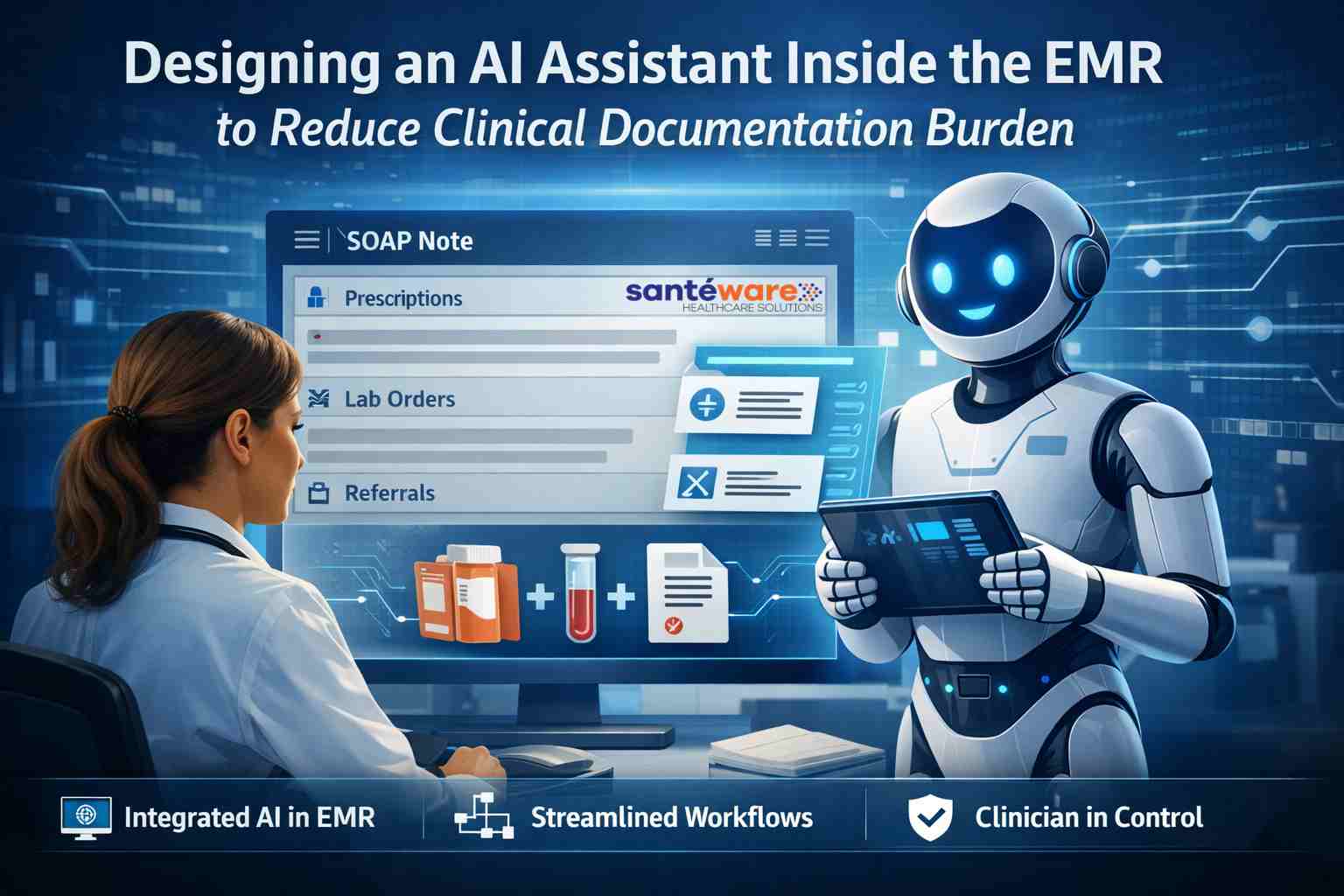
Santeware designed and implemented a custom AI assistant that operates inside the EMR interface itself.
The assistant:
📝 Accepts clinician notes (typed or dictated).
🤖 Uses GPT-based models to interpret clinical intent.
📋 Suggests structured actions.
🗂️ Opens relevant EMR forms with pre filled content
All interactions occur within the same clinical session.
No data export. No parallel systems. No external dashboards.
What the System Actually Does
- AI-Assisted SOAP Notes
Clinicians can write naturally. The system converts free-text input into structured SOAP documentation while preserving narrative nuance.
This improved:
📑 Consistency of notes.
✅ Documentation completeness.
👁️ Clinical readability.
Without forcing template-driven behavior.
- Context-Aware Clinical Actions
Based on the encounter, the system dynamically activates relevant workflows:
💊 Prescriptions
🧪 Labs & Imaging
📤 Referrals
📄 Patient summaries
If no clinical action is needed, no tabs appear. The interface stays clean and cognitively light.
3. Automated Form Preparation
With one click, the assistant can:
💊 Open medication forms with suggested dosage and instructions.
🧪 Select appropriate lab or imaging orders.
📝 Populate referral letters with clinical context.
Clinicians remain the final authority. The AI simply removes repetitive typing.
Architecture Without Exposing Sensitive Details
The technical solution was built using:
🌐 A web-based embedded interface inside the EMR.
🔐 Secure backend services for prompt management.
🧠 Structured AI outputs for predictable automation.
🔄 Event-driven communication with the EMR for form control.
No proprietary data models were exposed.
No patient data was stored long-term.
No changes were made to the core EMR system itself.
The system behaved like a thin intelligence layer, not a platform replacement.
Safety, Compliance, and Clinical Control
In clinical systems, automation without control is risk.
The implementation ensured:
🔒 Encrypted communication.
📑 Full audit trails.
👩⚕️ Human-in-the-loop for all actions.
🚫 No permanent storage of sensitive content.
🏥 Designed for HIPAA/GDPR-compliant environments.
The assistant never submits forms autonomously.
It prepares. The clinician approves.
What Changed in Practice
Over successive deployment phases, the organization observed:
📉 Reduction in documentation time per encounter.
⚡ Faster turnaround for orders and referrals.
📈 Improved consistency of clinical notes.
🧭 Lower cognitive load during consultations.
🌟 Higher clinician satisfaction.
The most important outcome was not speed.
It was reduced mental friction.
Clinicians stopped thinking about the system.
They started thinking only about the patient.
The Real Lesson: AI Is a System Design Problem
This project reinforced a simple truth:
AI in healthcare does not fail because models are weak.
It fails because systems are badly designed.
The success had little to do with GPT in isolation.
It worked because:
🗃️ The EMR remained the system of record.
🔄 Workflows were respected.
👨⚕️ Clinicians retained control.
🛡️ Safety and auditability were built in.
Without this, even the smartest AI becomes shelfware.
Why This Matters for Healthcare Organizations
This same delivery discipline underpins how Santeware Healthcare executes:
🔁 EMR modernization programs.
🧬 Clinical data migrations.
🔐 HL7/FHIR integration projects.
📊 Healthcare analytics platforms.
We don’t deliver tools.
We design operating systems for healthcare workflows.
Conclusion
What this engagement demonstrated is simple:
AI only creates value in healthcare when it is invisible, safe, and embedded into how clinicians already work.
By treating AI as a system architecture problem—not a product—we helped a healthcare organization reduce documentation burden without compromising clinical safety, regulatory compliance, or workflow integrity.
That is the kind of AI that actually survives in production.
Looking to Build AI Inside Your EMR?
🤖 Clinical AI assistants.
Santeware Healthcare Solutions brings the engineering depth, clinical understanding, and delivery governance required to implement it responsibly.