









Building a Patient Engagement Platform Using RESTful, HL7 v2, and FHIR APIs
The Challenge
Healthcare providers increasingly rely on digital engagement tools to improve patient experience, streamline administrative workflows, and strengthen communication between patients and care teams. However, many healthcare organizations operate multiple Electronic Medical Record (EMR) systems that store patient information in fragmented environments.
A healthcare organization sought to build a comprehensive patient engagement platform capable of connecting to several EMR systems—including Greenway, NextGen, and Allscripts—while providing patients with convenient digital access to care services. The objective was to enable real-time access to clinical and administrative data through standardized healthcare interoperability frameworks.
The challenge involved integrating diverse EMR systems using a combination of RESTful APIs, HL7 v2 messaging, and FHIR APIs, each with different architectural constraints and data structures. The organization required a scalable platform that could retrieve and synchronize patient information across systems while maintaining performance, security, and usability.
In addition, the solution needed to support multiple patient-facing modules such as mobile check-in, teleconsultation, and patient surveys, all while ensuring seamless interaction with underlying EMR data.
The Solution
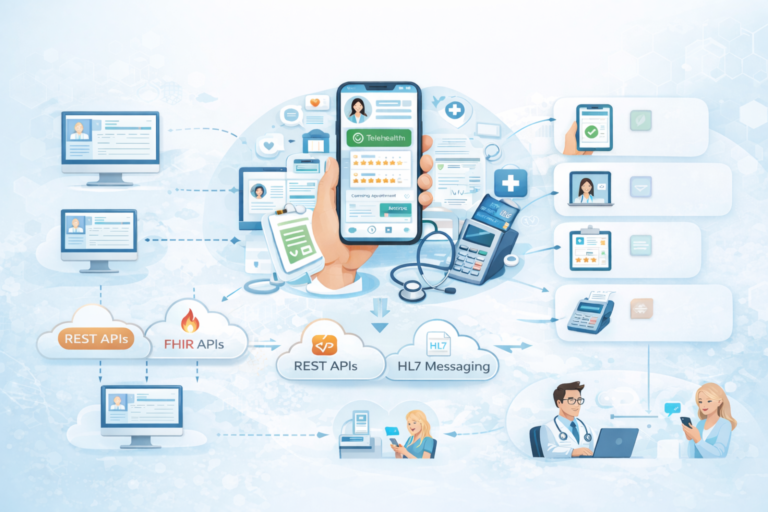
Santeware designed and implemented a patient engagement platform that integrates directly with multiple EMR systems using a hybrid interoperability architecture built on RESTful APIs, HL7 v2 messaging, and FHIR-based data exchange.
The system was engineered to function as a unified digital interface that aggregates patient data from disparate EMR systems and delivers it through a user-friendly platform designed for both patients and healthcare providers.
By leveraging healthcare interoperability standards alongside vendor-specific REST APIs, the platform ensures reliable data exchange while supporting a wide range of patient engagement features.
The modular architecture allows the system to scale across different healthcare organizations and EMR environments without disrupting existing workflows.
Core Technology Stack
| Layer / Category | Technology / Tools | Description |
|---|---|---|
| Backend Development | Java, Python, .NET | Programming languages used to build backend services, APIs, and integration logic for healthcare applications |
| Integration Engine | Cloverleaf | Healthcare integration engine used to manage and route clinical data between systems |
| Interoperability Standards | RESTful APIs | Web-based APIs used for secure communication between healthcare systems |
| Interoperability Standards | HL7 v2 Messaging | Standard messaging protocol used for exchanging clinical and administrative healthcare data |
| Interoperability Standards | FHIR APIs | Modern healthcare interoperability standard used to exchange electronic health records |
| Integrated EMR Systems | Greenway | Electronic Medical Record (EMR) system integrated for patient data exchange |
| Integrated EMR Systems | NextGen | Healthcare EMR platform used for clinical and administrative workflows |
| Integrated EMR Systems | Allscripts | EMR system used to manage patient records and healthcare operations |
What Santeware Built
1. Unified EMR Integration
The platform integrates multiple EMR systems using a combination of vendor-specific REST APIs and healthcare interoperability standards. This allows patient data to be retrieved and synchronized across Greenway, NextGen, and Allscripts systems in a consistent and reliable manner.
2. Mobile Check-In and Patient Portal
Patients can access healthcare services through a digital portal that supports online check-in and appointment management. The portal simplifies administrative processes while improving the patient experience by reducing waiting times and enabling easier communication with healthcare providers.
3. Teleconsultation Enablement
The platform includes teleconsultation functionality that allows patients to connect with healthcare providers remotely. By integrating telehealth services with EMR data, clinicians can access patient information during consultations while maintaining continuity of care.
4. Patient Feedback and Survey Modules
The system incorporates survey capabilities that allow healthcare organizations to collect patient feedback and satisfaction metrics. These insights help healthcare providers continuously improve service quality and patient engagement.
5. Standards-Based Healthcare Data Exchange
Using HL7 v2 messaging and FHIR APIs, the platform ensures interoperability with modern healthcare systems while maintaining compatibility with legacy EMR infrastructure. This hybrid integration model allows organizations to adopt digital engagement tools without replacing their core clinical systems.
The Impact
The implementation of the patient engagement platform delivered measurable improvements across both patient experience and operational efficiency.
Key outcomes included:
- Seamless integration with multiple EMR systems
- Real-time access to patient data through standardized APIs
- Improved patient engagement through digital self-service tools
- Increased convenience through mobile check-in and teleconsultation
- Enhanced patient satisfaction through survey and feedback mechanisms
- Simplified communication between patients and healthcare providers
The platform enabled healthcare organizations to modernize patient engagement while maintaining compatibility with their existing EMR infrastructure.
Why It Worked
Interoperability-first architecture
The solution leveraged industry standards such as HL7 v2 and FHIR alongside REST APIs to ensure compatibility with both modern and legacy EMR systems.
Modular patient engagement framework
The platform was designed as a set of modular applications that could evolve as patient engagement needs expand.
Deep healthcare integration expertise
Santeware’s experience with EMR systems and healthcare data standards enabled reliable integration across multiple vendor platforms.
Scalable technology stack
The use of Java, Python, .NET, and Cloverleaf ensured high performance and maintainability across complex healthcare integration environments.
Outcome
The result is a comprehensive patient engagement platform that connects multiple EMR systems through modern healthcare interoperability standards while delivering convenient digital services to patients.
By combining RESTful APIs, HL7 messaging, and FHIR integration, the platform enables healthcare organizations to improve patient satisfaction, streamline care access, and build a more connected healthcare experience.
Patient engagement was not treated as an isolated application.
It was built as an integrated extension of the healthcare data ecosystem.